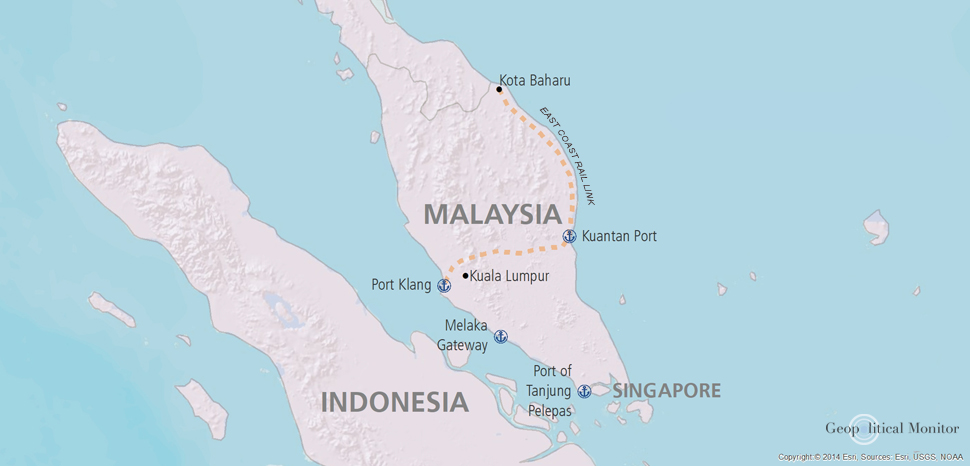
The Melaka Gateway is a $10-billion-dollar development that includes the construction of residential, retail, office, entertainment, and port facilities on three man-made islands off the west coast of Peninsular Malaysia. It is one Belt and Road Initiative (BRI) project that, for the time being at least, appears to have survived the new government’s sweeping infrastructure review (others were put on hold indefinitely over inflated costs). However, the government has reserved the right to tweak the project “so that it does not stray from its original objective of promoting tourism.”
Originally announced by the Najib government in 2014, the Melaka Gateway has frequently been the subject of political debate. Its promoters believe that it can recapture the historical glory of the Melaka port, and in doing so perhaps unseat Singapore as the leading transport hub in Southeast Asia. Its detractors point to the project’s high costs, negative environmental impact, and debatable long-term economic value, especially in terms of its potential freight volumes.
The Melaka Gateway is being developed by Malaysia’s KAJ Development Sdn Bhd (KAJD) in cooperation with the state-owned PowerChina International and two Chinese port operators: Shenzhen Yantian Port Group Co., Ltd, and Rizhao Port Group Co., Ltd.
Construction and land reclamation is already underway for the first phase of the project. This includes building a deep-water cruise liner berth (in partnership with Royal Caribbean Cruises Ltd.), along with the Pulau Melaka East 1 maritime industrial park, which hopes to become Southeast Asia’s largest marina by 2025. Both are in keeping with the tourism angle that the government wants to stress moving forward.
The maritime transport dimension of the project isn’t so clear-cut. The Melaka Gateway Port will have to compete with Port Klang – Malaysia’s largest port by traffic, which is located just up the coast. Approximately 11,978,000 TEUS worth of freight traffic moved through Port Klang in 2017. Moreover, Port Klang is already undergoing an expansion despite the fact that it’s not even running at full capacity. Then to the south there’s the Port of Tanjung Pelepas, Malaysia’s second-largest port, which is also currently undergoing an expansion to enable greater container volumes.