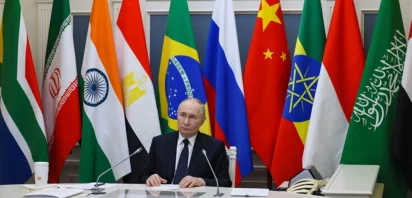
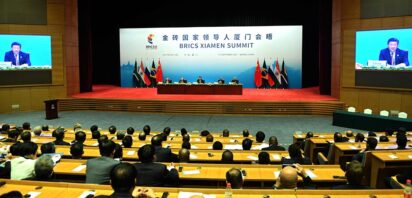
The Azerbaijan foreign ministry has announced its intention to apply to the BRICS bloc. The surprise announcement comes after a visit by Russia President Vladimir Putin earlier this month, and an earlier visit by Azerbaijan President Ilham Aliyev to Moscow in April.
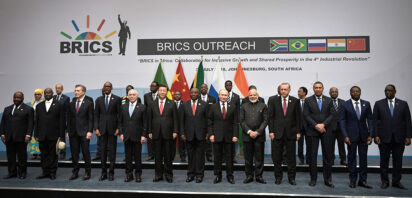
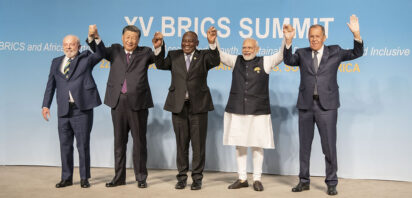
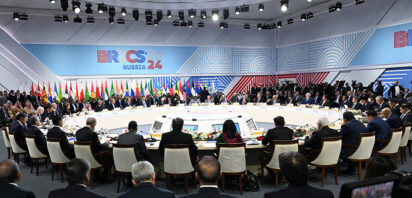
BRICS membership is an obvious choice for Baku, which continues to benefit from the geopolitics of the post-Ukraine war global arena. Joining BRICS represents a natural extension of the country’s multi-vector foreign policy, which seeks to engage with both the East and West. It would also help to shore up relations with Russia without giving up anything significant regarding Azerbaijan’s ongoing peace negotiations with Armenia. And while the appetite on the other side for more BRICS expansion remains unknown, with the bloc already welcoming in new members Iran, Egypt, South Africa, and the UAE at its most recent summit in January, Azerbaijan can be expected to make a strong case for membership whenever the next round takes place.
Why Would Azerbaijan Join the BRICS?
For Baku, joining the BRICS would be a natural extension of a foreign policy that seeks to place it at the center of East-West relations. And most importantly: it would do so without giving up anything significant, as joining the bloc doesn’t require any ideological, military, or economic commitment on the part of the applying state.
This multi-vector foreign policy stems from the economic imperatives of Azerbaijan’s oil and gas industries, along with its geopolitical positioning. The country has come to occupy the space left by Russia after the Ukraine war, becoming a critical energy supplier to certain EU markets like Bulgaria, Italy, and Greece. Natural gas in particular is a sector where Azerbaijan and Europe are closely intertwined, with the continent accounting for nearly all of Baku’s revenues (oil and gas account for over 90% of Azerbaijan’s exports). But oil exports occasionally head in the opposite direction, with BRICS member India accounting for 8.25% of purchases of Azerbaijani oil in 2022.
Azerbaijan inhabits a highly strategic geopolitical position as gateway between Europe and Central Asia via the Caspian Sea. The country is home to three major pipelines: the Baku-Novorossiysk pipeline (Caspian to Black Sea via Russia); the Baku-Tbilisi-Ceyhan pipeline (Caspian to the Mediterranean Sea); and the Baku-Supsa pipeline (Caspian to Black Sea via Georgia). It is also a part of the so-called Middle Corridor, a land corridor connecting China to Europe. The Middle Corridor has seen a resurgence of political and investor interest after the Ukraine war made the Russia-centered Northern Corridor untenable.
Russia figures prominently in Azerbaijan’s bid to join the BRICS, and it’s no accident that the announcement came so soon after Putin’s visit. Put simply, Moscow needs Azerbaijan more than ever before. It needs Baku to buy its oil and gas, backstop its presence in the Southern Caucasus, and most importantly, support the International North-South Transport Corridor (INSTC), which cuts a path for Russian exports into Iran and Persian Gulf ports. Azerbaijan on the other hand has more leverage than even ever before vis-à-vis Russia, and whatever concessions it has given on BRICS membership and/or the INSTC have come at the cost of expelling Russian influence from the Southern Caucasus, both militarily (withdrawing peacekeepers from Nagorno-Karabakh) and diplomatically (adopting a ‘No Russia, No West’ policy in ongoing peace negotiations with Armenia).
Why Would the BRICS be Interested in Azerbaijan?
Given the above, it’s clear how, from a geopolitics standpoint, Azerbaijan makes for a highly appealing BRICS applicant. For one, it is a major energy supplier and transit hub, including for BRICS member India. And two, it is a critical link in two transport corridors championed by BRICS members: the Middle Corridor (China) and the INSTC (Russia, India, and Iran). And if there is something resembling a shared value or norm that underpins the BRICS bloc, that of an aversion to Western-style universalism, Azerbaijan is a natural fit as well with its track record of receiving and rebuking human rights criticism from Brussels and Washington alike.
There remains a question over the speed and extent of BRICS expansion, however, as an enlarged membership dilutes the geographical and ideological coherence of the bloc and limits the scope of what it can hope to practically achieve, especially as most votes pass by consensus. Azerbaijan is not the only member-in-waiting, with Thailand and Malaysia also advancing bids to join the bloc at its upcoming Kazan summit in October. The good news is however that BRICS is already structurally well-suited to this kind of flexibility. Lacking a formal charter or secretariat, there is no strict ascension process or structural reforms necessary for membership. As such, there’s no reason why the bloc won’t be expanding again in the near future, especially given the lack of any obvious sources of opposition to Azerbaijan joining the club.