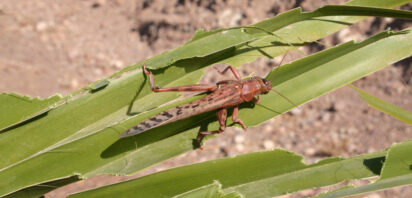
The situation has deteriorated further since an earlier situation report highlighted the growing risk to food production and local economies from billions of locusts spreading through East Africa and Yemen.
Locust swarms, which have already ravaged Kenya, Somalia, Ethiopia, and Yemen, have now crossed into South Sudan’s southern Magwi county, along its border with Uganda.
Still recovering from a five-year civil war and tormented by periodic droughts and floods, South Sudan is a country that can ill afford a plague of locusts. To get a sense of the stark food insecurity suffered by South Sudanese over the past five years, look no further than the United Nation FAO numbers: In September 2015, some 3.9 million people (one in three citizens) were facing food insecurity, and some 30,000 were suffering catastrophic shortages (level five; the highest level of the IPC famine scale) often leading to starvation and death. The situation worsened through 2016, when the number of severely food insecure people spiked to 4.8 million. By 2017, well over half the population was severely food insecure, with hundreds of thousands suffering life-threatening deprivations. By one FAO estimate, 100,000 people faced starvation conditions at the onset of 2017.
The situation has not markedly improved since then. As of January 2019, some 1.36 million were facing emergency food situations (IPC level 4), and 30,000 were in mortal peril (IPC level 5).
The famine, which peaked in 2017 but never truly ended, has effectively destroyed the South Sudanese economy, which remains overwhelmingly agrarian. 2017 saw GDP per capita drop below $200, down from the $1,111 level it was at just three years previous. Moreover, despite the efforts of humanitarian groups and the international community, the famine led directly or indirectly to tens of thousands of deaths.
The misery persisted into 2019, though in an inverse to the previous disasters, it was floods that inundated the country’s agricultural heartland and devastated crops and livestock. The floods destroyed large portions of the harvest and forced some one million people to leave their homes. By one estimate, some 73,000 tonnes of sorghum, millet, and corn were lost.
And that was before the first locust even arrived.