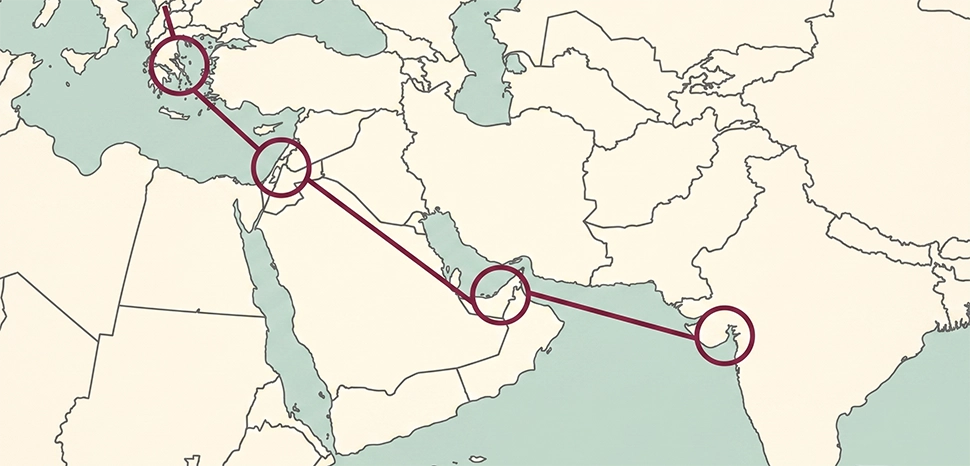
The India-Middle East-Europe Economic Corridor (IMEC) was presented in 2023 as a means of reducing exposure to maritime chokepoints. Conceived as an alternative to the Suez Canal and a counter to China’s Belt and Road Initiative, the corridor was intended to move goods between India and Europe through the Arabian Peninsula by a combination of shipping and rail.
The conflict between the United States, Israel, and Iran in 2026, and the closure of the Strait of Hormuz that accompanied it, has exposed a structural limitation in that design. The corridor intended to provide resilience against the weaponization of chokepoints continues to depend on the same waters that regional instability has repeatedly closed.
The project has changed form in response. The war in Gaza that began in 2023 froze the northern rail segment through Israel and Jordan, and the 2026 Iran conflict disrupted the maritime leg through the Gulf. In place of the integrated multilateral corridor described in 2023, the initiative is advancing through bilateral agreements among individual members and through components that do not depend on the contested rail route, including data cables, green hydrogen, and electricity interconnection.
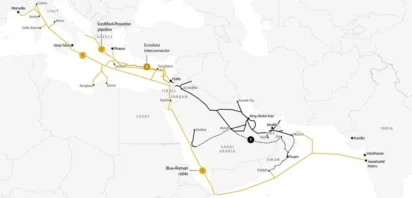
IMEC Corridor: Circa 2023
The corridor was originally announced at the G20 summit in New Delhi in September 2023. Its participants were India, the United States, Saudi Arabia, the United Arab Emirates, France, Germany, Italy, and the European Union. Jordan and Israel were designated as transit territories rather than signatories. The founding document was a memorandum of understanding that set out political commitments and created no obligations under international law, which left implementation dependent on the continued alignment of eight governments and the institutions of the European Union.