Stealth and networked targeting are the attributes of modern air power. This architecture relies on AWACS and ISR platforms to extend detection ranges, coordinate strikes, and enhance combat precision. Consequently, the decisive operational counterstrategy is to cripple or disrupt these high-value airborne nodes. In line with this logic, China unveiled its PL-17 ultra-long-range air-to-air missile in January 2026 with an approximate range of 400 km, extending its strategic reach and putting the ‘eyes and ears’ of enemy combatants in its crosshairs.
The missile is reportedly equipped with an advanced dual-pulse rocket engine, which allows for the longer range. Its cutting-edge guidance system directs the missile toward its target using inertial guidance along with satellite-based mid-course correction to accurately track and target the enemy aircraft. The missile also features an active electronically scanned array (AESA) radar-based seeker and a possible passive anti-radiation capability. Moreover, during the terminal stage, the missile is evaluated to make use of multimodal seeker, active radar, and passive infrared sensing. Such a configuration increases resistance to electronic countermeasures (ECM) and increases kill probability.
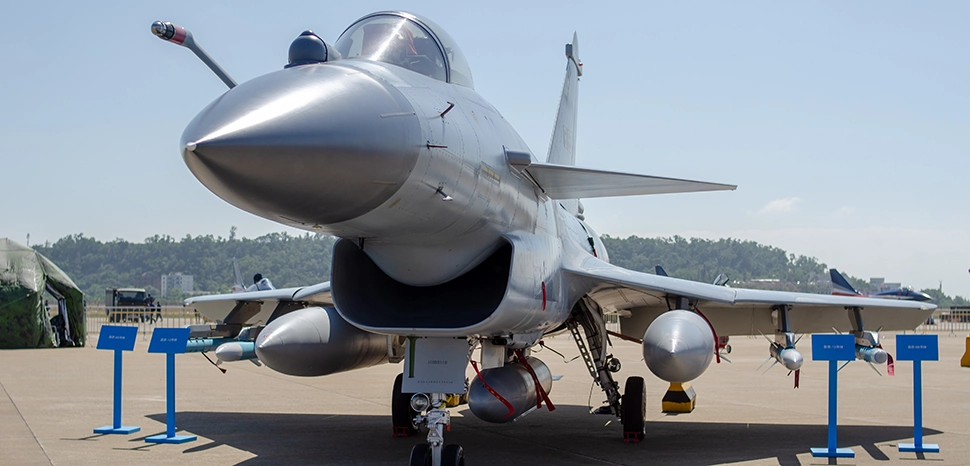
The missile first appeared on the People’s Liberation Army Air Force’s (PLAAF) J-16 Fighter Jet in 2016 and was dubbed PL-XX in the West, followed by additional images in December 2023. Almost a decade later, for the first time, close-up photographs of the PL-17 have been publicly released, showing it being equipped with the J-16 Flanker. The missile is also expected to be integrated with the J-20 and J-35 platforms. Likewise, the J-36 sixth-generation fighter, currently under development, appears to be the most viable future platform in terms of future integration. Analytically, the calibrated release of information reinforces deterrence signaling while simultaneously boosting the missile’s attractiveness in the export market.
The PL-17 demonstrates Beijing’s growing power projection capabilities, with significant strategic implications across the Indo-Pacific. The system distorts the calculus of sustained air operations in disputed zones like the Taiwan Strait and the South China Sea. Survivability of logistical and support infrastructure will be the main enabler of PL-17 operations, with the outcome reinforcing China’s Anti-Access/Area Denial Strategy (A2/AD). The PL-17 is also an indication that critical airborne command-and-control platforms of Japan, South Korea, Taiwan and Australia fall within China’s expanding kill web. This outreach marks a shift to a doctrine of strategic aerial decapitation.
The PL-17 is likely to intensify the global arms race. With a range of around 400 km and a top speed of at least Mach 4, on paper it surpasses existing Western long-range air-to-air missiles. This includes the three-decade-old US AIM-120D AMRAAM, which has a range of approximately 160 km, and is broadly comparable to Europe’s MBDA Meteor, known for its ramjet propulsion and large no-escape zones. Chinese advancements are intensifying US concerns about a narrowing long-range air-to-air ‘missile gap,’ which has prompted projects such as the highly classified AIM-260 Joint Advanced Tactical Missile (JATM), under development for nearly eight years. Reflecting this urgency, the US Air Force and Navy have requested nearly $1 billion in the FY2026 budget to accelerate the missile program.
The integration of ultra-long-range beyond-visual-range (BVR) missiles acts as a force multiplier, shifting the regional air power balance in South Asia. In the May 2025 Pakistan-India war, the Pakistan Air Force exposed significant vulnerabilities in India’s integrated air defense and early warning network and downed Indian aircraft using BVR PL-15 at a range of about 200 kilometers. PL-15 is equipped on Pakistan’s JF-17 Thunder Block-III multirole aircraft. Pakistan officials have also signaled a desire to acquire the J-35 platform, which is compatible with the PL-17, sending shockwaves through Indian defense circles. At the same time, such developments reflect a pattern of deepening Pakistan-China defense collaboration.
Ultimately, this potent missile operating from deep within Pakistani airspace would hypothetically neutralize the backbone of India’s integrated air battle management architecture at the outset of a conflict, which includes Netra and Phalcon AWACS, the S-400 system, and long-range maritime surveillance aircraft. As a countermeasure, India may be forced to keep its airborne assets far from the front line. However, this would limit the effectiveness of these critical airborne enablers in supporting combat aircraft. Thus, when materialized, the qualitative leap would be a strategic setback to India’s numerical strength and redefine Pakistan’s air denial posture, reinforcing deterrence through reach and disruption.
Looking ahead, the PL-17 has the potential to become a gamechanger in Chinese BVR fighting and the sensor-shooter ecosystem in general. The system implies the increasing reliance on offboard targeting services of airborne, space-based, and ground-based sensors, especially in the context of the Chinese sophisticated network-centric warfare framework. For Pakistan, the emergence of ultra-long-range systems such as the PL-17 signals the next phase in the evolution of networked air warfare. As its fighter fleet modernizes, these capabilities could provide an operational edge while shaping the strategic balance of airpower in South Asia.