The European Parliament has just approved a new €1.5 billion defense-industrial program that aims to strengthen Europe’s defense sector, notably by requiring that at least 65 % of a defense product’s components originate in the EU or allied countries. In the framework of a drawn-out struggle to achieve tech (especially chip) sovereignty, this is a welcome development.
The global political and industrial instability brought about by the second Trump administration has led the United States’ European allies to seriously question their structural dependence on US industry. Europe’s strategic vulnerability, especially in terms of its defense posture as Russia continues to rattle its sword in the East, has been laid bare. The continent continues to rely on US and Asian markets for essential technological components like semiconductors, critical for powering its military systems. High-performance processors, secure microelectronics and mission-critical embedded systems remain the invisible infrastructure of modern defense.
Yet they are also Europe’s weakest point. The renewed geopolitical environment has changed the equation. The aforementioned €1.5 billion program, although not explicitly a semiconductor initiative, directly amplifies pressure on Europe to secure its supply of strategic microelectronics. The war in Ukraine, worsening US-China rivalry, and the increasing digitalization of weapons systems have all converged to expose a simple reality: modern defense platforms from missile guidance units to ISR architectures and encrypted communications all run on sophisticated, secure processors that Europe largely does not build. For decades, the continent has relied on US suppliers for defense-grade CPUs and secure microelectronics, while outsourcing much of its manufacturing capacity to Asian foundries. The result is a supply chain that is efficient in peacetime but brittle in crisis. As Chief Executive of the European Defence Agency Jiří Šedivý warned in early 2025: “the European defense base remains fragmented, characterized by a lack of joint procurement and national preferences for defense spending. This results in small, localized markets with relatively low production numbers.”
In this context, establishing a sovereign European ecosystem for chips and secure micro-electronics is not only desirable but necessary if Europe wants to avoid repeating past vulnerabilities in moments of geopolitical stress.
Europe’s Strategic Blind Spot
A 2025 policy paper by IRIS opens with a significant fact: “the defense market is awash with money in 2025, but this will not guarantee a less dependent Europe in defense.” Quoting the 2025 Draghi report, the IRIS paper underlines how “heightened geopolitical competition and third countries’ aggressive industrial policies on tech-rich exports are reducing the security of the EU’s imports of critical technologies (e.g. semiconductors).” This suggests a structural vulnerability at the heart of the European defense sector and a strategic blind spot in times of crisis. Access to foreign microelectronics cannot be assumed. This warning is echoed across the industry. Whether examining the avionics of a sixth-generation fighter, the onboard processing needed for missile seekers, or the secure computation required for classified networks, the bottleneck is the same. Europe designs world-class defense systems, but the processors inside them are often imported.
Nowhere is this dependency more glaring than in high-performance computing and AI acceleration. European forces increasingly rely on data fusion, machine learning inference, battlefield cloud systems and autonomous decision-support platforms. These are domains dominated by US companies whose export regimes are tightening and whose supply chains are themselves stretched. When the Financial Times reported in October that Europe was “slowly awaken[ing] to its entry into US-China wars,” the message was clear: Europe is not simply a bystander in this competition but a participant whether it wishes to be or not. The Nexperia crisis is a classic example of this, where retaliatory chip curbs by Beijing brought European automative supply chains to a grinding halt.
Indeed, delays in US export authorizations, supply chain shortages in Asia, and disruptions caused by geopolitical shocks have already affected European industry. For defense contractors working on long-term programs, the risk of losing access to a foreign microchip is now a planning factor. Europe’s strategic autonomy hinges increasingly on the ability to design, secure, and manufacture its own processors.
Building Trust in European Semiconductor Pillars
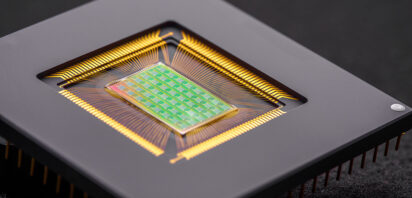
Responding to these shifts, European industry has begun to invest in sovereign or semi-sovereign alternatives. So far, the efforts remain modest when compared with American or Asian ecosystems, but they signal a shift in mindset and a template for the future. The most visible example is SiPearl’s Athena1 processor, unveiled in October and presented as Europe’s first sovereign high-performance CPU designed for dual-use, including defense. Athena1 integrates 80 ARM Neoverse V1 cores and is expected to reach the market in 2027.
New players do not necessarily compete directly with each other. Instead, they reflect a gradual emergence of European microelectronics capabilities across different technical layers: high-performance processing, reconfigurable logic, custom ISA development, and embedded acceleration. Taken together, they signify a European attempt to rebuild parts of the semiconductor value chain that were previously ceded to foreign entities. Yet scale remains the defining challenge. The European Chips Act 2.0, though important, pales in comparison to US industrial policy and Asian megafabs. The strategic gap is not merely technological but financial and organizational. To achieve meaningful autonomy, Europe would need sustained, coordinated investment across design, verification, manufacturing, and packaging—an effort that spans decades rather than electoral cycles.
Sovereignty Runs through Defense
Defense may be the sector capable of jump-starting this transformation. Unlike commercial markets, defense procurement can prioritize sovereignty and security over marginal cost. If European governments commit to integrating European-designed processors in future air, land, naval, and space platforms, they can generate predictable demand that allows industry to scale. The November 2025 European Parliament vote is a step in that direction. By encouraging European investment in defense systems, Brussels is not only supporting industry but also forcing member states to rethink their reliance on imported microelectronics.
Europe’s defense primes are watching the evolution closely. They are increasingly aware that sovereignty is no longer a rhetorical concept but an operational requirement. The rise of AI-driven command systems, autonomous vehicles and distributed battle networks only reinforces the urgency of securing the underlying hardware. EU-based companies therefore have a key role to play.
Still, Europe’s semiconductor renaissance remains embryonic. Without a unified strategy that aligns incentives from research to deployment, the gap with global competitors risks remaining wide. Yet the direction of movement is unmistakable: Europe is no longer content to be a passive consumer of foreign microelectronics in its most sensitive defense applications.
The coming years will determine whether today’s initiatives become the foundation of a sovereign ecosystem or remain isolated successes. What is certain is that strategic autonomy in defense cannot exist without autonomy in semiconductors. Europe has begun to recognize this link. The question now is whether it will act with the scale and urgency required to close the gap.
The views expressed in this article belong to the author(s) alone and do not necessarily reflect those of Geopoliticalmonitor.com.