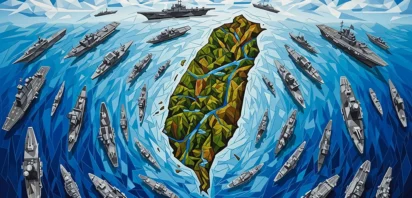
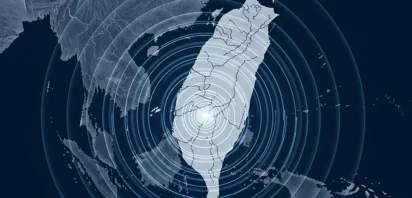
US and Chinese war planners pore over the map of a small and mostly mountainous island, gaming out every possible contingency to gain an edge in a hypothetical conflict. The tactics and outcomes vary across scenarios, but the costs remain consistent: trillions in damage, untold civilian and military casualties, and a permanent rupture in the global trading system.
What makes Taiwan so important? Why would these costs even be considered?
The reality is that Taiwan matters: militarily, economically, and symbolically. And the island’s future status will resonate far beyond the lives of the 24 million people living there. This series examines the strategic weight of Taiwan through the perspective of the major players in Indo-Pacific security. Next up is Japan, a state drawn into the Taiwan conflict indirectly by a fraught imperialist history and more directly by geographic vulnerabilities along the first island chain.
Taiwan: Gateway into Japan’s Backyard
To understand why Taiwan matters so profoundly to Japan, one must begin with geography. Taiwan sits in the middle of the so-called “first island chain,” a long arc of islands stretching from the Japanese archipelago through Taiwan and down to the Philippines. This natural maritime barrier separates the Asian mainland from the open Pacific Ocean. What may appear to be just a line on a map is, in fact, a structure that determines how military power can operate.
So long as Taiwan remains independent of direct control by a continental power, the island chain holds together as a protective wall. It limits the outward movement of mainland navies and allows Japan, together with its partners, to monitor and restrict activity within the East and South China Sea. This affords Japan defensive depth and added security along its maritime perimeter.
But if Taiwan were absorbed by a powerful state on the continent, the logic flips. Taiwan would no longer block outward movement but instead serve as a springboard into the Pacific. Naval and air forces operating from Taiwan could bypass the defensive line and directly threaten Japan’s southern approaches.
The difference between barrier and bridgehead is decisive. For Japan, located at the northern anchor of this chain, the fate of Taiwan determines whether its surrounding seas remain secure zones or become exposed corridors.
Geography gives Japan no choice in this matter. Taiwan’s position is fixed, as is Japan’s reliance on the island’s role within the regional defense architecture. Far from being peripheral to Japan’s security, Taiwan is central, the keystone that holds together the arch of the first island chain.
Taiwan and Japan’s Sea Lines of Communication (SLOCs)
Japan’s reliance on the sea magnifies the importance of Taiwan’s location. Unlike large continental states, Japan has few natural resources of its own. It must import nearly all of its energy, much of its food, and many of its raw materials. At the same time, its economy depends on exports of manufactured goods, from automobiles to electronics. In short, Japan lives and breathes through maritime trade.