Israel’s military strikes against Iran’s nuclear infrastructure are widely portrayed as preemptive, yet this term is strategically misleading. A genuinely preemptive strike responds to an imminent threat; Israel’s operation is preventive, a calculated campaign aimed at thwarting Iran’s long-term capacity to develop a nuclear deterrent. The strategic rationale is clear: a nuclear-armed Iran would constrain Israeli freedom of action across the region. It would not necessarily pose an existential threat through direct attack, but it would deter Israel from undertaking future military operations.
Essentially, Israel seeks to degrade Iran’s nuclear and conventional capabilities to forestall the emergence of a peer competitor. That such actions are cloaked in the language of deterrence and defensive necessity is not evidence of duplicity but of political necessity. States rarely advertise strategic fear; they reframe it as moral urgency. The irony, of course, is that Israel’s preventive doctrine is deeply rational, even as it is destabilizing.
Understanding the logic of Israeli policy does not entail its endorsement, particularly from the vantage point of American national interest. The fundamental question is not whether Israel’s actions are internally rational but whether they align with US strategic imperatives. The answer is unequivocal: they do not.
The United States has no compelling interest in policing Iran’s internal politics or safeguarding Israeli military superiority at all costs. What it does possess is a vast network of military installations throughout the Middle East, comprising over 40,000 American troops, now rendered potential targets in a conflict not of their making.
This is not a speculative fear but a recurrent feature of post–Cold War US policy. From Iraq to Syria, from Libya to Afghanistan, the United States has repeatedly found itself dragged into conflicts that bear little relation to core strategic interests, often under the illusion that presence equates to control.
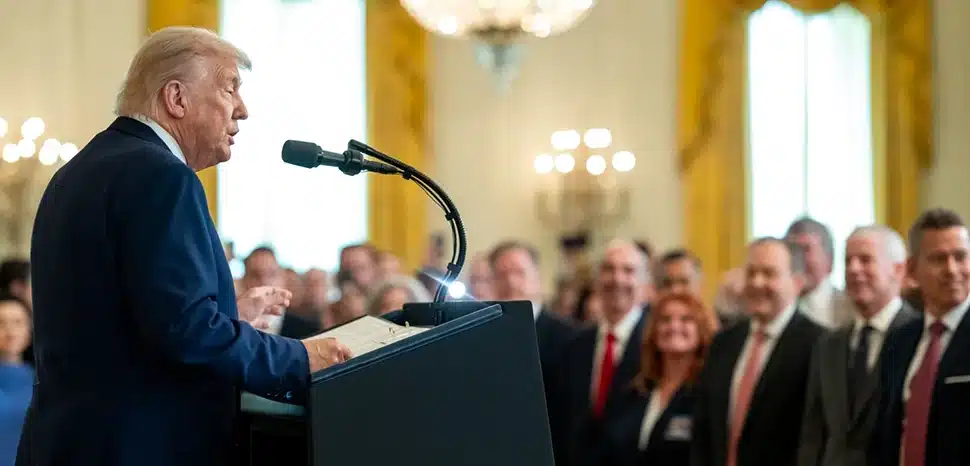
President Donald Trump, elected on a platform that promised to extricate the United States from endless wars, now confronts a defining moment. Will he permit American policy to be dictated by Israeli strategic calculations, effectively subordinating U.S. autonomy to a regional client state? Or will he assert the long-dormant principle that US foreign policy must serve US interests first?
This is not merely a test of ideology but of statecraft. Since Dwight Eisenhower’s confrontation with Israel during the 1956 Suez Crisis, no US president has meaningfully challenged Israeli prerogatives. Trump has the opportunity to break that precedent.
A deeper US military involvement would not only be strategically incoherent; it would be operationally disastrous. Iran is not a failed state like Libya, which disintegrated after the fall of Muammar Gaddafi. Nor is it like post-Saddam Iraq, where sectarian fragmentation made governance impossible without prolonged occupation.
Iran is a revolutionary regime embedded within multiple layers of clerical, military, and intelligence institutions. It is not legitimate because it is popular, but because it is durable, reinforced by decades of sanctions, isolation, and warfare. Any strategy predicated on swift regime change or spontaneous uprising recycles the delusions of neoconservative adventurism. That these delusions now emanate from the Israeli right rather than Washington’s think tanks does not make them any less dangerous.
Even in the event that the military campaign proves tactically successful (if Iran’s enrichment facilities are disabled, its leadership decapitated, and its retaliatory capacity suppressed), what comes next? A country of nearly 90 million people, ethnically diverse, economically fragile, and politically fractured, would be plunged into chaos. With no viable post-regime plan, the United States or its allies would face the specter of prolonged occupation, insurgency, and regional spillover.
All this, while US strategic competitors like China expand their influence across the Indo-Pacific, Latin America drifts toward multipolar realignment, and Europe continues its descent into strategic incoherence. The proposition is absurd: that the U.S. should expend its finite resources on a peripheral war with no defined end state, merely to fulfill the security aims of an ally that has no long-term plan beyond battlefield dominance.
The credibility argument, so often invoked to justify military escalation, deserves particular scrutiny. In international relations, credibility is not enhanced by frequent intervention but by coherent and consistent policy. When the use of force is decoupled from clearly defined interests, threats become less credible, not more.
The lesson for Tehran was not that American weakness invites defiance, but that surrendering deterrent capability guarantees destruction. Libya’s Gaddafi relinquished his weapons program and met a gruesome end. North Korea’s Kim Jong-un kept his and remains secure. This is the logic of deterrence: not ideology, not morality, but empirical pattern recognition. The Iranian regime has internalized this lesson; the question is whether the United States has.
Trump’s inclination toward peace must be converted into policy. This means delivering a message to Israel that is firm, unambiguous, and enforced by action: should Israel choose to escalate its campaign against Iran, it must do so independently, without the expectation of US cover or intervention. This is not abandonment; it is the restoration of sovereign discretion in US foreign policy. An alliance does not imply carte blanche. Nor should solidarity become servitude.
The cost of involvement in another Middle Eastern war extends beyond the battlefield. It exacts a toll on America’s domestic agenda, on border security, economic revival, and institutional renewal. Every dollar diverted to foreign conflict is a dollar lost to infrastructure investment, industrial policy, or public welfare. Every crisis abroad weakens the political bandwidth for reform at home. Trump’s nationalist agenda, built upon the ruins of bipartisan interventionism, cannot survive another round of military entrapment.
Those fantasizing about Trump transforming from Peacemaker to Conqueror ignore a fundamental truth about the US electorate: this is not a country that sustains enthusiasm for foreign wars. George H. W. Bush won a lightning war in Kuwait and was voted out 21 months later. George W. Bush presided over the capture of Baghdad, only to see his approval collapse as the occupation dragged on. In both cases, war eroded political capital rather than consolidating it. The sword does not guarantee reelection.
From Tehran’s vantage point, the picture is brutally clear. Iran, encircled by US military bases, harried by sanctions, and repeatedly subjected to covert sabotage and high-level assassinations, operates under siege. The regime’s security doctrine is shaped by a simple truth: those who abandon deterrence do not survive.
This is the context in which Trump’s diplomatic failure must be evaluated. His administration’s insistence on zero uranium enrichment, a maximalist demand Iran could never accept, was not a strategy but an ideological posture. It confused leverage for finality. By offering no realistic off-ramp, the U.S. adopted a coercive posture that lacked the will or domestic mandate to enforce its threats militarily.
Now, with Israeli bombs falling and Iranian missiles flying, the fiction of US non-involvement has collapsed. The administration may frame its participation as defensive, but in the eyes of Tehran and the broader region, the United States is already a belligerent. The real question is whether Washington will continue to be pulled into the war reactively or whether it will choose, affirmatively, to shape the terms of its withdrawal.
Iran, for all its menace, is not a rising great power. Its threat to US national security is localized and largely defensive in nature. To wage a war against such a state now is to embrace the fallacy that every regional fire must be extinguished by American force.
The case for restraint, therefore, is not based on idealism but on realism. True strategic discipline demands the preservation of power, not its dissipation. Influence is not measured by the frequency of intervention but by the capacity to shape outcomes without military exhaustion. Alliances must serve mutual interest, not function as instruments of coercive obligation.
If Trump is to preserve his domestic political objectives (controlling inflation, revamping immigration, re-industrializing the US economy), he must reject the drift toward another Middle Eastern quagmire, not because peace is innately noble, but because this war would be strategically disastrous.
Iran is not benign. Israel is not irrational. But the United States must not mistake either for a cause worth sacrificing its core national interests. In the final analysis, empires do not fall when they are defeated; they fall when they bleed themselves dry in marginal theaters, chasing illusions of control and subordinating national purpose to the demands of peripheral crises.
War with Iran will not bring liberation, democracy, or geopolitical advantage. It will bring cost. It will bring consequence. And it will bring the slow, grinding erosion of American strategic purpose under the weight of outdated obligations and misplaced loyalties.
The views expressed in this article belong to the author(s) alone and do not necessarily reflect those of Geopoliticalmonitor.com.