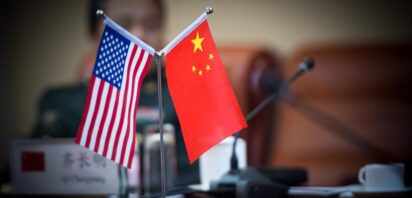
The onset of the second term of President Donald Trump has been accompanied by a marked escalation in the protectionist nature of US trade policies, reflecting profound strategic concerns over the widening economic and technological disparities between the United States and China. The Trump administration has espoused a protectionist stance, recognizing it as a pivotal strategy to address the perceived decline of the United States in pivotal sectors that fuel economic prosperity and national security, as compared to China.
A Narrowing Technological Gap
The United States has historically dominated global innovation and maintained technological supremacy in critical sectors such as artificial intelligence (AI), semiconductors, and renewable energy. However, recent developments indicate that China has made substantial progress in this area, driven by a combination of state-led strategic initiatives and sustained investments. In the year 2023, for instance, China’s investment in R&D surged to approximately $722.8 billion, nearly matching the 784-billion-dollar figure recorded in the United States. The convergence of these trends signifies a notable shift in the balance of technological superiority, a matter of significant concern for US policymakers. The urgency of this situation is underscored by President Trump’s introduction of protectionist measures.
The rapid growth in China’s innovation is evident in the surge in patent applications, particularly in the domain of AI and related technologies. In this sector, Chinese inventors have demonstrated a substantial lead in terms of the volume of patent applications compared to their US counterparts. Notwithstanding the continued preeminence of US researchers in the realm of pioneering research and the unassailable quality of US innovation, the escalating scope of China’s technological prowess portends a substantial strategic challenge to the United States in its role as a global leader in technology. Over time, this shift will chip away at the economic strength and military superiority of the United States, intensifying strategic competition and raising significant security concerns.
Dependence and Vulnerability in Global Supply Chains
A salient concern underpinning Trump’s protectionist policies is the vulnerability of the United States due to its heavy reliance on Chinese-controlled supply chains. This strategic dependency is illustrated by the significant reliance on semiconductors and clean energy technologies. While the United States currently maintains a narrow advantage in advanced semiconductor technologies, China’s ambitious pursuit of self-sufficiency in chip production poses a significant threat. This pursuit risks eroding America’s competitive edge, potentially undermining the nation’s economic and military superiority. This potential reorientation could potentially compromise both the economic competitiveness of the United States and its military preparedness.
A similar situation can be observed in China’s dominant position in the renewable energy sector. China currently accounts for over 80% of global solar photovoltaic production and approximately 65% of lithium-ion battery production. These figures underscore the critical dependence of the United States on Chinese energy sources. The strategic implications of China’s dominant position in these sectors are significant, particularly in the context of the United States’ shift toward renewable energy sources that rely extensively on Chinese manufacturing.
Consequently, the strategic approach advocated by President Trump is a protectionist policy agenda aimed at mitigating these concerns through the relocation of critical industries, the enhancement of domestic manufacturing, and the promotion of self-sufficiency. Tariffs, export controls, and government-directed investments in strategic sectors represent integral components of this overarching strategy.
Manufacturing Decline and Economic Security
The ongoing decline in US manufacturing capacity further substantiates Trump’s protectionist strategy. The United States’ current contribution to global manufacturing output stands at approximately 16%, marking a substantial decline in comparison to China’s 32% share. This precipitous shift, which has been attributed largely to competition with Chinese low-cost manufacturing, carries profound ramifications that extend beyond mere economic losses. It directly impacts the US defense industrial base and its innovation infrastructure.
The Trump administration has explicitly associated manufacturing strength with national security. Persistent trade deficits, such as the $295 billion deficit with China in 2024, further exacerbate these concerns, symbolizing US industrial weakness and external dependency. In response, the Trump administration has implemented a series of protectionist policies, including tariffs and industrial subsidies, with the aim of reversing the decline in manufacturing, rebuilding domestic capacities, and reducing strategic vulnerabilities stemming from economic dependency.
Strategic Decoupling and National Autonomy
At the core of Trump’s reinvigorated protectionist policies is the notion of strategic decoupling from China. This approach endeavors to insulate the US economy from disruptions and vulnerabilities emanating from interconnected global supply chains that are dominated by China. This strategic recalibration is evidenced by measures such as restrictions on technology exports, heightened scrutiny of foreign investments, and the promotion of domestic industries, reflecting a deliberate policy shift toward enhanced national autonomy.
The reliance on critical materials, such as rare earth elements, which are vital for defense and high-tech applications, further underscores the vulnerability of the US economy. China’s dominance in the processing of these materials, estimated at approximately 90%, puts the U.S. in a vulnerable position, susceptible to substantial strategic risks. In response, the Trump administration has implemented policies aimed at diversifying and securing the supply of critical minerals. These policies encourage domestic mining, refining, and collaboration among relevant industries to enhance supply chain diversity and reliability.
Conclusion
In conclusion, the recalibration of US trade policy under the second Trump administration appears to be a measured response to profound structural challenges. The administration’s protectionist measures—encompassing tariffs, export controls, and strategic investments—aim to reverse decades of industrial decline and restore American preeminence in technology and manufacturing. By targeting vulnerabilities in critical supply chains, particularly in semiconductors, these policies attempt to curtail the economic and security risks associated with overdependence on Chinese production.
If effectively implemented, such policies could potentially narrow the US manufacturing deficit by 5–10 percentage points over the coming decade, thereby reducing its strategic reliance on foreign supply chains. However, the scale and momentum of China’s state-led investments—illustrated by its near parity with US R&D spending and its dominant position in renewable energy components—indicate that the technological gap may widen further unless US initiatives achieve substantial breakthroughs. Moreover, while strategic decoupling could enhance national autonomy, the inherent complexity of global interdependencies makes complete separation unlikely, and the long-term economic impacts remain subject to considerable uncertainty.
Thus, although the current protectionist agenda addresses immediate strategic imperatives, its ultimate success will depend on a balanced approach that integrates domestic revitalization with nuanced international engagement. This conclusion leaves room for debate regarding the optimal mix of isolationist policies and multilateral cooperation, a discourse that remains essential as global economic and technological dynamics continue to evolve.
The views expressed in this article belong to the author(s) alone and do not necessarily reflect those of Geopoliticalmonitor.com.