On March 8, Global Affairs Canada (GAC) announced the conclusion of negotiations regarding a Status of Visiting Forces Agreement (SOVFA) between Ottawa and Manila. The negotiations were held after a Defence Cooperation Memorandum of Understanding (DC MOU) was signed between the two countries in January 2024.
The announcement is significant for both sides. Canada is currently embroiled in a trade war, with tariffs (postponed for now) looming over nearly all Canadian exports to the United States. For the Philippines, there’s some degree of uncertainty over whether the United States would come to its aid in the event of a conflict, even though both states are allies under their 1951 Mutual Defense Treaty (MDT). It is both sad and ironic that both these hitherto stalwart US allies would need to diversify and look elsewhere for new security partners.
Just days before the announcement of the agreement, on March 7, President Trump called out Japan, noting that their decades-old bilateral security treaty was nonreciprocal and thus unfair for the United States. The treaty, signed in 1960, requires Washington to protect Japan, though Japan is not legally obliged to protect the United States. What Trump fails to mention is that the treaty requires Tokyo to host US military bases in Japan, supporting US national interests in the Indo-Pacific, and that over 50,000 military personnel are permanently stationed on the Japanese archipelago. Furthermore, the treaty was signed in the context of the post-WWII period, where Japan had (and continues to have) a ‘self-defense force’ rather than a typical military, complete with constitutional restraints on its operations.
Having Canada and the Philippines work on the proposed SOVFA would allow each to work together in common areas that are beneficial to the rule of law, defense and security cooperation, and peace and stability in the Indo-Pacific. According to Canadian Minister of Defence Bill Blair, the “successful conclusion of this agreement is a significant milestone for the overall bilateral relationship between the Philippines and Canada, which celebrated 75 years of diplomatic ties in 2024.”
Among the areas the MOU touches down on are military education, training exchanges, information sharing, peacekeeping operations, and disaster response. The document is clearly a sign of Canada’s willingness to work with the Philippines, and it follows on the heels of another agreement signed in 2023 that extends access to Canada’s Dark Vessel Detection System (DVD) to the Philippine National Coast Watch Center (NCWC).
The DVD system allows for improved monitoring of illegal, unreported and unregulated fishing (IUU) in Philippine territorial waters. Under the terms of the agreement, the Philippines will gain access for free for five years.
The SOVFA is legally required for the Philippines to work with Canadian troops in joint military exercises and other military-related events without violating the constitution. Under Section 25, Article 18, the Philippine Constitution does not legally recognize the presence of foreign troops/bases barring a treaty officially being ratified by both the Senate and Congress.
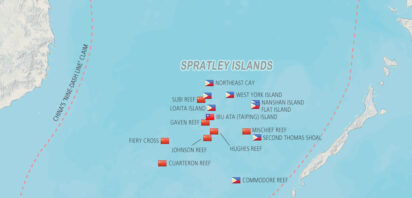
The ratification of the SOVFA thus allows the Armed Forces of the Philippines (AFP) to gain opportunities to train and work alongside their counterparts in the Canadian Armed Forces (CAF). In addition, it grants the Philippines an opportunity to diversify their security partners and reduce its dependence on the United States amid ongoing maritime tensions in the South China Sea.
This is not the only move that Manila has made in search of greater strategic autonomy. The Philippines and Japan recently signed a Reciprocal Access Agreement (RAA), with the Philippine Senate ratifying the agreement on December 16, 2024 (it has yet to be ratified in Japan’s Diet). Moreover, as of February 20, the Philippines and New Zealand have concluded talks on enacting their own SOVFA with an expectation that it may be signed after the second quarter of 2025.
In light of President Trump’s threats, and especially when they’re directed at close US allies, Manila and Ottawa are both carefully reflecting on the degree to which they can rely on their US alliance for national security going forward. Both face an uncertain future with Trump making significant changes to the geopolitical landscape.
With this in mind, Canada and the Philippines should commence negotiations to fully ratify the SOVFA as soon as possible. This would be a necessary step in diversifying their security agreements with other states that believe in upholding the rule of law in the Indo-Pacific. Canada would benefit by gaining an ally in the Indo-Pacific, thereby fulfilling one of the objectives of Global Affairs Canada’s Indo-Pacific Strategy, which calls for building of new security-based cooperative relationships. For the Philippines, Canada would be seen as a reliable security partner and another ally willing to back them in diplomatic channels amid the South China Sea dispute. This would allow the Philippines to present itself as a serious regional player.
The views expressed in this article belong to the author(s) alone and do not necessarily reflect those of Geopoliticalmonitor.com.
&BAP_Guise(CM-28)-412x198.webp "Abukama class destroyers; cc MOD Japan, modified, https://en.wikipedia.org/wiki/File:JS_Abukuma%EF%BC%88DE-229%EF%BC%89%EF%BC%86BAP_Guise%EF%BC%88CM-28%EF%BC%89.jpg")