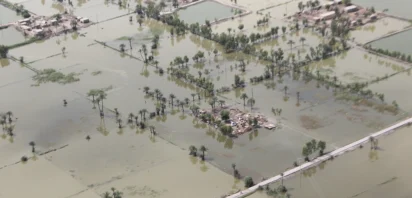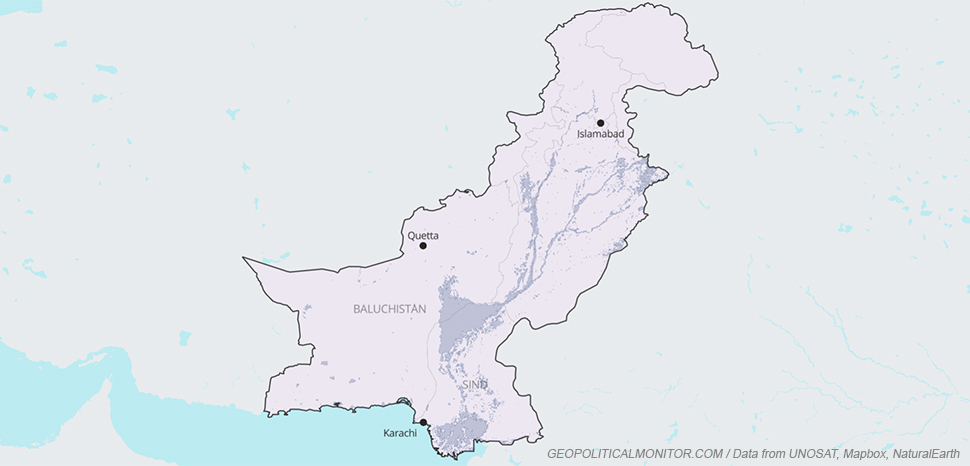
A wet season that has produced over three times the 30-year average in rainfall is causing extensive flooding in Pakistan, resulting in at least 1,000 deaths since mid-June. Some 33 million people have been affected across a long band of territory along the banks of the Indus River, stretching from the Himalayan headwaters in the north all the way to the Indus Basin in the south. In some places, such as Sindh Province in the south of the country, rainfall is as high as five times the 30-year average.
The flooding has been dubbed a ‘serious climate catastrophe’ by the country’s top climate official, Senator Sherry Rehman, who also warned that flooding was combining with other climate-related crises such as forest fires and glacial lake collapse to produce an unprecedented challenge for humanitarian efforts. Though the true extent of the damage won’t become apparent until the floodwaters recede, an estimated 300,000 homes are believed to have been destroyed, with critical infrastructure such as roads and electrical lines in ruins up and down the country. Even worse, the floodwaters have yet to abate; according to Rehman, by the time that happens, anywhere from one-quarter to one-third of Pakistan could be left under water.
Analysis
What’s currently unfolding in Pakistan, and elsewhere, is a scenario long warned by climate advocates: severe weather events are becoming more extreme and less rare. In this case, the floods are being compared to 2010, another ‘once in a lifetime’ disaster that has evidently now been upgraded to ‘twice’ or perhaps ‘three times.’ The 2010 flooding followed a similarly grim pattern: torrential rainfall that quickly overwhelmed flood defense along the length of the Indus River. By the time it was over, some 1.6 million homes had been destroyed, over 2,000 people had been killed, and some 18 million left homeless. But these numbers fail to convey the true extent of the economic damage from the floods, and how long it has taken – if ever – to regain a sense of developmental normalcy. In 2010, an estimated 2 million hectares of crops were either lost or damaged, along with 1.2 million heads of livestock. Most of this agricultural product belonged to small-scale farmers, many of whom never truly recovered from the disaster. All told, the 2010 floods are estimated to have caused a staggering $43 billion in damage, with the reconstruction bill coming in at around $9.3 billion.
Fast-forward twelve years and it’s all happening again, with more downpours in the short-term forecast; however, Pakistan is arguably in a more compromised position now than it was in 2010. The floods come at a critical time for the newly-installed administration of Shehbaz Sharif, who displaced previous prime minister Imran Khan after he fell out with the military establishment. This is a volatile juncture for several reasons:
First and foremost is the not-insignificant matter of Pakistan’s financial solvency. Following years of COVID-19 disruptions, inflation from the Ukraine war and supply chain upheavals, and now a tightening international lending market, Pakistan’s foreign exchange reserves are hovering at a dangerously low point of around five weeks’ worth of imports. Inflation of ‘sensitive’ items like food and fuel has climbed to over 45% year-on-year, and this figure can be expected to worsen in the short-term as suppliers turn to (price inflated) global food markets to make up for shortfalls in domestic production. Even before the worst of the flooding, the Pakistani rupee had lost about 25% of its value against the US dollar since December 31, 2021. And finally, the country remains awash in debt such that an increasing number of analysts are drawing parallels between Pakistan and pre-crisis Sri Lanka.