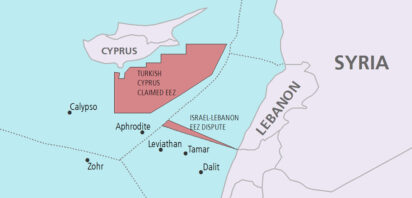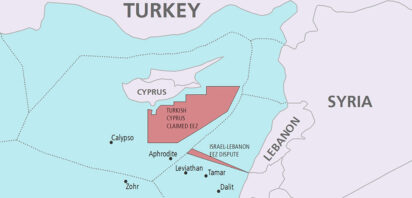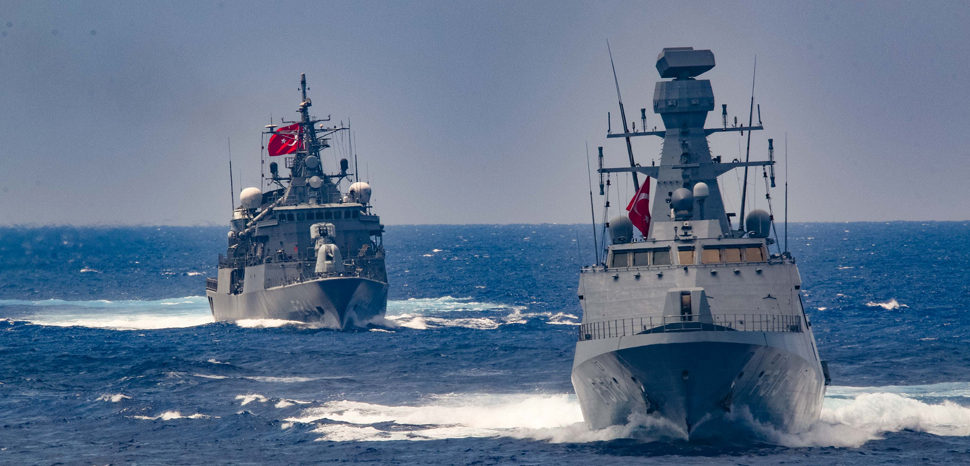
The Eastern Mediterranean has become increasingly tense in recent years. As Turkey continues to assertively advance its claims in this strategic region, other powers are reacting by strengthening their cooperation. This complex situation presents many similarities with the South China Sea dispute, and just like an informal coalition known as QUAD has emerged in Asia in response to China’s actions, something similar could happen here with regards to Turkey. Growing security cooperation between Greece, Cyprus, Israel, and Egypt suggests that this ‘QUAD of the West’ could emerge over the next few years, and other regional powers might become involved as well.
Analysis
Complex Regional Geopolitics
The geopolitics of the Eastern Mediterranean enmeshes multiple regional and external powers in a complex system of interests. There are five main regional actors: Turkey on the one hand, and a nascent coalition between Greece, Cyprus, Israel, and Egypt on the other.
Each of these four players has its own reasons to adopt an antagonistic alignment with Turkey.
Greece’s relations with its neighbor are marked by historical grievances, Turkish violations of Greek air and maritime space, disputes over islands ownership, disagreements on the delimitation of their territorial waters and exclusive economic zones (EEZ), and divergent views on the Cyprus question. The latter two are particularly important. In November 2019, Turkey concluded a controversial agreement with the internationally-backed Government of National Accord (GNA) in Libya over the delimitation of their respective EEZs, which was widely criticized by Greece and others because it ignores the presence of Crete. Then, in August 2020 Greece and Egypt reached a similar deal, which conforms to international law but has alienated Turkey.
As for the Republic of Cyprus, the island’s internationally-recognized state has seen its northern part under Turkish military occupation since 1974, when a failed coup promoted by the Greek military junta triggered a Turkish invasion resulting in the establishment of the Turkish Republic of Northern Cyprus (TRNC), an entity recognized only by Ankara. The island remains divided, with Athens siding with the official government in Nicosia (which it is committed to defending on the basis of the 1993 Greece-Cyprus Single Area Defence Doctrine) and Ankara backing the TRNC.
Israel is similarly opposed to Turkey’s moves in the Eastern Mediterranean. The country’s relations with Turkey have deteriorated starkly due to Ankara’s support for Hamas as well as its ties with Iran and Qatar, which is accused of funding Islamist terrorists across the Middle East. These geopolitical fault lines cut across the wider Middle East, with states like Saudi Arabia, the United Arab Emirates (UAE) and Egypt, all generally aligned against Turkey and Qatar, two states that have been ardent supporters of the Muslim Brotherhood. One recent example of this animus is Saudi Arabia’s apparent boycott of Turkish exports.