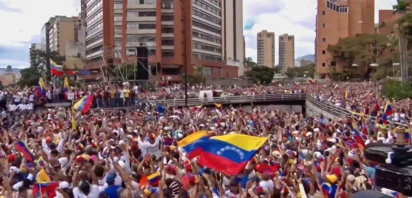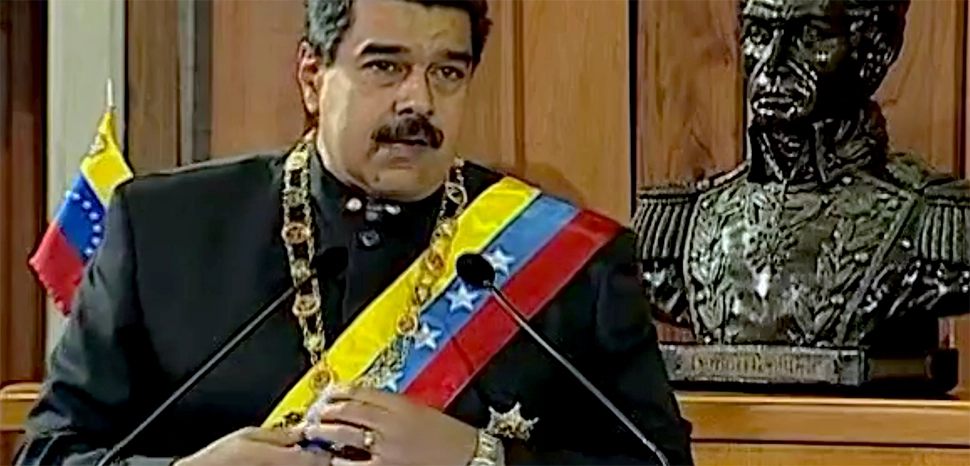
Venezuela is seeing increased violent conflict, as highlighted in last week’s Global Forecast. The ingredients for a breakdown of the political order have long been present in the Latin American state: deadlocked institutions, economic collapse, widespread protests, and armed paramilitary groups. But more recently there have been open clashes between politicians and paramilitaries, as well as direct attacks on state institutions. These are troubling trends, as they suggest that Venezuela’s struggles are about to slip from the political realm and into existential conflict. And tempers will flare further as President Maduro proceeds with constitutional reform.
Background
Two weeks ago it was the Oscar Perez affair which involved an ex-cop stealing a helicopter and attacking the interior ministry. Perez is still at large and producing anti-government videos. The grenade-bombing was either a calculated failure (as Perez claims it was merely symbolic and not intended to kill or damage), an attack thwarted by Perez’s own incompetence, or an ongoing bit of political theatre organized by the Maduro administration, as some have claimed.
Last week saw an escalation when pro-government militias, or ‘colectivos’ stormed Congress wielding wooden sticks and metal bars, attacking politicians as security forces looked on. Several politicians were injured in the attack, at least one seriously. For his part, President Maduro has been flip-flopping between denouncing the violence and pledging to launch an investigation, and himself pledging to resort to violence should the revolution be overthrown by the country’s growing protest movement.
In another telling development, opposition leader Leopoldo Lopez was shifted from prison to house arrest in a decision by the Supreme Court over the weekend. Lopez’s release could provide impetus to the opposition movement ahead of its symbolic referendum on Maduro’s presidency scheduled for July 16 (the vote won’t be binding). It could also be meant as an olive branch from the executive branch, as many of the justices on the bench owe their positions to the Chavez and Maduro administrations. Recall that the Supreme Court ruled to nullify the opposition-controlled National Assembly earlier this year before protests forced the Maduro government to overturn the decision. If Lopez’s release was intended as a peace offering, it’s not going as planned. Within hours of being freed, Lopez was calling on his supporters to ramp up their pressure on the government.
Impact
- Violence flares as the political process breaks down. The Perez grenade attack and the storming of the National Assembly could well come to be seminal events. History shows that once violence – however insignificant it may seem at the onset – becomes normalized in a political conflict, it doesn’t take much to trigger a chain of events that ends at war. Venezuelan society has been stretched the breaking point, both economically and politically. Any dissension in the ranks and/or partisan violence from the security forces (such as the indifference from the National Guard as the assembly was stormed) should be closely monitored as another potential step toward civil war.
- The battle for Venezuela’s future will center on President Maduro’s push to amend the constitution. President Maduro has made no secret his desire to rewrite the country’s constitution. He has already signed off on forming a new “constituent assembly” of 540 members. The body will be charged with drafting a new constitution to replace the 1999 document that former president Hugo Chavez created. It would also have sweeping powers to call elections and rework powers shared by the branches of government. Elections to the constituent assembly are scheduled for July 30, 2017. Its members will be chosen by a combination of local elections and representatives from various pro-government student and labor groups. One way or another, the process of constitutional reform will be taking center stage in Venezuela’s crisis. In its current form, the reform process will not allow for any substantial opposition representation. In fact, many believe that the constituent assembly option came about after the abortive attempt by the Supreme Court to strip the National Assembly of its powers. Though it follows a far more circuitous route, constitutional reform still achieves the same goal of sidelining the opposition and perpetuating Socialist Party Rule. It also offers more potential short-term relief, as the process would likely take years and afford Maduro the opportunity to postpone presidential elections scheduled for October 2018.
Forecast
The situation in Venezuela is such that widespread violence could break out at any moment. Yet it’s impossible to predict precisely when it might happen or what might trigger it.
Recent developments do afford a glimpse into the Maduro administration’s thinking. That the government wants to remain in power above all was never in doubt; the way it plans to accomplish this was far less evident. It appears as if the Maduro government will take the constitutional reform route to perpetuating Socialist Party rule. Constitutional reform will be a long process, and along the way the government can be expected to take limited steps toward de-escalating the country’s political crisis, as it did with Lopez’s recent release. However, should the Maduro administration at any point lose control and face the real possibility of ouster, it could be expected to shift gears toward far greater political oppression, and even outright violence through the colectivos and/or state security services.