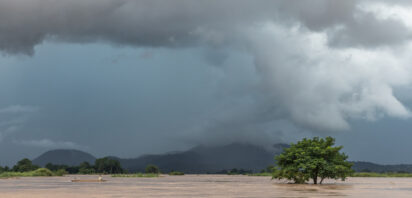
At first light this week in Vietnam’s Central Highlands, rescue crews began moving cautiously through brown, fast-moving water that now blankets much of Dak Lak Province. Streets once dominated by coffee trucks and schoolchildren on motorbikes have turned into violent rivers. Only the tops of homes, electric poles and the occasional tarpaulin break the surface as boats ferry stranded families to higher ground.
Further east along the coast, in Da Nang and the once postcard-perfect tourist hub of Nha Trang, seawater and inland floodwaters merged into a single muddy expanse—swallowing roads, hotels, markets and entire neighborhoods.
Flooding is not new to Vietnam. But what happened over the past week is different: a nationwide climate emergency unfolding faster than the country’s ability to respond. It is among the world’s most flood prone countries, with nearly half of its population living in high-risk areas.
In a matter of days, heavy rainfall and storm-driven surges cut a destructive path across the country—reaching Thai Nguyen in the north, overwhelming Lam Dong in the Central Highlands, and inundating coastal business districts from Da Nang to Khanh Hoa. Even Hanoi, where residents have grown grimly used to flooded streets, faced severe inundation again as drainage systems buckled under torrential rain.
The latest toll has now passed 102 dead, with more missing and tens of thousands displaced. And the province hit hardest — Dak Lak, the country’s coffee core — faces the harshest losses and the longest list of the missing.
Behind those numbers are families searching for loved ones, shopkeepers watching their livelihoods dissolve in floodwater, and farmers whose harvests—and futures—have disappeared overnight.
A Country Mobilizes — and Struggles
Vietnam has deployed more than 20,000 troops, border guards, and emergency teams. Soldiers in orange lifejackets have escorted elderly residents from rooftops, while schools, pagodas and government offices have been converted into emergency shelters.
Early-warning text alerts and loudspeaker sirens saved lives—but not enough.
Some remote communities remained cut off for days as landslides blocked mountain roads and power failures severed communication networks. In Lam Dong and Thai Nguyen, residents reported receiving little or no warning before waters surged.
For a country often held up as a regional model in disaster preparedness, the system appears to be straining under climate pressures it was never designed to manage.
Economic Shock and Vulnerability
Damage assessments remain preliminary, but the losses are staggering. Thousands of homes have been destroyed or damaged. More than 100,000 livestock have drowned. Hundreds of thousands of acres of cropland—rice, cassava, pepper and especially coffee—now sit under water.
Dak Lak lies at the heart of Vietnam’s globally competitive coffee belt. The timing could not be worse: harvest season.
For farmers already struggling with fluctuating global commodity prices and rising production costs, this disaster is not a setback—it’s a collapse.
In tourism-dependent cities like Da Nang and Nha Trang, businesses estimate losses will take months—if not years—to recover. Insurance coverage remains rare outside major cities, meaning families, farmers and small businesses will absorb most losses alone.
Climate Reality Comes Crashing In
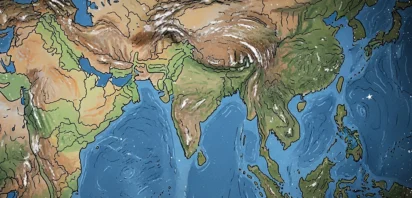
Vietnam may be the latest Southeast Asian country forced into a harsh reckoning, but it will not be the last. From Bangkok’s sinking suburbs to Manila’s permanent flood zones, the region faces a shared climate trajectory: hotter seas, heavier rainfall, more intense storms, and rising economic vulnerability.
Climate scientists have warned for years that warmer oceans pump more moisture into storm systems, increasing rainfall intensity. The Intergovernmental Panel on Climate Change forecasts wetter monsoons, concentrated storm bands and more rapid-onset floods—all now visible in Vietnam’s inundated provinces.
But climate change alone does not explain the scale of devastation.
Unchecked urbanization has paved wetlands, filled drainage canals and narrowed waterways. In the Central Highlands, deforestation and sand mining have destabilized slopes, fueling landslides. Development continues in known risk zones despite regulatory frameworks meant to prevent it.
“We are witnessing a compound crisis,” says Dr Tran Minh Duc, an environmental researcher based in Ho Chi Minh City. “Climate change intensifies storms, but land-use decisions determine how deadly they become.”
Hard Lessons in Adaptation
Vietnam has made meaningful progress under its National Strategy for Natural Disaster Prevention and climate adaptation frameworks. Investments continue in better forecasting, flood barriers, storm-resilient infrastructure and mangrove restoration.
Yet adaptation remains uneven. Major coastal cities have benefited most, while inland provinces like Dak Lak and Lam Dong remain dangerously exposed.
Officials insist that climate resilience for a fast-industrializing nation requires time and money. Critics respond that delay is no longer a manageable option—only a wager with increasingly catastrophic odds.
Yet amid the destruction, a different story also emerged: one of social resilience. Volunteer groups mobilized across Da Nang and Nha Trang via social media to deliver food, medicine, and blankets faster than local authorities could process emergency reports.
Across Da Nang and Nha Trang, volunteer networks didn’t wait for official orders. They mobilized instantly — proof that Vietnam is entering a new era where survival depends not on response plans, but on readiness. The storms are changing, and so are the people. The shift underway is unmistakable: disaster relief is no longer a temporary reaction, but a permanent way of life.
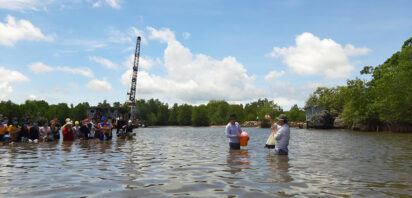
Some communities are already rebuilding homes on stilts. Others are advocating for community-managed wetlands and river buffers. International partners—including Japan, the World Bank and the United Nations—have begun supporting pilot adaptation models.
The Bigger Question
Floodwaters will eventually recede. Roads will reopen. Markets will buzz again. But the deeper question for Vietnam—and for Southeast Asia—is unavoidable:
How many more record-breaking floods must arrive before climate adaptation outpaces climate damage?
Vietnam is confronting that deadline now. The rest of the region should pay attention.
James Borton is a senior fellow at Johns Hopkins SAIS Foreign Policy Institute who writes on environmental security and is the author of Harvesting the Waves: How Blue Parks Shape Policy, Politics, and Peacebuilding in the South China Sea.
The views expressed in this article belong to the author(s) alone and do not necessarily reflect those of Geopoliticalmonitor.com.