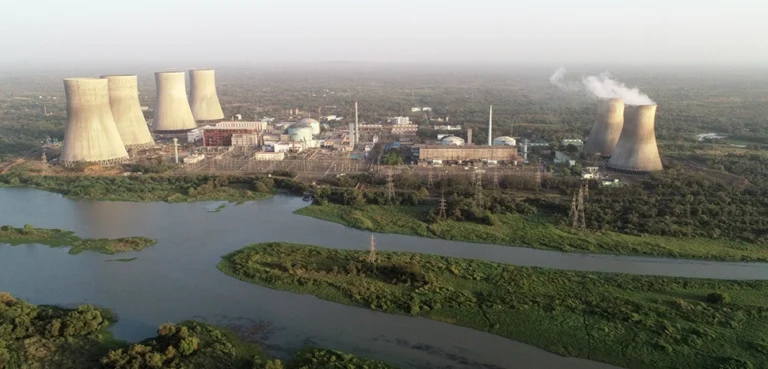
India’s growing civilian nuclear energy program offers long-term cooperation, particularly in uranium supply, and has the potential to serve as a strategic bridge between India and Central Asia, strengthening energy security, economic ties, and geopolitical diversification. The 2026 contract signed between Kazatomprom and India’s Department of Atomic Energy, valued at over $4 billion and backed by 92.9% shareholder approval, ranks among the largest uranium supply arrangements in Asia and exceeds 50% of Kazatomprom’s total book asset value. Its scale signals that India-Central Asia cooperation in this domain is shifting from episodic commodity trade toward a structural strategic axis.
As New Delhi seeks to scale up civilian nuclear energy generation and diversify fuel supplies, Kazakhstan and Uzbekistan are becoming important partners within a broader Eurasian resource architecture. For Astana and Tashkent, India represents not a transactional buyer, but a long-term partnership anchored in multi-year contracts and shared interest in continental connectivity. The main constraint remains geography. Without reliable routes through the Caspian, Iran, or Afghanistan, uranium diplomacy will face the same connectivity problems that have limited India’s presence in the region for decades. The core question is whether nuclear fuel can become the domain through which India establishes a durable foothold in Central Asia.
India’s Bet on Civilian Nuclear Energy
India’s turn toward civilian nuclear energy has moved from long-term abstraction to a structural factor in the global economy. The country remains one of the world’s fastest-growing major economies, meaning its energy demand will expand faster than most other large players. Within this logic, civilian nuclear energy is one instrument for securing industrial growth, energy security, and reduced dependence on hydrocarbons.
Nuclear generation’s share of India’s electricity output remains modest, at around 3%. The sector’s political weight, however, considerably exceeds its current share of the energy mix. According to NPCIL data, as of late 2025 India operates 25 nuclear reactors across seven power stations with a total installed capacity of approximately 8,880 MW, and eight additional reactors of 6,600 MW are being built. In fiscal year 2024-25, nuclear plants generated approximately 57 TWh of electricity. The largest project is the Kudankulam nuclear power plant in Tamil Nadu, where two 1,000 MW units already operate, additional units are under construction, and the design capacity is to reach 6,000 MW. The Tarapur, Kakrapar, Rajasthan, Kaiga, and Narora stations also remain significant.
New Delhi’s ambitions reach well beyond current capacity. The government has set a target of 100 GW of civilian nuclear capacity by 2047, with an interim goal of 22,480 MW by 2031-32. Small modular reactors are receiving separate attention. The 2025/26 budget has reserved more than $2 billion for this direction, and a Rs 200 billion Nuclear Energy Mission targets at least five indigenously designed small modular reactors by 2033.
The most significant institutional shift came in December 2025, when both houses of the Indian Parliament passed the Sustainable Harnessing and Advancement of Nuclear Energy for Transforming India (SHANTI) Bill, 2025. The legislation received presidential assent on 22 December 2025. The SHANTI Act consolidates India’s civilian nuclear framework by repealing two foundational statutes: the Atomic Energy Act of 1962, which had given the central government near-monopoly control over nuclear materials, and the Civil Liability for Nuclear Damage Act of 2010, whose supplier-liability provisions had long deterred foreign reactor vendors from entering the Indian market.
Several amendments embedded in the SHANTI framework carry direct implications for India’s external uranium partnerships.
First, the law permits private and foreign entities to build, own, operate, and decommission nuclear power plants under license from the government, while reserving enrichment of nuclear material, production of heavy water, and management of spent fuel beyond on-site storage for the Department of Atomic Energy.
Second, the new civil liability regime caps operator liability by plant capacity and removes supplier liability, bringing India closer to international nuclear liability conventions.
Third, the Atomic Energy Regulatory Board has received statutory recognition for the first time, addressing a long-standing institutional gap. For India’s uranium suppliers in Astana and Tashkent, the practical effect is that demand for natural uranium will become more structured and predictable over the coming decade, since private operators entering the sector will need long-term fuel supply contracts of their own.
Expanding civilian nuclear capacity runs into the question of fuel. India faced constraints in international nuclear trade for decades and has limited domestic uranium reserves. Diversifying uranium supply is therefore part of its long-term energy security calculus.
Kazakhstan’s Uranium Giant
Against this backdrop, Kazakhstan looks like a near-ideal partner for India. The republic holds approximately 14% of global uranium reserves and remains the world’s largest uranium producer. In 2025, Kazakhstan’s total uranium production reached 25,800 tonnes, including 13,500 tonnes attributable to Kazatomprom, supplying approximately 20% of global primary uranium output. For India, which plans to scale up civilian nuclear energy generation rapidly, such a partner carries strategic significance.
For Astana, cooperation with New Delhi extends beyond simply expanding an export market. Kazakhstan has long sought to move beyond the role of raw material supplier and climb higher up the value chain. The Ulba-TVS fuel assembly plant began operations in 2021 and by 2024 had reached its design capacity of 200 tonnes of low-enriched uranium per year. A significant portion of processing, conversion, and enrichment still takes place outside Kazakhstan, and Ulba-TVS’s key long-term contracts are oriented primarily toward Chinese nuclear power plants.
The Kazakh-Indian uranium partnership already has considerable institutional depth. Kazakhstan had previously been one of India’s important uranium suppliers alongside Canada. In 2015, Prime Minister Narendra Modi visited Astana, where the two sides signed a contract for the supply of 5,000 tonnes of uranium over five years. The 2026 agreement moves this relationship from a category of regular commodity cooperation into a longer-term strategic connection.
The new contract covers long-term deliveries of natural uranium concentrates (U3O8) between Kazatomprom and the Directorate of Purchase & Stores under India’s Department of Atomic Energy. The deal has been valued at over $4 billion, placing it among the largest uranium supply arrangements in Asia. In April 2026, Kazatomprom shareholders approved the contract with 92.9% in favor and 99.19% of voting shares represented. For Kazatomprom, India is becoming one of the most significant directions in its future contract portfolio. The company’s consolidated sales volume in 2025 rose 11% to 18,500 tonnes, with European utilities such as Axpo Power AG of Switzerland and ČEZ Group of the Czech Republic, alongside Japan’s Kansai Electric Power, also signing new uranium supply agreements. India enters this contract book as a significant new customer.
For New Delhi, Kazakhstani uranium strengthens the fuel base and reduces dependence on a single supplier at a moment when the country plans to scale up civilian nuclear energy generation rapidly. For Astana, the Indian market expands room for maneuver against the backdrop of a strong Chinese presence in Central Asian extraction, logistics, and raw material processing.
Chinese companies are already strengthening their positions in large Kazakhstani uranium projects, acquiring assets from Russia’s Rosatom. In this situation, India becomes another stable partner in the uranium market. For Kazakhstan, this format is particularly valuable. It allows the substance of multi-vector policy to be filled with concrete long-term contracts. In this sense, the uranium deal with India fits within Astana’s foreign policy doctrine of combining the protection of national interests with openness toward different centers of power.
In 2025, Kazakhstan-India trade turnover totaled $923.3 million, with Kazakhstani exports to India reaching $415.7 million, a decline of 10%. The structure remains predominantly commodity-based. More than half of deliveries consist of mineral fuels and processed products, with notable shares going to inorganic chemistry products, compounds of rare-earth and radioactive elements, precious metals, and mineral raw materials. The uranium deal therefore matters beyond ordinary trade. It can represent a step from fragmented commodity exports toward a more durable strategic connection with India in the spheres of civilian nuclear energy and critical resources.
Central Asia’s Rich Subsoil
Central Asia matters to India well beyond uranium. The region is gradually becoming one of the more promising directions for access to critical minerals without which energy transition, digitalization, and defense industry cannot function. Kazakhstan remains the key player in uranium, rare-earth elements, chromium, zinc, and copper. Uzbekistan holds large reserves of copper, lithium, molybdenum, and uranium. Kyrgyzstan and Tajikistan possess some of the world’s largest antimony reserves.
The joint statement adopted at the 4th India-Central Asia Dialogue on 6 June 2025 confirms interest in the International North-South Transport Corridor and the Iranian port of Chabahar, as well as in joint exploration of rare-earth and critical minerals. The ministers called for an early convening of the second India-Central Asia Rare Earth Forum, following the inaugural meeting held in New Delhi in September 2024. This indicates that New Delhi is progressively treating the region as part of a broader resource-logistics architecture.
Uzbekistan emerges as the second important regional actor within this logic. India already has experience with long-term purchases of Uzbek uranium. A 2019 contract provided for the supply of 1,100 MTU of natural uranium concentrate over 2022-2026. Uzbekistan itself is markedly scaling up its sectoral ambitions. Tashkent has set a target of increasing uranium production to 7,100 tonnes by 2030, and in 2025 Navoiyuran’s production reportedly reached 7,000 tonnes, close to that target ahead of schedule.
In 2026, the authorities planned to develop four new mines. Among the promising directions are Kyzylkok, Arnasay, and South Djengeldi. At South Djengeldi, France’s Orano operates through the Nurlikum Mining joint venture, now restructured so that Navoiyuran and Orano each hold 45% and Japan’s ITOCHU holds the remainder, with peak annual production projected at 700 tonnes. This makes Uzbekistan a significant potential partner for India. The country is already embedded in India’s uranium agenda and demonstrates readiness to scale up extraction rapidly while attracting external technology players.
The Logistics Puzzle for New Delhi, Astana, and Tashkent
Central Asia’s geographic characteristic is its position deep within Eurasia and its lack of direct access to the open ocean. Any strategy for reaching the Indian market therefore runs into transport corridors: through the Caspian and the Caucasus, through Iran, or through Afghanistan and Pakistan.
Each route carries its own constraints. The Middle Corridor through the Caspian is developing but remains an expensive and complex multimodal route. Railways, ports, ferries, and Caspian infrastructure require time and investment. The Iranian direction through Mangystau, Turkmenistan, and onward to the ports of Bandar Abbas or Chabahar is convenient for India but politically vulnerable due to tensions surrounding Tehran. Trans-Afghan routes are more sensitive still. They depend on stability in Afghanistan, on the state of Kabul’s relations with Islamabad, and on the reliability of border crossings. The region’s southern connectivity thus remains a political as much as an infrastructural challenge.
Uranium, however, carries different commercial logic from ordinary commodities. Its logistics are more complex, but its strategic value is higher. Uranium is compact, expensive, and critical to long-term energy security, in contrast to bulk cargo like grain or coal, where transport costs quickly erode commercial viability. Reliable supplies of such a resource therefore command a premium even under difficult geography.
Transport risks therefore do not cancel the prospect of India-Kazakhstan-Uzbekistan cooperation. They make it more political. The issue extends beyond the sale of raw materials into the creation of reliable routes, supply insurance, and long-term arrangements. These constraints align the foreign policy interests of the parties. New Delhi needs reliable access to resources and continental corridors, while Central Asian states need additional outlets to southern markets and ocean ports.
The 2026 uranium deal indicates that India-Central Asia relations are entering a more mature phase. The Indian direction holds a particular advantage for the region: New Delhi does not demand geopolitical loyalty. India is interested in resources, logistics, and energy security, and its approach is more flexible and less burdensome for Central Asian capitals. For Kazakhstan and Uzbekistan, this is significant. Cooperation with India can be embedded within existing multi-vector policy without disrupting relations with China, Russia, the EU, or the United States. India’s demand is also long-term. Its civilian nuclear energy program, industrial growth, and requirements for critical minerals will necessitate stable supplies for decades. India can therefore become for the region one of the most convenient and predictable partners, a market that broadens room for maneuver and improves Central Asia’s negotiating position.
At the same time, India needs to understand that Astana and Tashkent will give preference to partners willing to share technologies, support localization, and deepen processing within the region. Central Asia is increasingly reluctant to remain only a supplier of uranium, copper, or rare-earth metals. Long-term advantage will therefore accrue to those external actors who offer participation in value creation, from geological exploration and processing through training and infrastructure development. The SHANTI framework’s opening of India’s civilian nuclear sector to private and foreign players creates new room for joint ventures, technology transfer, and downstream cooperation that previous Indian frameworks could not accommodate.
Rassul Kospanov is a senior researcher at the National Analytical Center (NAC) at Nazarbayev University in Astana. He specializes in Kazakhstan’s domestic and foreign policy, as well as political developments across Central Asia. His professional interests include elite politics, regional development, political economy, and the region’s engagement with external actors. He is a co-author of three books on Kazakhstan’s domestic politics.
Eldaniz Gusseinov is a geopolitical analyst, who focuses on trade corridors, energy transitions, and the strategic behavior of middle powers across Eurasia. Eldaniz has worked for several academic institutions and think tanks in Europe and Central Asia.