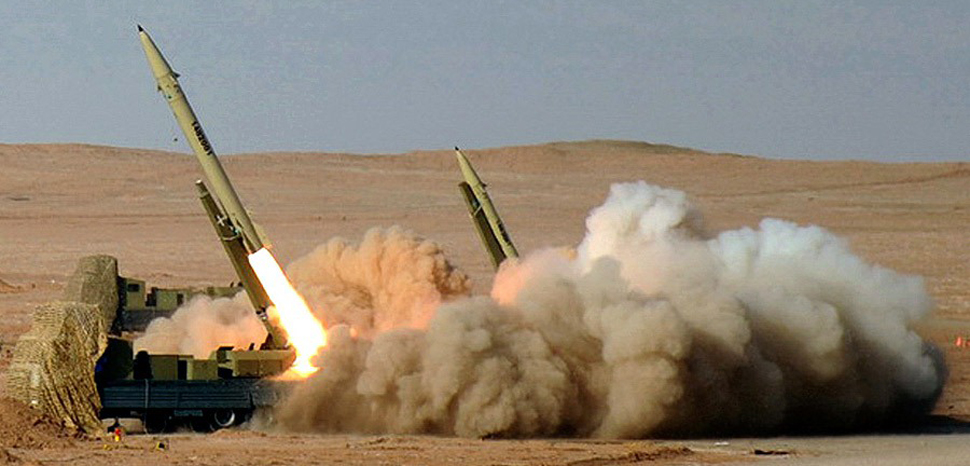
First introduced in 2015, the UN arms embargo on Iran has recently expired, meaning that the Islamic Republic is now able to buy and sell military hardware and technologies. While there is concern that this will allow Iran to modernize its armed forces and export its weaponry to anti-US actors in exchange of much-needed cash, a combination of political and economic factors makes it difficult for Iran to access the global defense market as either a customer or as a supplier. Nevertheless, some powers may now engage in arms trade with Iran, with potential impacts for diplomatic relations in the Middle East for years to come.
Analysis
The end of international arms restrictions
In its latest form, the UN arms embargo on Iran was introduced (on the basis of previous texts) by the 2015 Security Council Resolution (UNSCR) 2231, which gave legal status under international law to the Joint Comprehensive Plan of Action (JCPOA), the agreement that the Islamic Republic and the P5+1 countries (US, Russia, China, UK, France and Germany) had signed to put an end to the former’s military nuclear program. Though roundly panned by right-wing critics in the United States, the JCPOA was more generally hailed as a successful measure to peacefully solve the problem of Iran’s nuclear proliferation. Under the agreement, economic sanctions were gradually lifted as international inspectors supervised the dismantlement of facilities related to nuclear weapons development.
However, this denuclearization process was abruptly halted after Donald Trump’s election as US president. In 2018, Trump withdrew the US from the JCPOA (deeming it insufficient to definitively block Iran’s nuclear ambitions) and re-imposed economic sanctions, especially on the vital oil sector on which the country depends. Iran thus slid into a severe recession that has been made even worse by the COVID-19 pandemic. No progress has been made toward a new agreement on the military nuclear program, and in the meanwhile the arms embargo defined by the UN Resolution expired. In theory, this enables Iran to freely buy and sell weapon systems as well as defense-related technologies, even though the US claims that all sanctions are practically back in place due to the ‘snapback’ provision of JCPOA which allows their reintroduction if Iran violates the agreement. However, other states reject this interpretation, stating that the US renounced any right to trigger the mechanism when it abandoned the JCPOA. In any case, the US will introduce its own unilateral restrictions on the Iranian defense sector that will de facto replace the UN measures. The fear of being blacklisted by the US will be enough to deter most states and defense firms from doing business with Iran. However, not all countries will be so deterred.
Potential suppliers and customers
Iran has an urgent need for modern weaponry. Once a pro-West country, Iran has been under arms trade restrictions since the 1979 Revolution which brought the Ayatollah regime to power. Since then it could no longer legally access any Western equipment, and today it only disposes of outdated platforms affected by a chronic shortage of spare parts. The rest of its arsenal is made of aging Soviet/Russian or Chinese weaponry, reverse-engineered copies of Western platforms and domestically-built equipment of limited effectiveness. Its ‘next-generation’ systems are generally no more than combination of existing pieces of hardware. Even though it has been able to adapt by adopting an anti-access / are denial (A2/AD) strategy based on using a multitude of cheap but effective missiles, naval mines, and small vessels, as well as special forces and cyber operations, Iran’s military remains in serious need for an upgrade.