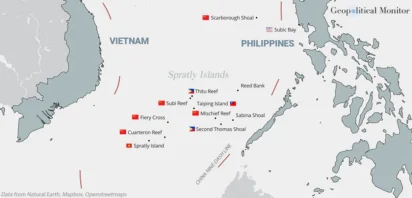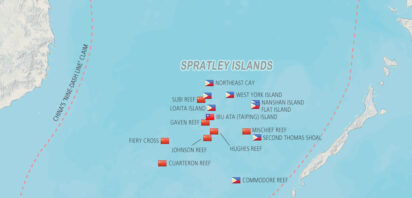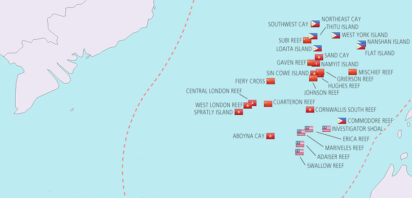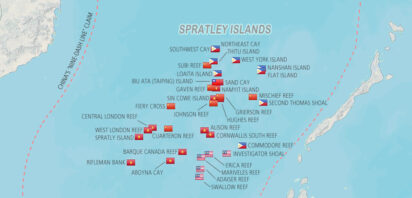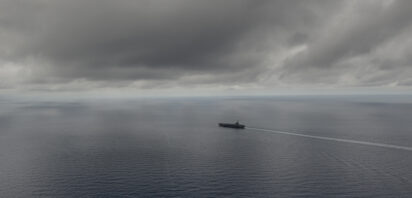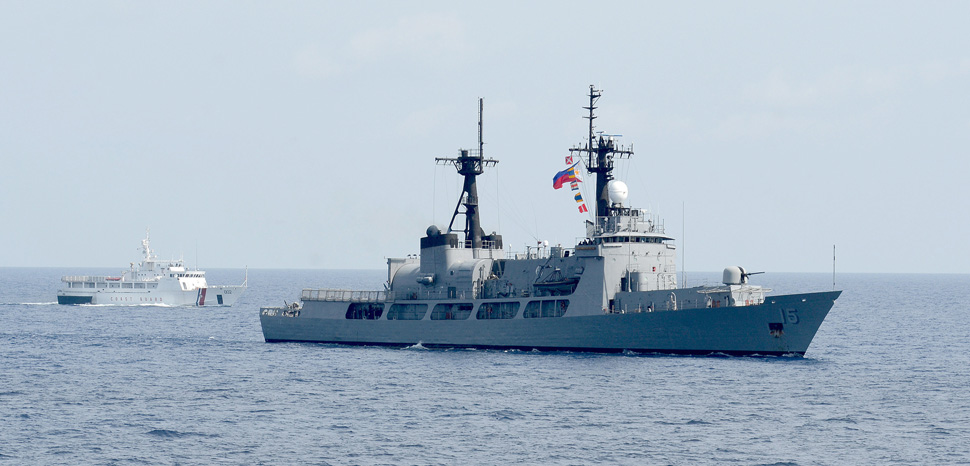
The Philippine government issued a formal diplomatic protest over China’s activities in the South China Sea over the weekend. The complaint centers on the contested shoal of Whitsun Reef (‘Julian Felipe’ in Philippines), where hundreds of Chinese coast guard vessels were spotted in early March.
Just over one year out from elections, the incident reflects the delicate balance struck by Rodrigo Duterte with regard China-Philippines relations. It also shows that, despite early heralds of a ‘free and open Indo-Pacific,’ the salami continues to be sliced in the South China Sea, slowly but surely altering the status quo in Beijing’s favor.
Analysis
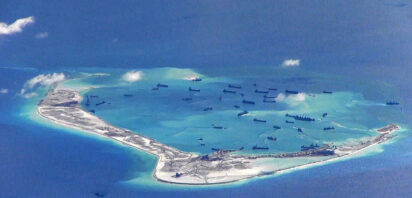
According to the diplomatic complaint, some 220 vessels were spotted moored off of Whitsun Reef on March 7. Philippine officials noted that they did not appear to be fishing vessels, and were likely a part of China’s maritime militia.
The People’s Armed Forces Maritime Militia (PAFMM) is a pseudo-coast guard that engages in ‘gray zone’ operations intended to establish de facto control over disputed waters. These operations include providing an armed guard for Chinese fishing vessels, intimidating fishing vessels from other nations in disputed waters, and dissuading the coast guards and navies of other claimants from policing their own waters for fear of potential escalation with Beijing.
The size of the militia has been estimated at around 84 large vessels and as many as 3,000 smaller vessels.
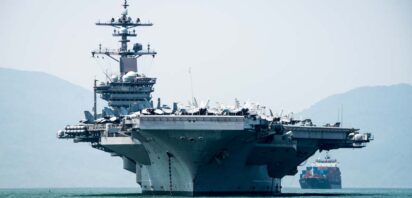
The PAFMM’s history stretches back nearly as long as the PRC itself. Comprising of a mix of military professionals and trained fishermen, the militia was created soon after the civil war and was primarily responsible for defending the mainland from Nationalist naval attacks. It was instrumental in capturing the Paracel Islands from Vietnam in 1974, and has been used to swarm fishing vessels around the Senkaku Islands (Diaoyu in Chinese) for decades. More recently, the militia has been helping to establish PRC writ over the South China Sea, engaging in harassment and blockades of Philippines- and Vietnam-flagged vessels. The PAFMM has even employed such tactics against US Naval vessels, notably the USNS Impeccable, which was swarmed by PAFMM and PLAN ships when it violated China’s EEZ south of Hainan in 2009.
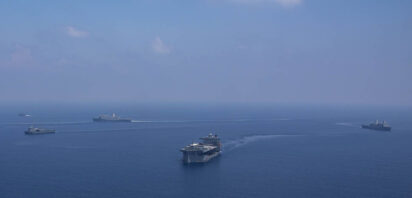
The PAFMM’s operations are low-intensity and designed to generate acquiescence on the part of rival claimants; in essence, they seek to win the war without a shot being fired. For evidence of the success of such tactics, one needs look no further than the evolving map of the South China Sea. However, regional players have begun to wise up to the strategy, and are treating the PAFMM as another wing of the PLAN. First and foremost is the United States, which has gone so far as floating the possibility of integrating its own coast guard assets with Pacific allies for joint surveillance and policing of coastal waters.
It’s in the context of this growing wariness of PAFMM operations that the Philippines’ diplomatic complaint should be viewed. To be sure, President Duterte, who has staked much of his political brand on the economic benefits of harmonious relations with China, would rather not be dealing with yet another escalation in the South China Sea. This is especially true given that Duterte had just lifted his country’s ban on energy exploration in the contested waters last October, paving the way for the possibility of joint development of South China Sea resources. According to Duterte, Beijing had offered Manilla a controlling stake in the energy project in exchange for shelving the 2016 international tribunal ruling that went in the Philippines’ favor.
But not everyone in the Duterte administration is on-board. Divisions came to the fore earlier this year when China passed a new law authorizing its coast guard to “take all necessary measures, including the use of weapons, when national sovereignty, sovereign rights, and jurisdiction are being illegally infringed upon by foreign organizations or individuals at sea” (emphasis added). Soon after it was announced, Duterte’s foreign secretary, Teodoro Locsin Jr. declared that the new law was “a verbal threat of war to any country that defies it,” and that failure to challenge the law was tantamount to submitting to its authority.
Relations with China will loom large in the lead-up to presidential elections in May 2022. Despite his enduring popularity, President Duterte is constitutionally barred from seeking another term in office. Whoever stands in his place will have their work cut out for them navigating the increasingly contradictory dictates of Manila’s two biggest partners in Beijing and Washington.