The scale, institutional architecture, and geopolitical context of the current effort differ fundamentally from the historical National Defense Stockpile, raising distinct questions about durability, market effects, and the boundaries of government intervention in strategic commodity markets.
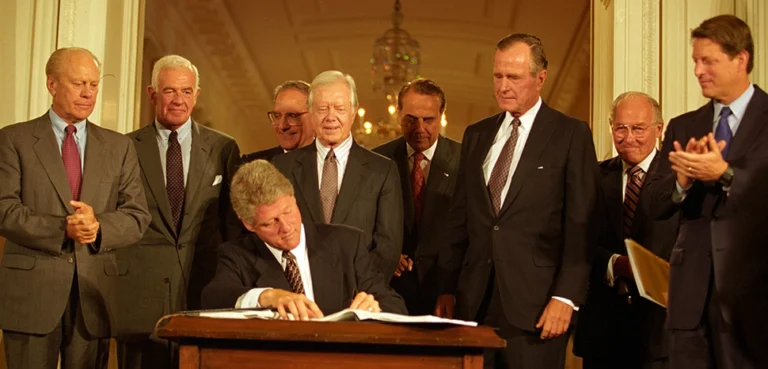
President Trump signed the executive order establishing Project Vault on February 2, 2026, at a White House ceremony attended by administration officials and industry leaders, including General Motors CEO Mary Barra. The initiative is structured as an independently governed public-private partnership, distinct from the traditional Pentagon-managed National Defense Stockpile.
Project Vault covers all 60 minerals on the USGS 2025 Critical Minerals List, with initial emphasis on the 15 rare earth elements, cobalt, nickel, lithium, copper, germanium, scandium, and gallium. The civilian-industrial focus distinguishes Project Vault from the NDS, which is a defense stockpile managed by the Defense Logistics Agency.
Congressional Appropriations and Legislative Architecture
The One Big Beautiful Bill Act (signed July 4, 2025) provided $7.5 billion for critical minerals through multiple channels.
Table 1: Federal Critical Minerals Appropriations Under the One Big Beautiful Bill Act
| Appropriation |
Amount |
Entity |
Purpose |
| NDS Transaction Fund |
$2 billion |
DLA Strategic Materials |
FY2025 stockpile expansion |
| Industrial Base Fund |
$5 billion |
DoD |
Supply chain investments through FY2029 |
| Defense Credit Program |
$500 million |
Office of Strategic Capital |
Critical minerals project lending |
Source: CSIS, Inside Government Contracts
The same legislation eliminated the Inflation Reduction Act’s Section 30D Clean Vehicle Credit and began phasing down the 45X Advanced Manufacturing Production Credit for critical mineral production (75 percent in 2031, 50 percent in 2032, 25 percent in 2033, eliminated after 2034). This shift represents a conscious reorientation from demand-side incentives for clean energy minerals toward supply-side investments in defense-oriented extraction and processing.
Equity Stakes: The Most Controversial Innovation
The administration’s most novel mechanism involves direct government equity stakes in private mining and processing companies. The approach departs from traditional procurement contracts and has drawn both praise and criticism across ideological lines.
Table 2: Major US Government Equity Stakes in Critical Minerals Companies (2025–2026)
| Company |
Investment |
Stake |
Key Assets |
| MP Materials |
$400 million |
~15% |
Mountain Pass RE mine (CA) |
| USA Rare Earth |
$1.6 billion |
8–16% |
Round Top Mine (TX); magnet facility (OK) |
| Lithium Americas |
$2.26B loan |
~5% |
Thacker Pass lithium mine (NV) |
| Trilogy Metals |
$35.6 million |
~10% |
Upper Kobuk Cu-Zn-Co (AK) |
| Vulcan Elements |
$100M + $700M |
Equity |
10,000 MT/yr NdFeB magnets |
Sources: Brownstein Hyatt Farber Schreck, CNBC
The MP Materials arrangement is the most structurally detailed. The Department of Defense purchased newly created Series A Preferred Stock at $30.03 per share, becoming the company’s largest shareholder. The deal included a ten-year price floor of $110/kg for neodymium-praseodymium oxide (roughly 80 percent above the then-market price of $60/kg), structured as a contract-for-difference mechanism.
Senator Rand Paul (R-KY) characterized the approach as a “step toward socialism,” warning that it conflicted with free-market principles central to the Republican Party. Senator Bernie Sanders (I-VT) praised the equity model from the opposite direction, arguing that taxpayers deserve returns on public investment. Analysts at CSIS have observed that the equity mechanism creates risks of politicized competition where contract winners may be selected for strategic alignment rather than commercial viability.
China’s Processing Monopoly and Escalating Export Controls
The strategic rationale for the current stockpiling effort centers on China’s dominance of mineral processing and refining, a vulnerability that differs structurally from the Cold War model of raw material supply disruption.
Table 3: China’s Share of Global Critical Mineral Refining
| Mineral |
China’s Refining Share |
Primary End Use |
| Gallium |
98–99% |
Semiconductors, military radar, 5G |
| Rare earth refining |
~90% |
Magnets, precision weapons, EV motors |
| Natural graphite |
90%+ |
Lithium-ion battery anodes |
| NdFeB magnets |
~94% |
Defense guidance, EV motors, wind turbines |
| Tungsten |
~83% |
Cutting tools, AP ammunition |
| Bismuth |
80%+ |
Lead-free ammunition, weapons systems |
| Cobalt refining |
60–76% |
Battery cathodes, superalloys |
| Germanium |
59–68% |
Fiber optics, infrared, night vision |
Sources: ODI, Carnegie Endowment for International Peace
China’s export controls have escalated in five distinct phases since August 2023. The August 2023 licensing requirements for gallium, germanium, and graphite products marked the opening action. Controls expanded to antimony in late 2024 (shipments to the US dropped 97 percent; prices surged 228 percent). A December 2024 outright ban on gallium, germanium, antimony, and superhard material exports to the United States followed in direct retaliation for new US semiconductor restrictions. Controls extended to tungsten, tellurium, bismuth, molybdenum, and indium in February 2025, then to seven heavy rare earth elements (samarium, gadolinium, terbium, dysprosium, lutetium, scandium, yttrium) in April 2025.
The October 2025 escalation introduced a Foreign Direct Product Rule for rare earths, requiring foreign companies to obtain Chinese licenses for products containing Chinese-origin rare earth materials. From December 2025, this applied to internationally manufactured products with 0.1 percent or more Chinese-origin rare earth materials by value. The USGS estimated the gallium-germanium ban alone could reduce US GDP by $3.4 billion per year.
The FORGE Alliance and Multilateral Architecture
The international architecture of the current stockpiling era differs fundamentally from Cold War bilateral arrangements. The Critical Minerals Ministerial of February 4, 2026, hosted by Secretary of State Marco Rubio, drew 54 countries and the European Commission. The State Department reported over $30 billion in US government financing support mobilized in the preceding six months.
The Ministerial launched FORGE (Forum on Resource Geostrategic Engagement) as successor to the Biden-era Minerals Security Partnership. FORGE is designed as a preferential trade zone for critical minerals, establishing reference prices that function as price floors enforced through adjustable tariffs. The administration signed 11 new bilateral frameworks at the Ministerial (with Argentina, Cook Islands, Ecuador, Guinea, Morocco, Paraguay, Peru, Philippines, UAE, UK, and Uzbekistan).
EXIM Bank has issued $14.8 billion in Letters of Interest for critical minerals projects, spanning rare earth development ($455 million), lithium extraction in Arkansas ($400 million), cobalt and nickel production in Australia ($350 million), and tin across the UK and Australia ($215 million). The Development Finance Corporation closed the $1.8 billion Orion Critical Minerals Consortium in January 2026 (a public-private partnership with Orion Resource Partners and Abu Dhabi’s ADQ sovereign wealth fund), signed a $565 million financing agreement for Brazil’s only producing rare earth mine, and committed up to $700 million for tungsten development in Kazakhstan.
Outlook: Structural Questions for the Second Stockpiling Era
The current effort faces at least three structural challenges that will determine its durability. The first concerns institutional resilience. The post-Cold War liquidation demonstrated that congressional appropriators will treat stockpile assets as budget relief when strategic urgency recedes. Project Vault’s quasi-commercial structure, with private capital and OEM commitment fees, may prove more resistant to congressional raids than the old NDS Transaction Fund. The equity stakes carry their own disposal risk: a future administration might sell government shares in mining companies for political or budgetary reasons.
The second challenge concerns the nature of the vulnerability itself. The Cold War stockpile addressed the risk of physical supply denial through military action or proxy conflict. The current vulnerability is structural dependence on a single nation’s processing monopoly. Stockpiling raw ore does not resolve a refining chokehold. Analysts at the Council on Foreign Relations have argued that the United States cannot feasibly match China’s processing capacity and should instead focus on innovation in materials engineering, recycling, and substitution technologies.
The third challenge is political sustainability. In February 2026, three ranking Democratic lawmakers sent letters demanding documents on the equity stakes program, citing the absence of safeguards against ownership positions influencing permitting decisions and potential conflicts of interest. The pattern of post-hoc congressional investigation mirrors the Kennedy-era Symington hearings, though the current investigations target an incumbent administration’s novel investment mechanisms rather than a predecessor’s stockpile overaccumulation. Nonetheless, potential conflicts of interest risk putting the program in political jeopardy in the future.
Whether the bipartisan consensus on the threat can survive partisan disagreement over mechanisms will shape the trajectory of US mineral security policy through the remainder of the decade.