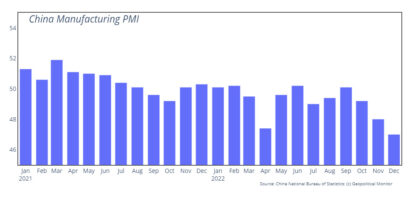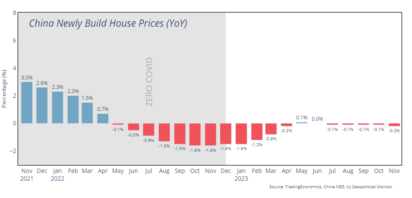
There can be no doubt that China is in the midst of economic and ideological flux. Gone is the deferential ‘peaceful rise’ of old, replaced with the more assertive policies expected of an increasingly global military power. Gone too is the supply side-focused and debt-fuelled model of economic growth – at least in theory – with Party officials now promising ‘common prosperity’ as a byword for a more equitable growth model based on domestic consumption and wealth redistribution. Yet numerous challenges loom in 2022 ,which together may slow or even reverse this supposed transition: global trade slowdowns, the omicron variant, the Winter Olympics, a reeling property sector, electricity production shortfalls, and an ever-growing debt balloon. Will Beijing succeed in staying the course?
Background
A general economic slowdown
The Party’s top-level growth target, if kept at all, is expected to be in the vicinity of 5%, down from 6% in 2021. The tempered expectations reflect a near across-the-board decline in economic metrics to close out the year. Industrial production growth hovered in the 3.1-3.8% range from September-November, and retail sales have been equally soft, hitting just 3.9% year-on-year growth in November – a far cry from the 8-9% range that 2019 averaged. Overall, the Chinese economy grew 4.9% in the third quarter, and fourth quarter growth is expected to come in at around the same level.
Headwinds abound heading into 2022
China’s economic weakness of late can be traced back to several factors, namely COVID-related shutdowns, logistical bottlenecks and input inflation, energy production shortfalls, and a slowdown in the property sector.
Despite the public health benefits of its draconian containment measures to contain COVID-19, China has not completely escaped the negative impacts that have ravaged economies elsewhere. Moreover, given the policy divergence between China’s ‘zero Covid’ approach and growing insistence among other major economies to remain open amid soaring case rates, it stands to reason that these negative effects will likely worsen as China seeks to lock down clusters of omicron infection, especially in the lead-up to the Olympics. Furthermore, the efficacy of China-produced vaccines represents another potential wrinkle, as early clinical indications suggest that their ability to fight the omicron variant is significantly worse compared to mRNA peers. Thus, early hopes of the variant’s relative mildness notwithstanding, Beijing may be uniquely constrained with regard to omicron due to its population’s vaccine profile and relative lack of natural immunity owing to the absence of community spread (a victim of its own lockdown success in a sense). All this portends serious economic headwinds in the year ahead, particularly in the first few months.