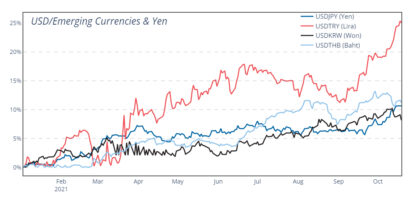
The past decade has witnessed a steep accumulation of debt in emerging economies, with servicing burdens expanding in tow. According to estimates from the Institute of International Finance, EM economies will pay some $800 billion in debt servicing in 2020 alone. Between 2020-2022, some $10.7 trillion in redemptions will be required – $2 trillion of which is denominated in foreign currencies like USD. The glut was fueled in part by unorthodox monetary policies which helped to keep borrowing costs down amid successive bouts of fiscal stimulus. But with many tools in the monetary policy toolbox exhausted, foreign exchange reserves dwindling, USD-denominated redemptions looming on the horizon, and narrowing fiscal room to maneuver due to growing debt-servicing costs, 2020 projects to be a year where the only policy option available to some EM governments is to hope for favorable macroeconomic conditions. The alternative of a global downturn means spiking debt yields, sovereign debt crisis, and the inevitable IMF bailout with all the usual strings attached.
Though this trend is readily apparent in the emerging world, the outlook is particularly fraught for three economies heading into next year: Turkey, Lebanon, and Argentina.
Turkey
Turkey’s economic struggles have been well-documented of late. Broadly speaking, they boil down to a combination of politicized monetary policy, debt-fueled stimulus spending, forex-sapping currency volatility, and now moribund growth rates. As expected whenever there’s a run on an EM currency, inflation has also been a nagging problem, albeit one that has been easing of late, reaching the 8-9% range in November after touching 25% in 2018.
Looking to the year ahead, Ankara’s overriding concern will be its $120 billion in external short-term debt obligations – of which only approx. 13% is denominated in lira, with the lion’s share being USD (approx. 50%) and euros (approx. 30%). External debt is also piling up, having grown some 3.6% year-on-year as of October.