Update: In the time since this article was published, Giuseppe Conte has given up his bid to form a government citing President Sergio Mattarella’s refusal to accept eurosceptic finance minister Paolo Savona. The situation is fluid with President Mattarella maintaining that he will wait before making any decision, but new elections are now a distinct possibility.
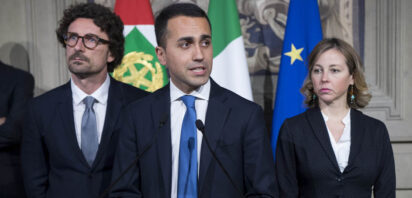
Italy’s populist Five-Star Movement (M5S) and the far-right Northern League are in the final steps of forming a government under premier-designate Giuseppe Conte. The task hasn’t been an easy one so far, as the two parties’ often antagonistic policy platforms have made for an arduous negotiation process, even spawning a ‘conciliation committee’ to settle internal differences before they can reach the light of day. These frictions have been laid bare in the two parties’ coalition contract – a laundry list of goals that, though softened from earlier proposals, will still cause hardened EU bureaucrats to blanche.
Here’s an examination of the most important points of the coalition contract, and what they might mean for the Italy’s politics and economy going forward:
Impact
The League gets its way on migration. The coalition contract is a veritable minefield of future showdowns with EU law, beginning with the ever-controversial issue of migration. Here we see many of the Northern League’s core policy planks reflected in the contract: an 18-month limit for the asylum process, forced repatriation of up to 500,000 migrants in Italy, and the detention of migrants who entered the country illegally. It’s a policy that garnered widespread popular support; Italy has been struggling to deal with a massive influx of migrants following the Libya and Syria civil wars, absorbing an estimated 624,5000 arrivals from 2014-2017.
Reaching the 500,000 deportation goal will be prohibitively expensive; in 2017, just 6,500 deportations took place. Costs run high on the policing end – rounding up migrants and guarding them through the deportation process – and the logistical end, as planes must be chartered to their home countries. It can also be a diplomatic quagmire since an agreement must be struck with the receiving country to take back the migrants. In the past, the Northern League has campaigned on threatening sanctions in order to gain compliance on the receiving end.
These policies will run afoul of existing EU laws, setting the stage for a showdown with Brussels. However, the showdown might be a little overstated on the migration front. There’s a slow turning of the tide in the EU as Brussels watches election after election result in victories for anti-establishment parties. Angela Merkel, the former champion of expanding and reforming the EU migration system, is hamstrung at home by the inclusion of more conservative elements within her own governing coalition, and all attempts by Brussels to gain compliance for migration quotas in eastern Europe have come up short. Migration is no longer a principle that pro-EU politicians want to stake their existence on, and this could well reflect in the battles to come between the new Italian government and Brussels.
Russia rehabilitated. The coalition contract calls for the lifting of EU sanctions on Russia while asserting that Russia is a friend, not enemy, of Europe. The pledge comes as no surprise given both the 5SM and Northern League’s closeness with a Russian regime that has squarely aligned itself with the interests of the EU’s populist insurgency. Both parties have previously floated the idea of abandoning NATO, but such a move did not appear in either of their electoral platforms. Matteo Salvini, leader of the Northern League, has made several trips to Russia, often meeting with representatives from Putin’s United Russia party.
The new Italian government, if ultimately approved by President Sergio Mattarella, is poised to clash with Brussels almost immediately on Russia relations. EU sanctions over Russia’s annexation of Crimea and support for rebels in eastern Ukraine are up for another six-month extension on September 15. The European Council needs a unanimous vote to extend the sanctions, so it’s hard to imagine the sanctions would survive a 5SM-League government. There’s always a slim possibility of another extension, but it would come with the qualifier that no future extensions would be forthcoming.
Government finances will be squeezed on both sides of the ledger. The Northern League wants to cut taxes and the Five-Star Movement wants to battle inequality via more government expenditures – it’s a recipe for a debt spike, one that Italy cannot afford given its existing debt load hovering around 130 percent of its GDP (just about where Greece was in 2007).
Most of the new spending comes in the form of a ‘basic guaranteed income,’ which is more like an extended unemployment insurance program as it only lasts two years so long as someone is looking for a job. The contract also seeks to roll back cost-saving pension reforms instituted by the previous government. One estimate from IMF official Carlo Cottareli puts new spending commitments as high as 126 billion euros.
This new spending will be assailed from two sides, by the market and Brussels. Market forces will start to drive up the cost of Italian debt; the EU will push back against any major breach of EU Growth and Stability Pact spending rules (max. 3% deficit spending). The latter has been a predictably easy target for the new government so far, with financial minister-designate Paolo Savona decrying Germany’s undue influence over EU member country budgets (former finance minister Ignazio Visco has described Savona as “suicidally anti-German”).
The market has already begun to react to the possibility of a Conte government, with some $2.6 billion flowing outward from European equity funds last week according to EPFR Global. Bonds saw $1.8 billion in withdrawals over the same period. The combined $4.4 billion withdrawal was the most since the $6.1 billion outflow in the week after Brexit. Italian bonds have been locked in a widening sell-off in the past month, a period that has seen the two-year bond up 100 basis points against the German equivalent, the widest spread since late 2013.
It’s on the spending front that we’re likely to see the biggest battles between Rome and Brussels. With the Greek sovereign debt crisis still fresh in many minds, the EU will push back against profligate spending, and the Italian government will in turn blame Brussels for any unrealized campaign pledges that are in reality thwarted by Italy’s harrowing fiscal outlook.
In the sobering words of one Citi rate analyst: “a sovereign debt crisis is a 100% risk, in the long run. To bring forward the existential crisis to the near term needs populists to take on Germany…”
Forecast
The ascent of a 5SM-Northern League government has the potential to be a deeply destabilizing event for both global markets and the EU establishment. However, the government’s formation is not yet a foregone conclusion. There has been pushback from President Sergio Mattarella, particularly in his refusal to accept the appointment of anti-EU Savona as finance minister, and Mattarella has the power to trigger new elections if he feels that the proposed government is untenable.
Should the Conte government be approved, it will still be beholden to the same political maelstrom that has consigned countless Italian administrations to oblivion in the early days of their governing mandate. The 5SM-Northern league coalition has a narrow majority in the upper house, and its support might be tested early, particularly if a new sovereign debt crisis begins to coalesce around its spending pledges.