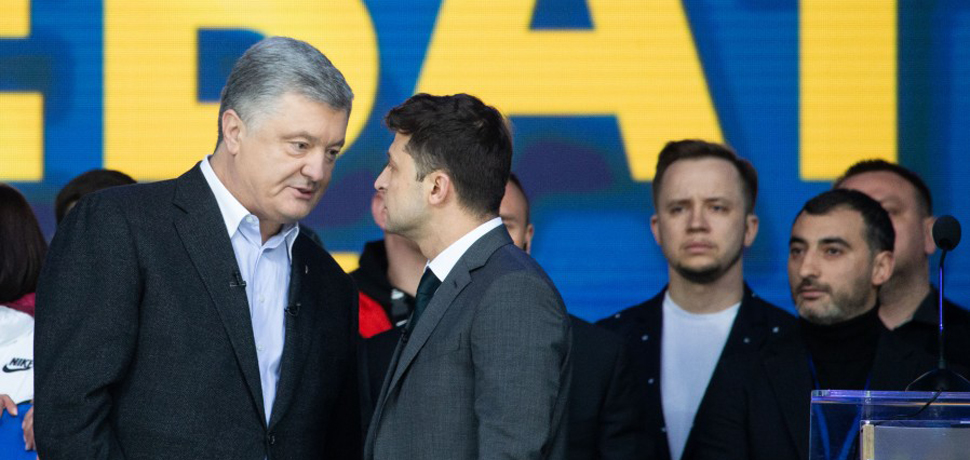
Ukraine’s anti-establishment wave crested over the weekend, sweeping Volodymyr Zelensky to power in a landslide win over Petro Poroshenko.
A 41-year-old comedian with no previous political experience, Zelensky is famous for playing the president in the popular television show Servant of the People.
Poroshenko’s sky-high disapproval ratings made it so that the business tycoon-turned president always faced an uphill battle to secure reelection. However, few predicted that he would suffer such a severe drubbing at the hands of an unknown quantity in Zelensky. With nearly all the votes counted, Zelensky took 73 percent to Poroshenko’s 25 percent.
Little is known about Zelensky’s policies, but one thing is certain: the political neophyte will be under intense pressure to effect change one way or another.
Impact
Servant of the People follows a high school teacher who is elected president after an impassioned rant against the establishment goes viral. Once becoming president, Zelensky’s character tries to remain above the temptations of power and a corrupt bureaucracy, all the while striving to improve the lives of his fellow citizens.
Ukraine’s new president has already achieved the first plot point. But how will he do on the second?
There is little to go on for gauging the policy potential of a Zelensky presidency. He has no record in office and, like other anti-establishment analogues worldwide, offered little in the way of a policy platform while on the campaign trail. Zelensky’s broad strokes did lend themselves to a few clues: he supports Ukraine’s continued warming to the EU, and he wants to reform Ukraine’s political institutions – again, sans any concrete details.
What we do know is that Zelensky’s victory affords a unique opportunity to take a radical new direction. Domestically, he could foster new institutions to stem corruption at all levels of power. In this his outsider status is a boon, as Zelensky is (presumably) not personally compromised nor is he reliant on patronage networks that stand to lose in a credible anti-corruption drive. A Zelensky presidency could hypothetically empower the country’s anti-corruption bodies, something that Poroshenko failed to do and was ultimately punished for at the ballot box. Incidentally, it will also be interesting to see whether or not bodies like the National Anti-Corruption Bureau (NABU) or the Specialized Anti-Corruption Prosecutor’s Office (SAPO) end up targeting the outgoing president or Yulio Tymoshenko, the other love-or-hate establishment candidate who lost in the first round. Either way, we can expect some big fish to get caught in the net as Zelensky’s political branding is now inexorably tied to the idea of cleaning house at the highest levels of Ukraine’s politics.
It’s worth noting that there’s some evidence to suggest that Zelensky is not the total outsider he portrays himself as. People point to his links to oligarch Ihor Kolomoyskiy – the owner of the television channel that originally aired Servant of the People – as proof that he’s merely a pawn in the great game of Ukrainian politics. Kolomoyskiy is an avowed enemy of Petro Poroshenko, who nationalized Kolomoyskiy’s PrivatBank and accused the oligarch of syphoning billions from the lender, which was at the time Ukraine’s largest. More recently it was revealed that Kolomoyskiy is under investigation by the FBI for possible financial crimes in the United States. He currently resides in Tel Aviv and it’s unclear whether or not he’ll be able to return to Ukraine under a Zelensky presidency.
The new president will also have unique opportunities on the foreign policy front, if anything because he lacks Poroshenko’s toxic personal history of dealing with Russia. Zelensky has repeatedly suggested that he would be open to negotiations with Russia over the frozen conflict in the Donbas. A new leader on the Ukrainian side might be just what’s needed to reinvigorate the Minsk II process, which has been languishing since it was agreed to back in 2015. To this day, many of its provisions remain unimplemented.
However, it’s worth noting that although Russia may be more amenable to negotiating in good faith with a Zelensky government, there are still huge roadblocks on the path to peace. Certain aspects of the Minsk process are anathema to the public and implementing the agreement as-is would be viewed as an unacceptable surrender in the face of Russian aggression. There’s also the question of what a reintegrated Donbas would mean for Ukrainian politics, which has lurched toward a pro-Western consensus since the largely pro-Russia region was excised from the body politic. These factors will restrict the president’s options despite his outsider status. At present time, the most likely outcome appears to be more of the same: a frozen conflict in eastern Ukraine.
Similarly, the status quo won’t be altered in Crimea. Zelensky has refused to recognize Russian sovereignty over the area, and is unlikely to ever do so, but he has also admitted that Crimea won’t be returned to Ukraine under the current Russian administration.
Poroshenko hammered home the trinity of nationalist themes on the campaign trail: army, faith, language. But it still wasn’t enough to get him even close to the presidency amid a faltering economy. The same will likely be true of Zelensky, whose success or failure will ultimately be judged based on how he provides for the long-suffering people, an increasing number of whom are picking up and leaving the country in search of greener pastures.
After two failed revolutions, a slow-burn civil war, and now a new IMF bailout, fixing what ails Ukraine won’t be an easy task. For Zelensky, the campaign trail was just the audition; now the real performance begins.