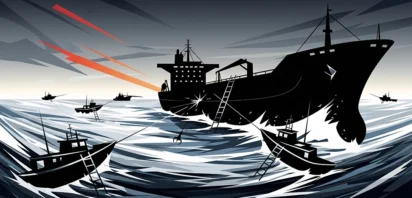
While global attention remains fixed on the Red Sea crisis and Yemen’s Houthis, a quieter but more profound threat is unfolding: Israel’s repeated attacks on aid ships bound for Gaza. These assaults not only deepen the humanitarian crisis in the enclave but also challenge one of the most fundamental principles of international law—the freedom of navigation in international waters. The latest incident, Israel’s naval assault on the Madelene on June 9, 2025 a vessel carrying humanitarian supplies and human rights activists—offers a clear example of this aggressive pattern. In direct violation of the UN Convention on the Law of the Sea (UNCLOS), Israel continues a decades-long strategy of siege and collective punishment that targets not only civilians but also global maritime security.
Since imposing its blockade on Gaza in 2007, Israel has repeatedly intercepted and attacked civilian vessels delivering humanitarian aid in international waters. The most notorious case remains the 2010 assault on the Mavi Marmara—part of the Gaza Freedom Flotilla—where Israeli commandos killed nine peace activists, sparking global outrage and condemnation by the UN Security Council. This was far from an isolated incident. In 2011, ships such as the Rachel Corrie and Dignity were intercepted and their passengers detained. In 2015, the Marianne—part of the third Freedom Flotilla—was similarly seized and towed to Ashdod without any evidence of weapons on board. The attack on the Madelene in 2025, then, is not an anomaly but part of a longstanding Israeli strategy: sever Gaza’s lifelines and intimidate humanitarian actors.
Violations of International Law and Threats to Maritime Freedom
The principle of freedom of navigation, enshrined in UNCLOS (1982), is a cornerstone of global order that enables international trade and humanitarian cooperation. Israel’s assaults on civilian vessels—like the Madelene, which carried food, medicine, and medical equipment—constitute a direct violation of this principle. These ships, often flying the flags of neutral countries such as Malta, pose no military threat. Their sole aim is to alleviate the suffering of Gaza’s 2.3 million residents living under crippling siege.
Israel justifies the attacks by claiming that it is trying to prevent weapons smuggling to Hamas. Yet the absence of credible evidence and the repeated targeting of humanitarian shipments suggest a deeper goal: the collective punishment of Gaza’s population and the suppression of international solidarity. These actions send a chilling message to the world: any ship seeking to deliver aid to Gaza risks being attacked. This not only discourages humanitarian organizations from acting but also undermines confidence in the safety of international waters.
By contrast, while the Houthis’ actions in the Red Sea are illegal, they are explicitly framed as retaliatory and have targeted only ships linked to Israel. After a temporary ceasefire in Gaza in January 2025, Houthi attacks on unrelated vessels sharply declined. When Israel resumed restrictions, those attacks resumed. The difference is clear: the Houthis’ actions are reactive and potentially negotiable. Israel’s assaults appear structural, unrestrained, and aimed at entrenching the siege.
Ceasefire in Gaza: A Path to Regional De-escalation
A political solution in Gaza could immediately de-escalate Red Sea tensions. The Houthis have repeatedly declared that their maritime operations are responses to the Gaza blockade and Palestinian suffering. The January 2025 ceasefire, brokered by Egypt and Qatar, demonstrated this link: during the truce, attacks on non-Israeli ships ceased and Red Sea trade routes gradually resumed. This confirms that a lasting ceasefire and lifting the blockade could not only ease humanitarian suffering but also contribute to regional maritime security.
Israel, however, continues to escalate by attacking aid ships and reinforcing the siege, undermining any momentum toward peace. These policies destabilize the region and isolate Israel further in the court of global public opinion. UN reports show that over 70% of Gaza’s population faced severe food insecurity in 2025, with Israeli-imposed restrictions on aid being a key driver of the crisis. Instead of facilitating relief, Israel’s attacks on civilian vessels mark it as a barrier to peace and international security.
Diplomatic Contradictions and Israel’s Growing Isolation
US support, particularly in the UN Security Council, has enabled Israel to persist with these tactics. Washington’s veto of ceasefire resolutions, including in December 2024, reflects unconditional backing. Yet this support is increasingly out of step with global sentiment. European nations like Norway, Spain, and Ireland recognized Palestinian statehood in 2024, and massive protests in Western cities signal a shifting public mood. Even traditional allies like the UK and Canada have expressed concern over the attacks on aid ships and called for independent investigations.
This contradiction—Israel claiming self-defense while violating international law—cannot hold indefinitely. Activists like Greta Thunberg, who was aboard the Madelene, have drawn worldwide attention to Israel’s actions, increasing international pressure. These calls, echoed by global leaders such as the UN Secretary-General and Pope Francis, show the world’s growing demand for an immediate ceasefire. Israel, by continuing its attacks, not only undermines these efforts but also risks becoming the subject of a global wave of condemnation.
From the Mavi Marmara in 2010 to the Madelene in 2025, Israel’s attacks on humanitarian ships form a consistent pattern—one that intensifies Gaza’s suffering and threatens the safety of international waters. While Houthi attacks in the Red Sea are linked to the blockade and potentially containable through ceasefire, Israel’s assault on civilian ships lacks legal or moral justification and has become a source of global instability.
The world now faces a defining choice: to support a lasting ceasefire and the lifting of Gaza’s blockade—which could usher in regional peace and maritime security—or to remain silent in the face of what amounts to modern-day piracy. The international community, especially Western powers, must act decisively to pressure Israel to end attacks on civilians and allow unhindered humanitarian aid. Only then can we hope for a safer, more just global order.
The views expressed in this article belong to the author(s) alone and do not necessarily reflect those of Geopoliticalmonitor.com.