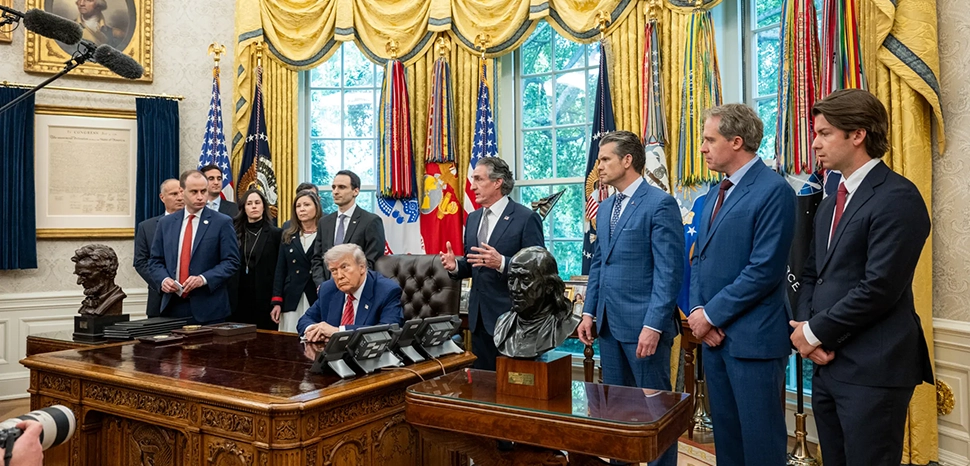
When US president Donald Trump signed a slate of executive orders earlier this year to accelerate the deployment of nuclear reactors in the United States, the announcement was framed as part of a broader “energy dominance” agenda. Nuclear, long mired in regulatory delays and public skepticism, is now recast in Washington as a cornerstone of national energy security.
At almost the same moment, Kazakhstan broke ground on its first nuclear power plant. In his speech on September 26, President Kassym-Jomart Tokayev called the project “only the beginning of a much larger effort” to build not just a single station, but a competitive nuclear industry that can underpin the country’s long-term security and growth. That parallel is no coincidence. Both the United States and Kazakhstan are wrestling with a similar dilemma: how to keep the lights on in an era of surging demand while meeting increasingly fraught decarbonization commitments.
Energy security will be one of the topics discussed at the US-Central Asia Summit on November 6 in Washington with the participation of President Donald Trump and the leaders of the five Central Asian states.
The United States operates 94 nuclear reactors but produces little uranium of its own. Kazakhstan, by contrast, has no operating commercial reactors but supplies roughly 24% of the fuel used in US plants. The implication is that Kazakhstan is no longer merely a raw material supplier. Its ambition is to move up the value chain, develop nuclear science and technology at home, and expand into nuclear power plants, advanced research, and radiation technologies.
The decision was based on a nationwide referendum last year. More than 70 percent voted in favor, giving Tokayev the political mandate to advance. Kazakhstan’s nuclear ambitions are part of a broader strategic framework laid out in the “Concept for the Transition to a Green Economy,” a long-term plan that commits Astana to modernizing energy and infrastructure while steadily lowering emissions. It sets phased targets for cutting energy intensity, boosting renewables, and ultimately reaching carbon neutrality by 2060. The nuclear program is a key pillar of that transition.
The first nuclear plant is planned to be completed in the mid-2030s. President Tokayev also emphasized the need to integrate Kazakhstan into global nuclear research – from thermonuclear fusion to nuclear materials science – to attract investment and technology transfer.
Nuclear is only one pillar of Kazakhstan’s energy architecture. Coal remains the bedrock. With annual production of nearly 113 million tons, Kazakhstan is one of the world’s top ten coal producers, and coal-fired plants account for more than 60 percent of electricity generation. For Tokayev, this a “strategic asset” that must be managed rationally.
The president’s message was that while renewable projects are often expensive and can disrupt ecosystems, new technologies make it possible to clean coal efficiently, reducing environmental damage while keeping costs low. In his words, coal will remain the foundation of a sustainable and affordable energy future for Kazakhstan.
Expanding supply quickly is a necessity. Renewable energy projects, though part of the mix, are unlikely to scale fast enough to fill the gap.
The tension between climate pledges and energy pragmatism is evident. Kazakhstan officially maintains its commitment to full decarbonization within the next 35 years, with carbon neutrality targeted for 2060. Incremental progress is visible: reductions in gas, a growing number of solar and wind projects, and now a move toward nuclear. The direction is thus set.
The US–Kazakhstan Nexus
For the United States, Kazakhstan’s balancing act may sound familiar. President Trump’s current energy policy has tilted back toward oil, gas, and coal, even as his administration seeks a nuclear renaissance to guarantee baseload reliability. State-level politics, from West Virginia to Texas, reflect the same dilemmas Tokayev articulated in Astana: energy security, affordability, and sovereignty often outweigh the allure of green targets.
In both Washington and Astana, leaders see nuclear as the only scalable option to square the circle, delivering reliable power while keeping carbon promises, however flexible those may be. Both also see fossil fuels as too strategically valuable to abandon.
What makes Kazakhstan’s story directly relevant to the United States is not just the similarity of dilemmas, but the material ties that already exist. Without nearly a quarter of the uranium from Kazakhstan fueling US reactors, America’s nuclear fleet would be far less secure. France’s reliance is even greater. Kazakhstan is becoming not just a supplier but a strategic partner in ensuring the resilience of allied nuclear power.
There is scope for cooperation beyond raw fuel. The United States and Kazakhstan recently signed a joint statement on nuclear safety at the IAEA, reaffirming decades of collaboration that began with Project Sapphire in the 1990s, when Washington helped secure and remove weapons-grade uranium from Kazakh territory. Expanding this cooperation into areas like SMRs, nuclear materials science, and regulatory frameworks would align with both countries’ priorities.
Kazakhstan’s energy trajectory is not straightforward. Building a nuclear industry from scratch, maintaining coal as a strategic pillar, and promising carbon neutrality by 2060 is a complex diplomatic act testing the country’s institutions and financial resources.
Both Washington and Astana are trying to reconcile rising demand with decarbonization pledges, and both are rediscovering nuclear power as a centerpiece in their strategies. Furthermore, Kazakhstan is a major piece in the global energy puzzle supplying American reactors today and could, in the future, become a far greater partner in nuclear technology and research.
The symmetry between Washington’s nuclear push and Astana’s nuclear turn is a reminder that the two countries have more in common and more at stake together than many might assume.
The views expressed in this article belong to the author(s) alone and do not necessarily reflect those of Geopoliticalmonitor.com.