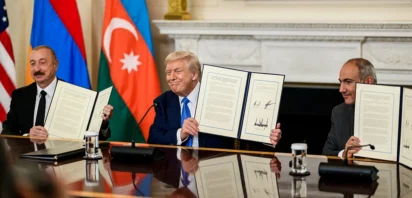
On 8 August, the leaders of Armenia and Azerbaijan stood at the White House alongside the president of the United States to sign a joint peace agreement. It was a landmark moment in the South Caucasus, committing the two neighbors to respect each other’s sovereignty, restore diplomatic relations, and open transport links, including a new corridor linking Azerbaijan to its Nakhchivan exclave through southern Armenia, which are separated by a 32-kilometer-wide strip of Armenian territory. The agreement also formally closed the OSCE Minsk Group process, long the main international mediation channel.
Such summits inevitably dominate headlines. The Washington ceremony was the decisive act that moved the peace process from aspiration to reality. Yet, as with most diplomatic breakthroughs, the final agreement was only the tip of the iceberg. Beneath it lay a long, often unglamorous sequence of smaller steps, technical talks, and confidence-building measures, many facilitated by states with less geopolitical weight than the United States, but with the neutrality to bring adversaries to the table.
The Armenia–Azerbaijan peace track illustrates this dynamic well. From early 2024 to the agreement in August 2025, a series of engagements – some public, some behind the scenes – built the scaffolding that Washington could ultimately finish. Among these, the May 2024 meeting in Almaty, Kazakhstan, stands out as an example of “incremental diplomacy.”
What Happened in Almaty
Before the Almaty meeting, foreign ministers Ararat Mirzoyan of Armenia and Jeyhun Bayramov of Azerbaijan had already restarted dialogue in Berlin in February 2024. In April, Armenia’s border commission agreed to return four abandoned villages to Azerbaijan, an unpopular step in Yerevan, but one that reduced immediate friction and allowed technical talks to advance.
Kazakhstan’s offer to host the next round carried symbolic weight. Almaty was the site of the 1991 Alma-Ata Declaration, in which post-Soviet states affirmed mutual recognition of their borders. Kazakhstan has spent the past two decades cultivating a reputation as a neutral convenor: hosting the “Astana Process” talks on Syria, a negotiation track launched in 2017 between the Syrian government and opposition, co-sponsored by Russia, Türkiye, and Iran to complement UN-led peace efforts; initiating and providing a platform for the Conference on Interaction and Confidence-Building Measures in Asia (CICA), a 28-member intergovernmental forum aimed at enhancing cooperation and trust across Asia; chairing the Shanghai Cooperation Organization (SCO) summit; and facilitating the P5+1 nuclear negotiations with Iran in 2013.
That neutrality is rooted in what Kazakh officials call a “balanced” foreign policy – maintaining good relations with Washington, Brussels, Moscow, Beijing and beyond. For mediators, this is a rare commodity: great powers often carry too much baggage, with one or both parties fearing partiality. Smaller or middle powers with no direct stake in the dispute can offer a trusted space.
On 10–11 May 2024, the Armenian and Azerbaijani foreign ministers met in Almaty with their Kazakh counterpart. According to the joint statement, they “welcomed the progress in the delimitation of borders” and “continued discussions on the provisions of the draft bilateral Agreement on the Establishment of Peace and Interstate Relations,” agreeing to keep negotiations going. Mirzoyan described the talks as having taken place “in a constructive atmosphere,” while Bayramov expressed hope they would “contribute to the settlement process.”
The two sides agreed on which historical maps to use for border delimitation, a technical but critical step. Kazakhstan’s role here was not to mediate the substance of the dispute, but to offer a venue where substantive technical work could be done in relative calm. In that sense, Almaty was a confidence-building waypoint.
Other Quiet Contributors
Kazakhstan was not alone in this supporting role. In April 2025, Georgia hosted a trilateral meeting of deputy foreign ministers from Armenia and Azerbaijan, a format designed to explore practical cooperation. Tbilisi’s geographic proximity and relationships with both sides make it a natural low-ego convenor.
Switzerland, working through the Inter-Parliamentary Union (IPU), offered a parliamentary track in late 2024 to keep communication open at another level. The European Union, meanwhile, kept the process nudged along through Brussels-based leader meetings, even when progress slowed.
These efforts rarely make front pages, but they keep the channels open, sustain momentum, and normalize the idea that dialogue is possible.
By March 2025, Armenian and Azerbaijani officials publicly stated that the text of the peace agreement was complete, with remaining issues in the political domain, including constitutional questions in Armenia. The stage was set for a closing act. The United States, leveraging its diplomatic weight and ability to offer security and economic incentives, provided that act in Washington this month.
In that sense, the pipeline ran from the Almaty meeting to EU nudging and the Georgia forum, then to text closure, and finally to the Washington signing. Each stage depended on the last; skip one and the structure might have collapsed.
Lessons for Mediation in a Multipolar World
The Almaty meeting and its counterparts in Tbilisi and Geneva provide several lessons.
First, neutral middle powers have a real role in conflict resolution. They may not be able to impose terms or offer vast aid packages, but they can create space for technical progress when trust is too low for the parties to meet in a great-power capital.
Second, technical progress matters. Agreements on maps, legal formulations, or the sequencing of steps are not glamorous, but without them, political leaders have nothing to sign.
Third, persistence is key. In protracted disputes, there is rarely a single “magic meeting.” Success is cumulative, the product of sustained engagement by multiple actors over time.
The United States deserves credit for bringing the parties together at the highest level and closing the deal. But the ceremony on 8 August was built on a foundation laid by others – in Almaty, Tbilisi, Geneva, Brussels, and elsewhere.
States like Kazakhstan and Switzerland will continue to be essential in a multipolar world where great-power rivalries often hinder direct negotiation. Neutral venues, technical progress, and persistence remain the quiet tools that make peace possible.
Emil Avdaliani is a professor of international relations and the history of diplomacy at European University in Tbilisi, Georgia. His research focuses on the Silk Road and the interests of world powers in the Middle East and the Caucasus.