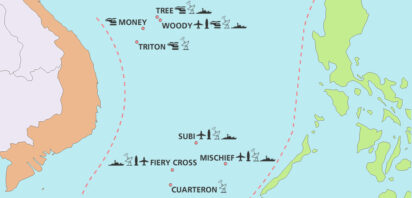
Over the past few years, China has begun to transition away from its ‘peaceful rise’ strategy, which called for fostering an international environment that’s amenable to economic expansion; or in other words, not rocking the boat of the prevailing US-led order in East Asia. A centerpiece of this policy shift has been to push the PLA Navy’s advance defense perimeter out from the coastline and towards the ‘first island chain’ (spanning down from Kyushu Island in Japan, east of Taiwan, and all the way to the western coast of Malaysia). There are two keys to the successful realization of Beijing’s maritime goals: controlling Taiwan, and expanding into the waters of the South China Sea.
Taiwan being the intractable dilemma it is, it’s no surprise that the authorities chose to start with the South China Sea. Broadly speaking, China has adopted a two-pronged strategy: to unilaterally change the situation on the ground in a way that strengthens its claim to area, and to deal with other claimants on a strictly bilateral basis, outside the jurisdiction of any multilateral forum that could allow for their grouping up against China (ASEAN or the United Nations, mainly).
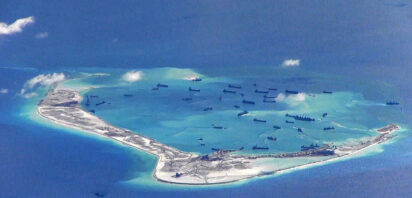
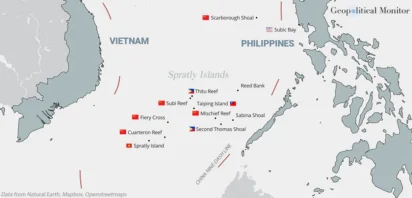
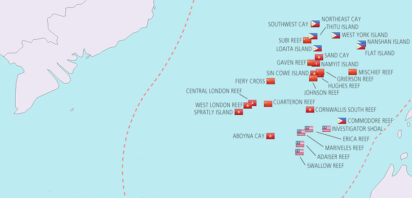
China has been strengthening its claim to the area through a controversial island-building program whereby tons of sand are dumped onto preexisting reefs, allowing for the construction of new military and civilian facilities. Construction is taking place at a variety of sites, including Hughes, Johnson South, McKennan, Gavin, Subi, Mischief, and Fiery Cross reefs. The most ambitious construction thus far is taking place at Fiery Cross Reef, where a runway was completed in September 2015 and several flights have recently landed, prompting angry responses from the Vietnamese government. Fiery Cross will likely serve to project the basing of China’s local maritime patrols outward from Hainan Island at the northern end of the South China Sea.
Beijing’s strategy is to build up its military infrastructure and expand patrols throughout the entirety of the South China Sea Nine-Dash Line area, such that even if rival claimants (Vietnam, Malaysia, Philippines, Taiwan, Brunei) receive international or judicial validation for their claims, the ‘court of realpolitik’ will already have decisively ruled in China’s favor.
International forums, notably ASEAN, have proven unable to resolve the issue so far. Negotiations on a shared code of conduct in the South China Sea have been ongoing for over a decade within ASEAN, which is precisely the lack of accord among rival claimants that benefits China’s approach. Chinese diplomats have proven adept at thwarting ASEAN’s effectiveness as a counterbalance to China’s moves in the South China Sea. They’ve done so by cherry-picking a country to play the spoiler role within ASEAN’s consensus decision-making framework. Cambodia played the part in 2012, when the ASEAN summit failed to issue a joint communique over disagreements on the South China Sea. Cambodia has since gone onto put itself forward as an ‘impartial’ mediator on the issue, but a consensus is forming that, should the South China Sea issue be resolved via negotiations, it definitely won’t be happening under the auspices of ASEAN.
The Philippines has opted for a different route entirely and taken its case to the International Court of Justice at the Hague, but even if the court rules in Manila’s favor it’s guaranteed that China will not implement the decision.
Outlook
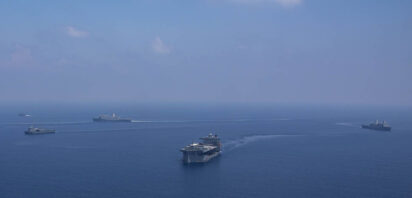
The South China Sea is an issue that will not be going away. It will continue fester for years, even decades, and with each passing moment there’s the risk of a crisis as military, coast guard, and civilian vessels operate in close proximity without any shared operational guidelines.
The root of the problem is that no party will be backing down anytime soon.
China sees the entire South China Sea as its superpower patrimony. The waters are strategically important from a defense standpoint, especially while Taiwan remains outside of Beijing’s writ. The PLA Navy’s free use of the South China Sea pushes China’s defense line out towards the Straits of Malacca, a crucial energy trade route and flashpoint in any hypothetical conflict with the US Navy. Before China’s expansion to fill out the nine-dash line, the PLA Navy was essentially blocked in by Taiwan and Okinawa, which itself is home to a large US naval base. Securing the South China Sea creates breathing space and – depending on the extent of the subsequent military buildup – could allow China to protect its southern flank in the event of a military clash over Taiwan.