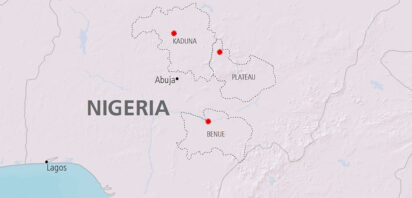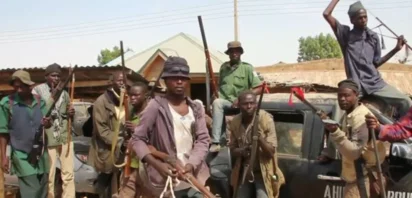
That the Boko Haram-led insurgency in northern Nigeria has remained outside the purview of Western headlines – save a few cameos following particularly heinous attacks – is not indicative of the severity of the crisis facing Abuja, but rather a pervasive and unfortunate lack of attention paid to political life on the African continent. In truth the situation in northern Nigeria is going from bad to worse, and there is no reason to believe that Boko Haram couldn’t make a breakthrough in 2015 similar to what Islamic State achieved in Mosul last year.
Background
Boko Haram (lit. ‘Western education is prohibited’) can be thought of as an extreme manifestation of Nigeria’s stark north-south divide. It is a fundamentalist Islamic paramilitary group that operates in Nigeria’s predominantly-Muslim north. Founded in 2002, the militant group has been very successful at taking advantage of local dissatisfaction towards the government’s economic policies and hard-handed tactics to swell its ranks.
Throughout 2014, Boko Haram has been intensifying its fight against the Nigerian government. In April it kidnapped over 200 girls from a school in Chibok in northern Nigeria, many of whom have yet to be found. It planned and executed large-scale terrorist attacks throughout the year, such as an attack in the national capital of Abuja that killed 88 people at a bus station. In response to mounting international pressure and the brutality of the attacks, the Nigerian government launched a military offensive against the group in the latter half of 2014. The operation was a failure. Boko Haram used its familiarity with local surroundings to melt away ahead of army advances, and several instances of brutality by government troops served to further alienate local populations that were already hesitant to cooperate, fearing Boko Haram reprisals when government troops eventually pulled out.
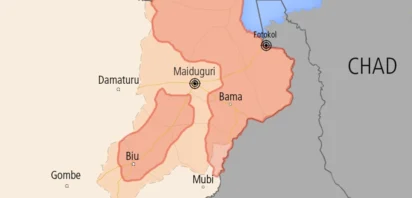
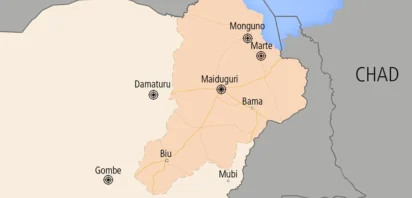
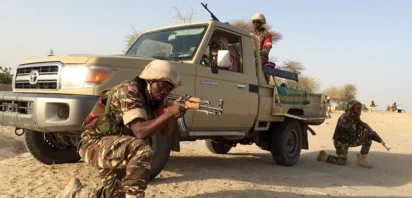
The militant group kicked off 2015 with a resounding victory along the Nigeria-Chad border. In a scene reminiscent to the fall of Mosul, Boko Haram fighters took over a military base in Baga, the scene of a well-publicized army massacre that transpired in 2013. The base housed troops from the Multi-National Joint Task Force (MNJTF), an anti-drug trafficking turned anti-Boko Haram multinational force comprised of soldiers from Nigeria, Chad, and Niger. Local residents reported soldiers dropping their weapons and running from the city when faced with a Boko Haram push from three directions.
Outlook
Whether goals, modus operandi, or the respective groups’ fortunes of late – there are many similarities between Boko Haram and Islamic State. One disconcerting similarity is the possibility that Boko Haram could ‘snowball’ similar to how Islamic State did, with one major victory paving the way for a vast territorial foothold. The fall of the Baga military base is illustrative here. Rather than risk an all-out offensive, Boko Haram fighters stood at the edges of the city and fired off heavy guns in order to scare local residents and troops. The plan succeeded, and this shows us that Boko Haram, like Islamic State, can be highly effective despite its relatively small numbers. Just as the predominantly Shiite troops ran from the Sunni city of Mosul in mid-2014, Nigerian forces stationed in the north are too-often heavy-handed and disconnected from the local reality, making them first to wither under Boko Haram’s brutality.
That 2015 projects to be a bad year in the fight against Boko Haram is not solely because of the group’s string of victories over the second half of 2014. Nigeria is an oil exporter that derives 75% of its government revenues from its energy sector. The new national budget has been slashed twice as prices plunged, and even the most recent revision in December predicts a price of $65 a barrel – over $15 more expensive than the current figure. Furthermore, 2015 is an election year which means the potential for large-scale attacks in the lead-up to voting and flaring sectarian tensions as the religiopolitical cleavage between Nigeria’s north and south is once more laid bare.
Boko Haram is already on the ascendance and all indications point to the government needing to scale back its efforts against the group due to financial constraints. 2015 will be a key year for the fight against Islamic extremism in Nigeria.