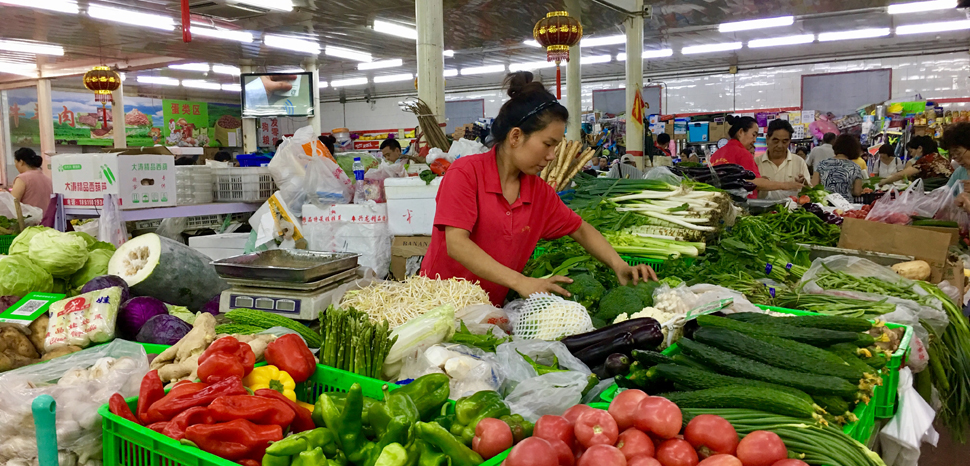
COVID-19 is upending well-oiled national, regional, and global supply chains, producing higher prices in food markets around the world. Food inflation hasn’t discriminated, impacting developed and developing countries alike, but the consequences certainly have, depending as they do on a variety of social, political, and economic factors.
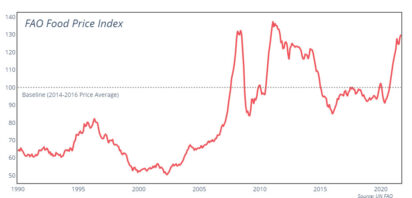
The trend of rising food prices pre-dated the COVID-19 pandemic, as global prices were already hovering near a five-year high in December of 2019.
Here’s how food inflation is manifesting in countries around the world:
Analysis
China
The Chinese authorities were struggling to keep pork prices under control toward the end of 2019; then COVID-19 hit.
One recent survey from Qufu Normal University found that over 60% of village respondents were pessimistic or very pessimistic about the planting season in China. One analyst cited by Financial Times went so far as to say that China’s agricultural industry had “collapsed” due to the domestic supply chain impact from COVID-19. A sharp decline in migrant labor flows – the lifeblood of China’s agricultural industry – has hit farmers particularly hard.
Consequently, food prices in China spiked by 21.9% year-on-year in February, after a 20.6% gain the month before, according to Wind Data Service. The inflationary trend moderated in March as the economy was slowly brought back online, but not by much: that month saw an 18.3% increase in food prices. The rate eased further in April, which recorded a 14.8% increase. All of the above numbers come from China’s National Bureau of Statistics and should be qualified with the disclaimer that food prices are considered sensitive information in the People’s Republic of China, and thus are subject to distortion by state and Party authorities. In other words, it’s possible that the problem is worse than it already appears.