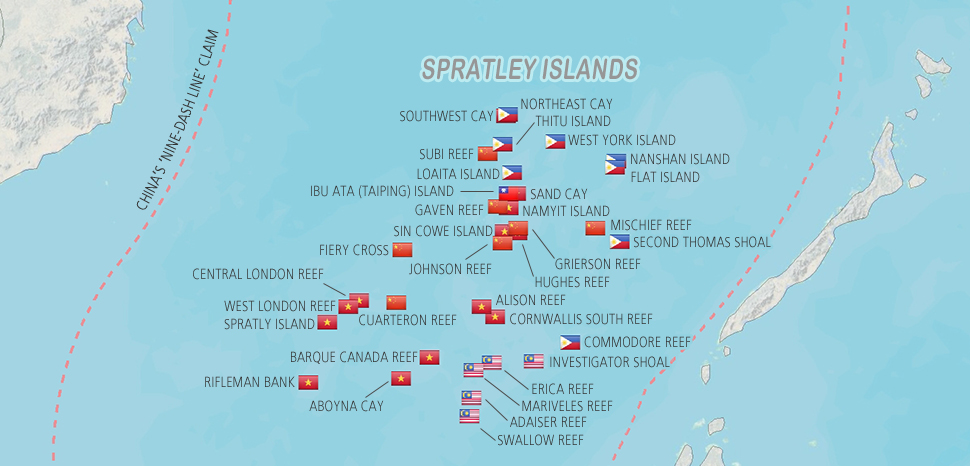
In recent weeks, the stance of President Rodrigo Duterte on the South China Sea dispute appears to have undergone a remarkable about-turn. Having downplayed the row for most of his presidency, on 23 September Duterte said for the first time that he backs the 2016 arbitral ruling which legitimized the Philippines’ rights in the sea and declared China’s nine-dash line claim invalid. Philippine naval chiefs have since discussed creating a ‘maritime militia’ to deter Chinese boats in disputed waters, while in October Duterte lifted a six-year moratorium on energy exploration in the region.
These events signal an end to the Philippines’ broadly accommodative approach toward China, which had surprised many given that, during the 2016 election campaign, populist Duterte had pledged to personally defend the Philippines’ sovereignty by riding a jet-ski to the disputed islands and planting the Philippine flag. The controversial leader appears to have reverted to his original stance, yet his rhetoric this time round is noticeably more muted. The reasons for Duterte’s careful approach lie mainly in domestic politics—where growing demands to take on China are still tempered by the economic benefits of close ties with Beijing.
2016 Arbitration Ruling on South China Sea
Duterte revealed his change in perspective in a virtual address to the UN General Assembly in September, when he declared the 2016 ruling at The Hague to be ‘international law, beyond compromise and beyond the reach of passing governments to dilute, diminish or abandon,’ adding the Philippines ‘rejects attempts to undermine’ it. The tribunal found that China had ‘no historical rights’ to the waters while asserting that the Philippines had exclusive rights to claim natural resources within 200 nautical miles of its coastline.
In July, the Department of Foreign Affairs had released a statement supporting the ruling, which reinforces the rules enshrined in the UN Convention on the Law of the Sea, for the first time since Duterte assumed office.
Just last year, Duterte remarked that he would ‘set it aside’ in favor of bilateral talks with Beijing over joint energy development offshore, indicating he would be prepared to sideline the Philippines’ territorial claims in favor of ‘economic activity’ at sea and investment from Beijing for infrastructure projects on land.
A Philippine Fishing Militia?
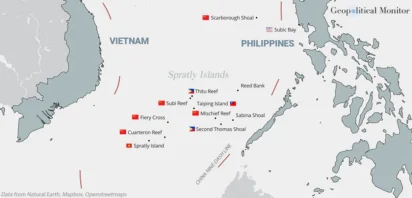
Duterte often views things in matter-of-fact terms, and expresses his opinions bluntly. In reference to the South China Sea during his last state of the nation Address, Duterte stated ‘they [China] are in possession of the property,’ calculating ‘China has the arms. We do not have it. It is as simple as that.’ Military chiefs in Manila, however, do not view tackling China’s militarization in the region as a lost cause, as evidenced in their apparent enthusiasm following Duterte’s UN speech in September. The navy is reportedly looking to establish two new outposts near Reed Bank, while there has been talk recently of arming a civilian maritime militia.