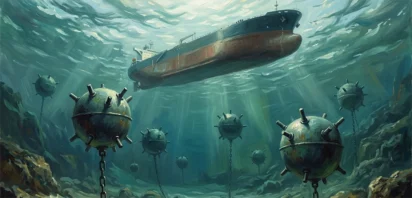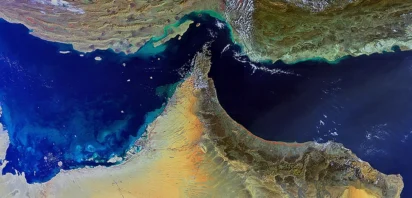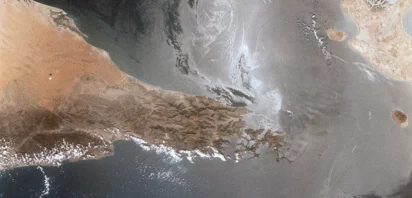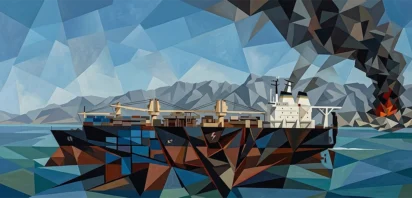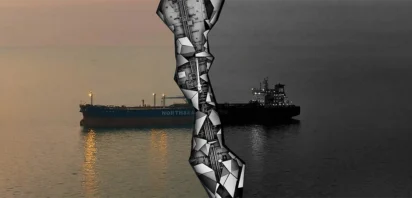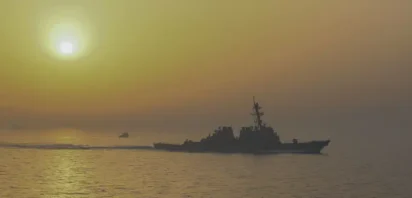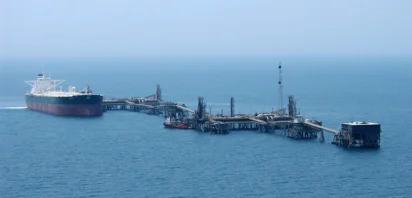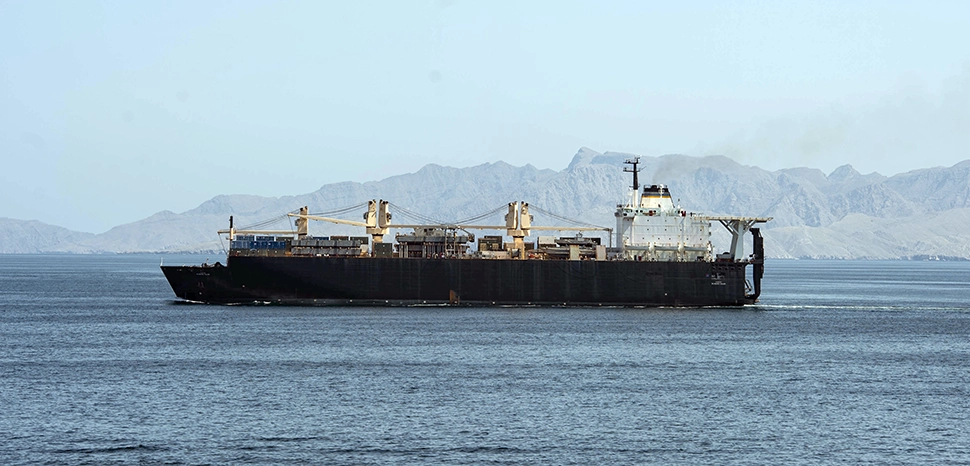
On February 28, within 48 hours of the US-Israeli strikes on Iran, a committee convened in London. It was not a government body. No parliament had appointed its members. No foreign ministry had instructed it. The Joint War Committee redesignated the entire Arabian Gulf as a conflict zone, and war risk premiums surged to sixty times their pre-crisis rates. Tanker traffic through the Strait of Hormuz collapsed by 95 percent. No shot had been fired at an insurance syndicate. An actuarial table closed what Iran’s navy had not yet managed to close on its own.
Iran saw this. It studied it. Then it built the mirror institution.
On May 16, while negotiators in Islamabad argued over memorandum language, Iran’s Ministry of Economy launched “Hormuz Safe” — a maritime insurance platform running on Bitcoin and stablecoins, accepting payment in Chinese yuan, designed so that no treasury department on earth can freeze its accounts. Tehran’s own estimates place the platform’s potential annual revenue at ten billion dollars. The name is polished and the function unambiguous: those seeking safe passage through the Strait may purchase “security” from the only party that defines what the risk is.
A Committee No Tanker Can Ignore
The Joint War Committee appears in no international treaty. The UN Charter does not mention it. UNCLOS does not reference it. No maritime convention grants it authority. Its authority derives from something older than law: no bank, shipping company, or port will accept a vessel entering a war risk zone without appropriate coverage. When the JWC raises its classification, underwriters raise premiums, shipping agents raise surcharges, and captains refuse orders. No single decision closes the Strait — a cascade of independent commercial decisions produces the closure.
This mechanism has been described elsewhere as “diffuse accountability”: Hormuz was closed without a single identifiable actor who could be held responsible. But the other side of that equation has never been written. When Iran wants to open the Strait conditionally — for those who pay, to those it chooses — it needs an institution that produces “conditional opening” by the same commercial logic that produced closure. An institution that tells a vessel: you are covered here, provided you are registered with us.
“Hormuz Safe” is that institution. And it is a more precise instrument than it first appears. Where Lloyd’s war risk policies cover destruction and casualties, Hormuz Safe covers something different: vessel inspection, detention, and confiscation — the exact categories of risk that Iran itself controls. Lloyd’s prices the danger of being sunk. Iran prices the danger of being stopped. These are not competing products. They are complementary layers of the same chokepoint architecture, and Iran has now built both sides of the transaction.
The Layer No Text Covers
In a previous analysis published in Geopolitical Monitor, I proposed a framework for the layers of maritime control at Hormuz. Mahan theorized military sea power. Shaybani codified transit rights and the law of passage. The 2026 crisis added a third layer — insurance sovereignty — when a London committee closed the Strait before the IRGC fired its first drone. A subsequent paper introduced a fourth: settlement sovereignty, where whoever writes the ceasefire text controls the legal reality of the waterway.
“Hormuz Safe” adds a fifth layer that neither Mahan nor Shaybani contemplated: decentralized financial infrastructure. It is the first layer of international strait governance in history that no state can shut down with a signature. The US Treasury has no mechanism to freeze a Bitcoin wallet the way it freezes a correspondent bank account. Sanctions lists were not designed to target pseudonymous cryptographic addresses. No SWIFT intermediary can block a stablecoin transfer.
Washington has tried. In late April, American authorities froze hundreds of millions of dollars in crypto assets linked to Iranian entities. The countermove is telling: the US now fights on the Bitcoin battlefield because Tehran forced it there. But the structural asymmetry holds. A correspondent bank account, once frozen, cannot be replaced in seconds. A Bitcoin wallet can. The cost of generating a new cryptographic address is zero. The US is playing whack-a-mole against an opponent who can produce new holes faster than any enforcement action can close them. The arms race belongs to the side that can regenerate at no cost.
Ibn Khaldun observed in the Muqaddimah that whoever controls the exchange of goods controls the political authority over the territory — because commerce is not merely economic activity but the infrastructure from which states draw their practical legitimacy. Hormuz 2026 embodies that observation in a form he did not foresee: when a cryptographic platform subject to no jurisdiction becomes the practical key to transit rights, maritime sovereignty migrates to a terrain that has no map.
The Blind Spot in the MOU
The American draft of the memorandum of understanding reportedly states that passage through the Strait of Hormuz will be “unrestricted, with no tolls and no Iranian interference.” A clear sentence. But the MOU does not name “Hormuz Safe.” It does not require Iran to dissolve it. It does not address the maritime insurance platform launched by the same party negotiating the memorandum.
That silence is not an oversight. It is the gap in which the platform survives the agreement.
There is a further complication. The London insurance market will not normalize Hormuz the moment a ceasefire is signed. Industry analysts expect a lasting risk premium for years, because the crisis demonstrated to every actuarial model that closure is possible — and that knowledge is now permanently priced in. As of May 5, JMIC still rated the Arabian Gulf and Strait of Hormuz as CRITICAL maritime risk areas. When traditional Lloyd’s premiums remain elevated and “Hormuz Safe” offers coverage on Iranian terms for the specific risks Iran controls, the market will do what markets do: calculate the cheaper option, whatever the conditions attached to it.
Yuan and Bitcoin: A Coordinated Architecture
On May 2, China invoked its blocking statute for the first time in its history, compelling domestic companies to defy US sanctions on refineries purchasing Iranian crude. In mid-May, “Hormuz Safe” accepts payment in Chinese yuan or Bitcoin — not dollars.
These two developments are not coincidental. The blocking statute protects Chinese companies from US sanctions at the legal level. “Hormuz Safe” provides the payment mechanism outside SWIFT and the dollar-denominated banking system at the technical level. Together they produce a parallel financial architecture for commerce through the world’s most critical waterway — one that Washington’s available instruments cannot fully reach.
On June 1, Iran suspended talks entirely, citing Israel’s operations in Lebanon. The ceasefire frays. US forces struck Iranian radar sites on Qeshm Island on June 5. Through each breakdown and each escalation, “Hormuz Safe” and the blocking statute continue to operate. The parallel financial architecture is not contingent on negotiations succeeding. It was designed to outlast them.
When the Idea Spreads
Hormuz is not the final examination. If “Hormuz Safe” survives the MOU — if the platform continues operating after the agreement is signed and the mines are cleared — it will have demonstrated that a sanctioned state can build its own maritime financial infrastructure, bypassing Lloyd’s, the dollar, and sanctions simultaneously.
The lesson is portable. Moscow can study its application to the Baltic exits. Beijing can calculate its relevance to the South China Sea. Because the most durable instrument of strategic control does not require a missile. It requires a digital wallet, a blockchain settlement layer, and an algorithm that decides who passes — one that regenerates itself faster than any enforcement apparatus can pursue it.
What the Deal Leaves Running
The MOU will be signed, eventually. The Strait of Hormuz will formally reopen. Oil prices will fall. The press will announce the end of the crisis.
But “Hormuz Safe” will remain operational. China’s blocking statute will remain in force. Lloyd’s classification of Hormuz as a risk zone will remain embedded in every actuarial model for years. Three layers of parallel financial infrastructure, unaddressed by any clause in the memorandum under negotiation.
The question no one is asking in the coverage of these negotiations: what happens when the strait reopens officially but the financial architecture of Iranian sovereignty over it continues running in the background — silent, decentralized, and outside the reach of any jurisdiction?
Ibn Khaldun answered six centuries ago: whoever owns the market owns the ground beneath it. The Strait has not reopened. It has become a market.
Nayef Sha’aban is Research Director of the Applied Arab-Heritage Models Project at the Istiqlal Forum for Political and Strategic Studies (IFPSS Damascus), in collaboration with the Levant Centre for Studies and Research, London. He has published strategic analysis in Geopolitical Monitor, including “Five Years in the Drawer: Iran War, a Laboratory for China’s Sanction-Busting” and “Iran’s Lost Mines: How Accidental Weapons Will Settle Hormuz Sovereignty” (2026). He publishes at naifshaaban.substack.com
The original manuscript was written in Arabic. The English version was translated by Claude (Anthropic) at the author’s direction and reviewed by the author.