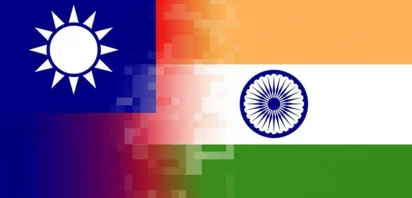
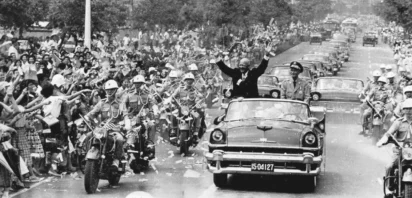
In February 2026, representatives of the Kuomintang (KMT) and the Chinese Communist Party (CCP) met in Beijing for another Think Tank Forum. The communiqué followed a familiar script: resume exchanges, revive tourism, expand industrial cooperation, manage differences through dialogue. Song Tao supplied the headline line: “兩岸關係終將冬去春來,家國團圓,未來可期.” Winter will pass; spring will return. Reunion is not only desirable, but inevitable.
The rhetoric was warm. The structure beneath it was not.
The 2026 forum was neither rupture nor renaissance. It was another turn in a century-long cycle of civil war and coexistence, denunciation, and pragmatism. KMT–CCP relations have never moved in a straight line. They swung from alliance to annihilation, from artillery duels to staged handshakes. Every thaw has the possibility of reversal.
To grasp the present, one must return to 1949 as institutional origin. The Republic of China (ROC) and the People’s Republic of China (PRC) did more than separate; they evolved along incompatible ideological and governance paths, reinforced by distinct socioeconomic transformations and international alignments. Over time, those differences hardened into identity, electoral logic, and regime legitimacy. They also set boundaries. The CCP cannot relinquish unification without striking at its ideological core. The KMT cannot move too close to Beijing without confronting an electorate increasingly protective of Taiwan’s autonomy.
The revived party-to-party channel reflects a recurring KMT instinct: engage without conceding, stabilize without resolving, defer sovereignty while securing practical gains. It is an effort to manage a divide neither side can reconcile, and neither can erase.
Song Tao’s metaphor casts history as seasonal and restorative. Cross-strait history has behaved less like climate than geology — pressure contained, friction managed, movement possible, but never cost-free.
Origins of the Divide: 1945–1949 and the Founding of Two Chinas
The divide across the Taiwan Strait did not begin as a policy disagreement. It began as a civil war that hardened into two states.
When the KMT lost the decisive campaigns of 1948–49, it did not surrender; it retreated. Chiang Kai-shek relocated the ROC government to Taiwan, carrying with him the constitutional framework of 1947, the gold reserves that could be salvaged, and the claim to represent all of China. On 1 October 1949, Mao Zedong stood in Beijing and proclaimed the founding of the PRC. Two regimes now asserted a single sovereignty.
The rupture was institutional from the start. The KMT envisioned China as a republic temporarily displaced but constitutionally continuous. The CCP framed China as reborn through revolution, purified of “feudal” and “bourgeois” remnants. Each claimed historical legitimacy; each denied the other’s right to exist.
Socioeconomic divergence followed immediately. On the mainland, the CCP launched sweeping land reform campaigns that dismantled landlordism and redistributed property, soon moving toward collectivization. Class struggle became a governing principle. Political loyalty and economic transformation fused. In Taiwan, by contrast, the ROC implemented its own land reform, less violent and more administrative, and stabilized the currency with substantial American assistance. US aid anchored Taiwan within a Cold War security architecture and bought time for economic consolidation.
These early choices created path dependence. On the mainland, mass mobilization and centralized planning strengthened party penetration into every level of society. On the island, martial law imposed political repression, yet the state preserved private enterprise and gradually nurtured export-oriented growth. One system fused party and state to remake society; the other subordinated politics to survival and economic recovery.
Military crises in the 1950s such as the shelling of offshore islands cemented separation. Each government entrenched its institutions while insisting it alone embodied “China.” What began as unfinished civil war evolved into a dual-state reality.
The tragedy, and the paradox, is that both sides initially believed the division was temporary. By acting as if reunification were inevitable, they built structures that made it increasingly remote.
Divergent Ideological and Governance Models: ROC vs. PRC
The political distance across the Taiwan Strait is not reducible to rhetoric or military posture. It is institutional and constitutional. It is embedded in how authority is organized and justified.
On Taiwan, the ROC evolved in ways few anticipated in 1949. After decades of martial law under the KMT, political reform accelerated in the late 1980s. Opposition parties such as the Democratic Progressive Party gained legal status. The press broke free of state supervision. Direct presidential elections began in 1996, and power alternated peacefully between parties. Courts asserted independence. Civil society groups learned to mobilize and influence legislation.
Taiwan’s system today rests on competitive elections, institutional checks and balances, and an electorate that expects accountability. Sovereignty is not abstract. It is exercised at the ballot box. The constitutional order assumes that legitimacy flows upward from citizens.
Across the Strait, the PRC institutionalized a different logic. The CCP did not merely govern the state; it fused itself with it. Leninist principles including democratic centralism, party supremacy, and cadre discipline structured authority from the outset. Economic reform under Deng Xiaoping loosened markets but did not dilute political monopoly. “Socialism with Chinese Characteristics” allowed experimentation in commerce while safeguarding one-party rule.
Under Xi Jinping, that architecture has tightened. Party committees permeate state agencies, private firms, universities, and media organizations. The People’s Liberation Army answers directly to the Party’s Central Military Commission. Surveillance technologies extend the state’s reach into daily life. Political campaigns emphasize ideological conformity and national rejuvenation.
These governance choices shape strategic behavior. A democratic Taiwan cannot bargain away sovereignty without electoral sanction. A Leninist party-state cannot abandon its unification claim without eroding its ideological core. Institutional design narrows diplomatic imagination.
Deng’s formula of “One Country, Two Systems” sought to bridge the divide. It promised autonomy under ultimate national unity. Yet the premise that sovereignty is singular and resides in Beijing collides with Taiwan’s lived constitutional reality. In Taipei, presidents derive authority from voters, not from delegated central permission. The system presumes pluralism; it tolerates dissent; it treats identity as contested and evolving.
The divergence has produced contrasting governance outcomes. Taiwan combined export-led growth with political liberalization, creating a prosperous, technologically advanced democracy. The PRC engineered one of the fastest economic transformations in history while constructing an increasingly sophisticated apparatus of political control. Both achieved modernization. They did so through incompatible political logic.
As long as Taiwan’s legitimacy rests on popular sovereignty and Beijing’s rests on centralized party authority, cross-strait engagement will remain structurally constrained. Dialogue may expand or contract, but neither side negotiates from a neutral constitutional baseline.
The real divide, then, is not simply national identity. It is the source of political authority itself. And that difference does not fade with warmer rhetoric; it hardens with institutional time.
Socioeconomic Forces and Path Dependence
The first phase of KMT–CCP interaction after 1949 was deterrence, not dialogue. In the 1950s and 1960s, artillery over Quemoy and Matsu replaced conversation. Each side claimed exclusive legitimacy: the KMT vowed to “retake the mainland” (反攻大陆), the CCP to “liberate Taiwan” (解放台湾).
These declarations defined regimes, not rhetoric. Cold War alignments hardened the divide: the ROC embedded in a US-led security architecture, the PRC anchored in the socialist bloc. Under these conditions, hostility was inevitable. Engagement would have demanded an existential concession, a relinquishing of sovereignty that neither could afford.
The second phase began in the late 1980s, as ideology yielded to economics. Taiwan democratized; the PRC opened markets. Businesses flowed across the Strait before politicians. Investment flowed into Fujian and the Yangtze Delta. Direct links expanded cautiously. Both sides discovered the utility of studied ambiguity: defer sovereignty disputes, expand functional cooperation. The 1992 Consensus, where there is “one China, respective interpretations,” was less a shared vision than a diplomatic tool. It allowed the KMT to uphold constitutional continuity while letting Beijing insist on “One China.”
The structural lesson was clear: engagement succeeded only when sovereignty questions were deferred. Ambiguity created political space; interdependence deepened without forcing resolution.
The high-water mark came under President Ma Ying-jeou. Between 2008 and 2016, agreements multiplied. Tourism surged; direct flights normalized once politically fraught contact. In November 2015, Ma met Xi in Singapore, the first leaders’ encounter since 1949. Ma stated “Both sides of the Taiwan Strait belong to one and the same China” (兩岸同屬一個中國). The phrasing, anchored in ROC constitutional language yet resonant with Beijing, symbolized the closest approximation of convergence in decades.
Its precision revealed fragility: the formula depended on ambiguity and collapsed when domestic legitimacy shifted. The 2016 DPP victory reflected a society wary of integration. Identity politics had changed. Simultaneously, US–China rivalry raised strategic stakes, stalling engagement. Dialogue built on deferred sovereignty proved reversible when domestic opinion hardened or external pressures intensified.
KMT–CCP relations moved in cycles, rather than linear progress. Hostility yielded to pragmatism; pragmatism peaked in symbolic theater; symbolism dissolved under political gravity. What persists is not convergence but constraint. Engagement survives not by resolving contradictions, but by managing them. It is an art dictated less by goodwill than by the shifting balance of identity, power, and time.
Yet even at its peak, engagement was constrained. Cycles of dialogue and thaw revealed persistent limits: structural differences, domestic pressures, and strategic imperatives continued to shape what each side could and could not do. These constraints set the stage for understanding the enduring challenges that define cross-strait relations.
Enduring Limitations and Challenges of Both Sides
Cross-strait engagement does not fail for lack of meetings. It falters because both sides operate within constraints they cannot shed. Some are self-imposed while others are structural. Together, they compress the space in which dialogue can function.
Self-Imposed Constraints
For the KMT, the core problem is credibility. It casts itself as Taiwan’s stabilizer, the only major party able to sustain dialogue with Beijing. Yet domestic politics complicates that claim. Factionalism persists. Local networks dilute strategic coherence. Under electoral pressure, message discipline slips.
The deeper challenge is generational. Younger voters increasingly identify as exclusively Taiwanese. For them, engagement signals not shared heritage but political risk. The KMT struggles to escape the “pro-China” label, even when it frames outreach as risk management. As a result, it leans heavily on economic deliverables including tourism, farm exports, student exchanges, to justify its approach. That reliance is precarious. When Beijing tightens the tap, the KMT’s argument weakens almost instantly.
Beijing faces its own limits. The CCP cannot dilute the “One China” principle without eroding its ideological foundation. Under Xi, unification is tied to national rejuvenation and party legitimacy. It is framed as destiny, not choice. Nationalist sentiment, amplified by state media, further narrows flexibility.
Equally constraining is the CCP’s failure to offer a model that appeals to Taiwan’s electorate. “One Country, Two Systems” now carries the shadow of Hong Kong. For voters accustomed to competitive elections and adversarial media, autonomy under party supremacy lacks credibility.
Externally Imposed Constraints
The most serious barrier to trust remains Beijing’s refusal to renounce force. The 2005 Anti-Secession Law codified that stance, and regular military exercises reinforce it. Missiles and aircraft sorties are not symbolic. They underscore that dialogue unfolds beneath an explicit threat. No Taiwanese party can negotiate with confidence under that condition.
At the same time, Taiwan’s identity shift has hardened. The steady rise of those identifying solely as Taiwanese reflects decades of democratization and lived political separation. Identity now sets boundaries. Any party perceived as diluting de facto sovereignty risks swift electoral punishment.
The Structural Constraint
At bottom lies a systemic incompatibility. Taiwan’s order rests on democratic self-determination. The PRC’s rests on Leninist unification logic and centralized party authority. These premises do not converge.
Economic interdependence once promised gradual alignment. Trade expanded, investment surged, and movement across the Strait intensified. Yet politics did not follow economics. Interdependence has coexisted with sharper identity differentiation and deeper mistrust.
Dialogue can ease friction. It cannot erase structural divergence. The constraints are not passing distortions. They are the fixed beams of the architecture, they are always present, even when the room appears calm.
The KMT’s Historical Strategy in a Multipolar World
Zheng Liwen’s 2026 outreach to Beijing did not mark a strategic reinvention. It followed a familiar script. For decades, the KMT has relied on a calibrated middle path: keep channels open, lower the temperature, and avoid commitments that would foreclose Taiwan’s room to maneuver. The method has evolved from clandestine envoys to semi-official foundations to think-tank forums, but the underlying instinct has not. Engagement is a tool of risk management, not ideological convergence.
This continuity matters. The KMT has long preferred party-to-party dialogue precisely because it operates in a grey zone, neither formal diplomacy nor private contact. It allows reassurance without treaty, symbolism without signature. By emphasizing the “original flavor” of the 1992 Consensus, the party seeks to preserve constructive ambiguity. The formula’s power lies less in its content than in its elasticity. Each side can read its own premise into it, and that mutual vagueness creates a narrow but usable bridge.
Language does additional work. When KMT figures describe the United States as “our benefactor” (我們的恩人) and the mainland as “our family” (我們的親人), they are not indulging sentimentality. They are layering geopolitics with kinship. The phrasing lowers emotional barriers and reframes strategic balancing as cultural continuity. It signals that dialogue with Beijing does not need equal capitulation, just as security ties with Washington need not imply permanent estrangement from the mainland.
The strategic objective is straightforward: present the KMT as the adult in the room, one that can manage cross-strait relations without drifting toward provocation or surrender. In a multipolar environment shaped by intensifying US–China rivalry, that positioning offers a claim to competence.
Yet the party’s wager has always rested on a delicate assumption that ambiguity can outlast polarization. Its historical record suggests otherwise. The middle path survives not because tensions disappear, but because neither side is ready for the costs of clarity.
Conclusion: History’s Weight on the Present
The February 2026 KMT–CCP forum was never a break from history; it was another turn in a familiar cycle. For nearly a century, cross-strait relations have oscillated between confrontation and controlled engagement, punctuated by fleeting openings that collapse under the weight of structural contradictions. Each attempt at dialogue has been bounded by irreconcilable frameworks: Taiwan’s democratic pluralism and de facto sovereignty on one side, and the PRC’s Leninist centralism and uncompromising claim of “One China” on the other.
Even as economic interdependence has deepened, it has neither resolved the underlying political impasse nor softened structural constraints. Trade, investment, and people-to-people exchanges coexist with military signaling, coercive legislation, and generational shifts in identity that harden Taiwanese resistance to reunification under Beijing’s terms. Engagement remains reversible; agreements dissolve as quickly as they are forged, reminding both sides that pragmatism is fragile without systemic alignment.
History has thus produced a paradoxical equilibrium: resilient in its persistence, fragile in its foundations. The forum demonstrates that dialogue can continue, but only within limits that both sides tacitly acknowledge and enforce. In the absence of fundamental transformation—whether a reimagining of Taiwan’s sovereignty framework or a redefinition of the CCP’s unification logic—the future of the strait is not shaped by decisive breakthroughs. It is shaped by the continuous, indefinite management of a divide that cannot be closed, a delicate choreography that is at once necessary, strategic, and perpetually unstable.