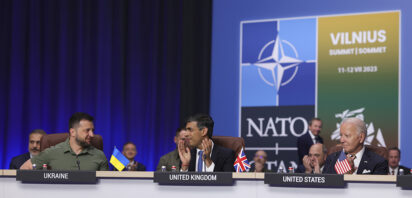
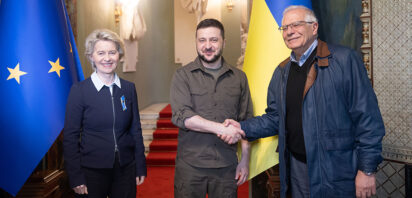
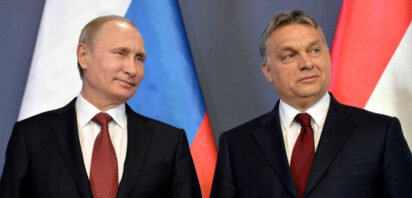
‘Nothing about Ukraine without Ukraine’ was the message President Zelensky and key European leaders made at the White House on Monday in a show of unity days after President Putin’s red-carpet welcome in Alaska. For Ukraine, security guarantees and continued NATO military support are vital, with the ultimate prize being NATO membership and the alliance’s highly coveted Article 5 clause. Given that NATO membership is many years or perhaps decades away for Ukraine, diplomatic flexibility is key, but there are also historical precedents to avoid. The 1994 Budapest Memorandum, while not a collective defense treaty, was a recognition of Ukraine’s sovereignty and territorial integrity by the US, UK, and Russia in exchange for Kyiv giving up the arsenal of Soviet nuclear weapons housed on its soil. However, the world of 1994 was very different than the present moment, with Russia believed to be on a democratic path and NATO enlargement being actively pursued by former Soviet republics and Warsaw Pact states.
Given everything NATO allies now know about Putin’s Russia, combined with the fact that Putin may remain in power for another decade at least, a document that only rhetorically respects Ukraine’s territorial integrity without committing to any military enforcement measures is gravely insufficient. Likewise, a document passed in the Russian Duma that supposedly prohibits Moscow from any further military action in Ukraine, as proposed by US envoy Steve Witkoff, is essentially null and void in an autocratic system like Russia’s without checks and balances. The Baltic states, Finland, Poland, Georgia, and many others with a long history of Russian aggression would never take the Kremlin’s word as doctrine when it comes to their own security.
Ukraine’s security will be principally upheld by its European partners, namely the Coalition of the Willing, led by the UK and France, and with significant material and financial support from Germany. Crucially, the Franco-German partnership and perspective on Putin’s Russia is much sharper under the leadership of Macron and Merz than it was under Merz’s predecessor, Olaf Scholz. Merz and Macron have both countered Trump’s notion that a ceasefire isn’t needed for Ukraine and are willing to play the bad cop role with Trump so long as leaders like Britain’s Keir Starmer and Italy’s Georgia Meloni can play the good cop.
It is easy to view the show of force in Washington, combined with a very different demeanor and welcome for Zelensky, as a well-needed boost of optimism over the course of a long and bloody conflict. However, every leader that was present at the White House is susceptible to the whims of democracy and accountable to their voters and constituents. While they are playing the long-game and thinking strategically about the future security of Europe, their political lifespans are much more limited and vulnerable than Vladimir Putin’s. Despite already losing over a million troops and the UK’s Defence Intelligence estimating that it will take Putin another four years to take the entirety of the four Ukrainian oblasts he already claims as his own, Putin still has plenty of time working in his favor. Putin is correct that any sustainable peace treaty in Ukraine will have to address the conflict’s root causes, however he is incorrect as to what those root causes are. Territorial concessions to Putin will not bring a permanent peace, only the dismantling of Russia’s imperial ambitions combined with the full teeth of the NATO alliance can do that. Anything else is merely another frozen conflict defined by geopolitical paralysis and ambiguity, the post-Cold War optimism of Budapest in 1994 combined with the undefined yet certain pronouncements of Bucharest in 2008.
President Trump and his team may be eager to get a deal in Ukraine, but the Ukrainians, and most of Europe, are eager for peace. A peace that is not just a notch on the diplomatic belt but an enduring one that moves Ukraine closer to its geographic homeland and away from the suffocating gaze of its imperial history. This week’s meeting at the White House was welcome proof that Zelensky and his allies in Europe understand how to approach and navigate the Trump administration on this issue. However, given Trump will always consider his own his legacy above anything else, Europe must consider Ukraine’s. As Macron stated at the White House on Monday, Ukraine’s security guarantees are not just about the protection of its sovereign territory but ‘about the whole security of the European continent.’ For Ukraine deserves much more than a hasty peace agreement, and Europe deserves nothing less than a Ukraine that is whole and free, unencumbered by the long and tumultuous shadow of its history.
The views expressed in this article belong to the author(s) alone and do not necessarily reflect those of Geopoliticalmonitor.com.