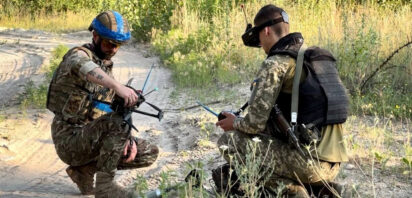
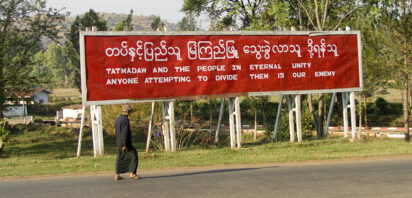
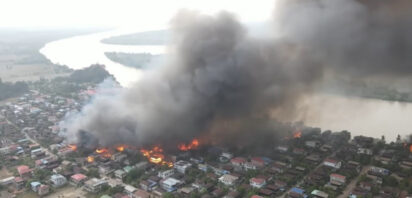
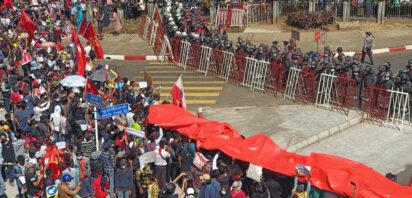
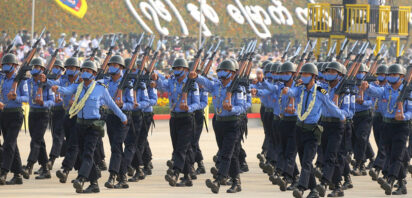
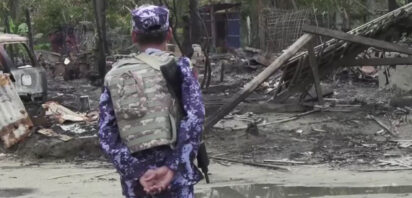
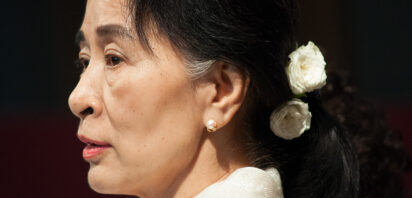
The Myanmar civil war, which has been ongoing for 80 years, escalated after the 2021 coup that ousted the democratically elected government of Aung San Suu Kyi. Since then, numerous ethnic armed organizations (EAOs), border guard forces (BGFs), and People’s Defense Forces (PDFs) have joined the fight on both sides. Now, with the pro-democracy coalition of ethnic groups controlling 70%-80% of the country’s territory—mostly jungles and villages—the focus of the conflict is shifting to the small towns and cities still held by government forces.
Myawaddy, situated near the Thai border in southeastern Myanmar’s Kayin State (formerly Karen State), is an example of a relatively small city with an urban population of about 57,000 that has become the focal point of intense fighting due to its strategic location. As the main import and transit point for goods and supplies into Myanmar, where domestic manufacturing and transport are faltering, the control of Myawaddy remains crucial. Positioned along key trade and smuggling routes, whoever holds Myawaddy gains access to significant economic activities and supply lines, making it a highly valuable asset for the Myanmar military (Tatmadaw) and other stakeholders. The battle for Myawaddy, much like the war itself, involves a complex web of interests, including Chinese investments, pro-democracy ethnic armies, Tatmadaw, transnational crime syndicates, and warlords.
Among the pro-democracy EAO forces fighting in the area are the Karen National Union (KNU), Karenni National Liberation Army (KNLA), Karen National Defense Organization (KNDO), People’s Defense Forces (PDF), and the Democratic Karen Buddhist Army. The Karen, one of Myanmar’s largest minority groups with a population of around seven million, have their own ethnic state, Kayin State. The presence of multiple EAOs among the Karen people highlights the conflicting interests within the same ethnic group, underscoring the challenges that must be overcome for the entire ethnic population—comprising hundreds of linguistic and ethnic subgroups—to unite against the Tatmadaw.
On the opposing side of the battle for Myawaddy is the national government, known as the State Administration Council (SAC), which controls the Tatmadaw, along with the Karen National Army (KNA). The interests of various ethnic group organizations diverge so broadly here that some ethnic armies fight alongside the government, while others maintain a ceasefire with government forces.
The Border Guard Forces (BGFs)—militia groups that were once part of ethnic armed organizations but are now integrated into the Tatmadaw’s command structure—also play a significant role in the conflict. These BGFs either support the Tatmadaw or operate autonomously, further complicating the situation. Although Thai security forces are not directly involved in the fighting, they are closely monitoring the border to manage refugee flows and prevent the conflict from spilling over into Thailand. Under Thai law, it is illegal to transit weapons through the country. Consequently, the Tatmadaw has no difficulty securing weapons and advanced military equipment, delivered by air or sea from China and Russia, while the EAOs struggle to obtain basic arms, mostly small weapons, which are smuggled across the Thai border in limited quantities.
Not far from Myawaddy is Shwe Kokko, one of several criminal enclaves disguised as a special economic zone. Shwe Kokko is a hub for a wide range of criminal activities, including telephone scam centers, drug trafficking, money laundering, human trafficking, weapons smuggling, kidnapping, prostitution, gambling, and cybercrime. In sum, these illicit operations generate billions of dollars in revenue each year, far surpassing the area’s legal cross-border trade.