The recent election of Mohamed Muizzu as president of the Maldives highlights an imminent shift in the nation’s geopolitical stance, especially concerning the island’s relationships with China and India. Viewed as the decidedly more pro-China candidate, Muizzu has openly committed to removing foreign troops from the Maldives. In doing so, Muizzu indirectly alludes to India, which has maintained a discreet unit comprised of 75 Indian soldiers in the country. Despite the island’s small size and population, the situation in the Maldives serves as another reset of alliances and influence between China and India.
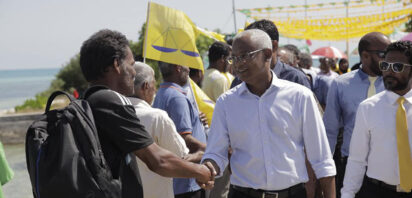
Mohamed Muizzu’s election win reflects several geopolitical and domestic implications for the Maldives. His campaign leveraged public sentiment against foreign military presence, primarily from India, establishing a platform emphasizing sovereignty and resistance to external influences. As a result, Muizzu’s campaign frequently invoked slogans such as “India Out,” a sharp contrast to incumbent President Ibu Solih and his “India First” foreign policy.
In addition to reflecting Maldivian public sentiment, the election results also reignite past discussions regarding the island nation’s foreign policy, particularly considering the pro-China inclinations of former Maldivian president Abdulla Yameen. In his five-year tenure as president, Yameen swiftly lost popularity due to economic mismanagement, corruption scandals, and a poor human rights record, leading to his subsequent loss and imprisonment during the 2018 elections. Before becoming the mayor of Male, Muizzu served as the construction minister in Yameen’s government, directly working with Chinese-funded mega projects that led to a substantial rise in external debt.
Maldives-India Relations in Context
In the post-independence period, India’s relationship with the Maldives has featured a lengthy history of diplomatic, military, and economic ties. This relationship burgeoned in subsequent decades, marked notably by India’s intervention in 1988 to thwart a coup in the Maldives, symbolizing a protectorate-like stature on the island. Yet India’s involvement hasn’t always been perceived benignly in the Maldives, where local nationalism often brushes against India’s security-driven presence. Under President Ibrahim Mohamed Solih (“Ibu”), the “India First” policy sought to allay such concerns by enhancing ties through cooperation in development, trade, and healthcare.