Ten years ago, the beginning of Myanmar’s reform process under military-backed president Thein Sein marked its opening-up as a frontier market in Southeast Asia. For much of the next decade, the country’s economy grew at an average rate of 7% per year, as domestic entrepreneurs and foreign firms took advantage of an improving climate for doing business in the formerly isolated nation. And after the election victory of Aung San Suu Kyi in 2015, it seemed Myanmar’s economic boom would endure.
Yet progress ground to a halt early last year as COVID-19 emerged, causing Myanmar’s economy to shrink by nearly 10% in 2020. Then the military coup of 1 February, which marked a sudden reversal of the reforms that had allowed the National League for Democracy to rise to power, had an equally devastating impact. The World Bank now forecasts an 18% contraction in 2021, which would render Myanmar’s economy a third smaller than it was before the double crises of the coup and COVID-19.
The prospects for recovery are grim, with junta chief Min Aung Hlaing recently extending the state of emergency to 2023 whilst a third wave of COVID-19, driven by the Delta variant, grips Myanmar.
Initial post-coup economic shocks
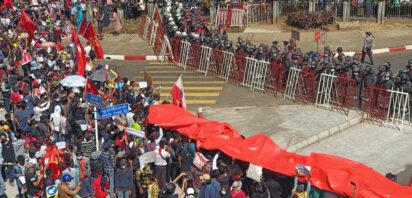
In the initial aftermath of the coup, protests and labor shortages amidst a broad civil disobedience movement disrupted economic activity and essential services nationwide. Thousands of doctors and teachers walked out in opposition to military rule, while telecommunications were impacted as the junta imposed internet blackouts to prevent anti-regime protesters from organizing on social media. The mass walkout of civil servants in a series of strikes denied the junta the ability to keep the state functioning, as staff shortages left it unable to effectively control key public utilities or collect taxes.
The World Bank, in its latest Myanmar Economic Monitor, released on 23 July, reported that access to banking and payment services remained limited more than five months after the coup, impacting businesses in all sectors. It further found that “physical currency continues to be in short supply,” whilst the Myanmar kyat has “depreciated by around 23%” against the United States dollar since late-January. Combined with disrupted trade, this has caused rapid price increases for imported goods, including fuel.
Garment and construction sectors hit
Key economic sectors are on the brink of collapse. Aside from the shuttered tourism sector, already decimated by COVID-19, the International Labor Organization reported last month that a quarter of a million workers in Myanmar’s lucrative garment industry have lost their job due to the pandemic. Building projects have stalled and an estimated 650,000 laborers are newly out of work since the army seized power in February. It is not only export-oriented firms that have suffered: the domestic construction industry has ground to a halt due to lingering insecurity and movement restrictions.