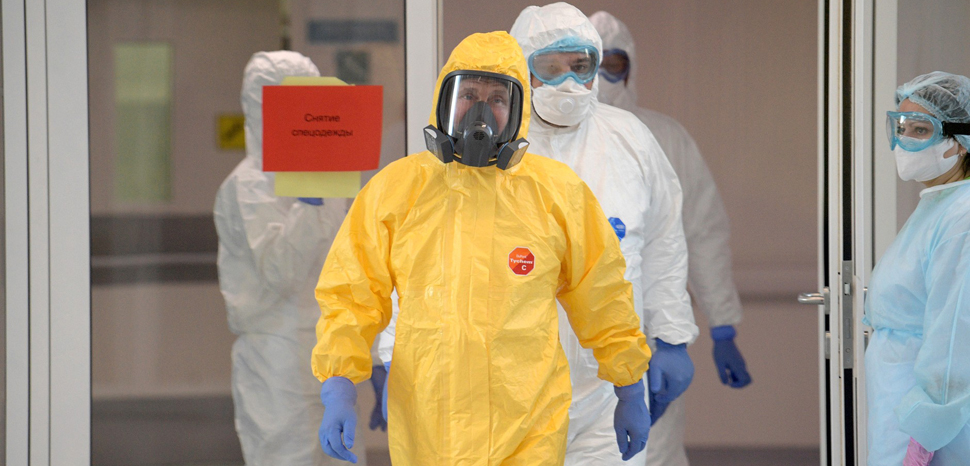
The first cases of COVID-19 in Russia were contained successfully after closing the border with China in January. But after March 2020 there was a resurgence of COVID-19 cases, originally linked to Russian tourists returned home from Italy as the disease began to spread in Europe. As of June 11, 2020, there have been 502,436 cases in Russia, with 6,532 total deaths. As a response to the increase of new cases mid-March, the Russian government finally implemented domestic and international travel restrictions, work leave periods until mid-May, and other self-isolation measures. In Moscow (home to the most cases in Russia), quarantine measures were especially stringent. For example, the capital saw the introduction of digital passes requiring online registration before individuals could leave their homes. During the lockdown period, the government aimed to prepare for the reopening of Russia by building sixteen additional hospitals across all regions of Russia, increasing spending for hospital staff and distributing new medical equipment.
Russian President Vladimir Putin announced that the work ban will be lifted and coronavirus lockdown eased as of May 12th, 2020. Although large public events remain banned and “strict sanitation demands” are mandatory, Putin expressed that it is in everyone’s interest for the economy “to return to normal quickly.” According to the official narrative, the current tide of COVID-19 cases has seen a steady decline in new inflections and fatalities. However, there has been public speculation that the Russian Health Ministry has been underreporting deaths in order to justify the country’s reopening.
Due to the coronavirus outbreak, Russia has postponed the referendum on keeping Putin in power until 2036 and the annual national parade. In April, Putin’s approval ratings hit a historic low of 59 percent on the back of unpopular pension reforms that pushed the retirement age back, along with his management of the pandemic.
During the COVID-19 pandemic, world leaders have generally seen an increase in approval ratings. For example, Angela Merkel’s approval rating reached 80 percent recently in Germany. The opposite seems to be true in Russia, and there have even been rumblings of Putin’s descent from the heights of Russian political power as COVID-19 fuels popular anger toward the system of “managed democracy” and the Kremlin’s unchecked authority.
Economic Factors
President Putin’s eagerness to restart the economy, perhaps at the expense of sound public health policy, reflects some of the pressures currently bearing down on Russia.
Six years before the COVID-19 crisis, the country was already suffering from economic isolation measures as a result of its military intervention in Ukraine along with meddling in the 2016 US elections. In some ways, the Russian economy is prepared for a downturn in the global economy and a collapse in oil prices: it has large financial reserves, is mostly debt-free, and is generally self-sufficient in agriculture. However, despite these preparations, April’s lockdown has cost Russia up to 2 percent of its GDP growth this year, with 2020 GDP currently 28 percent smaller in nominal terms than in the same period last year. This sharp contraction can be explained by the drop from 50 to 13.9 on the IHS Markit Russia Service Purchasing Index (PMI) Data, which measures the Russian services industry (a reading over 50 denotes expansion). In addition, the virus had impacted the volatility of the stock market and the ruble conversion rate, resulting in decreased foreign investment. According to a survey of 28 economists from Moscow’s Higher School of Economics (HSE), Russia is facing its sharpest recession in the past two decades.