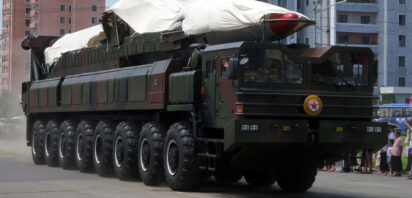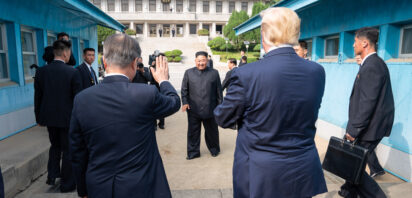
The latest round of North Korean missile tests produced visible discord between the United States and its East Asian ally. For Trump, the tests were business-as-usual – ‘a lot of people are testing those missiles’ – though the US president did later admit to being somewhat disappointed. The Japanese government took a more strident view, arguing that the tests were in violation of UN resolutions and thus were worthy of direct censure from the international community.
And now we know why: according to Japan Defence Minister Takeshi Iwaya, these latest missile tests involved a new model of short-range ballistic missile, one that’s designed to circumvent missile defense shields. Judging by the irregular course of the missiles, North Korea is working on ways to increase its offensive capabilities – at least with regards to Japan.
The top-level disagreement highlights a tactical asymmetry in the alliance. Simply put, the two countries face vastly different risk outlooks. Japan – the proximate state – falls well within range of the North’s short-range missile arsenal; these missiles are less technologically complex, more accurate, and as we now see better equipped to circumvent missile-based defenses. The United States on the other hand is much further afield. Though troops stationed in Okinawa and to a lesser extent Guam are very much at risk, it would take an inter-continental ballistic missile to reach the continental United States. Recent advances in North Korea’s missile program have made even this possible; however, there are many more intervening factors that make it a challenge to carry said missile across the ocean, let alone ensure its accuracy or adopt a trajectory that thwarts conventional missile defense systems.
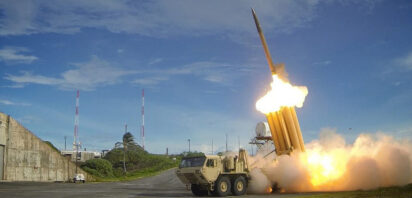
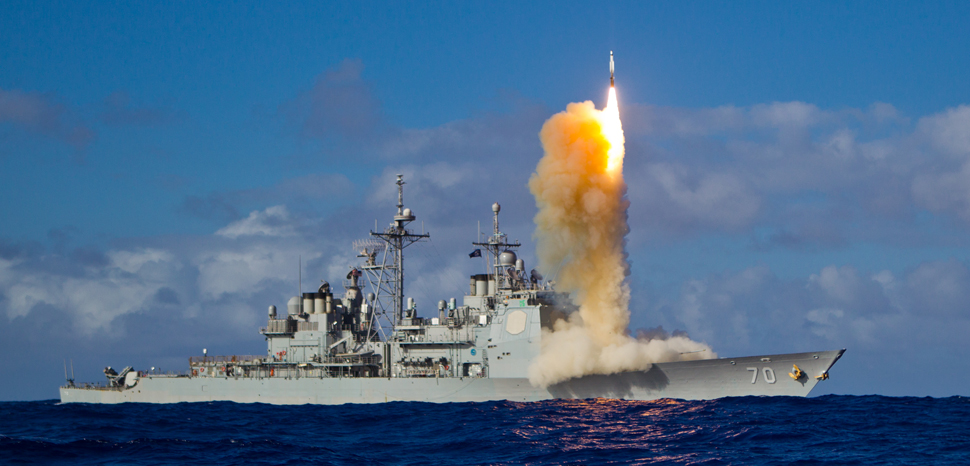
Japan currently operates a two-level missile defense system. Its first line of defense comes from Aegis-equipped warships stationed in the waters between North Korea and Japan. These ships, operating in-tandem with an extensive network of on-shore radar stations throughout Japan, launch SM-3 interceptors at incoming ordinance when it’s at its mid-point, or the apex of its flight arc. Failing that, the SDF also deploys Patriot Advanced Capability-3 (PAC-3) missile batteries that can intercept during the final phase of a missile’s descent, also known as the terminal phase. But these platforms have relatively limited operational ranges of around 20 kilometers and as such are clustered around high-value targets, whether population centers or military bases.