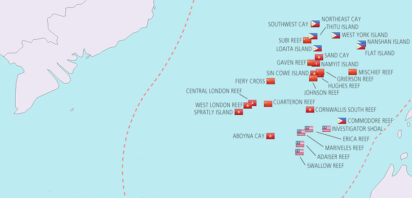
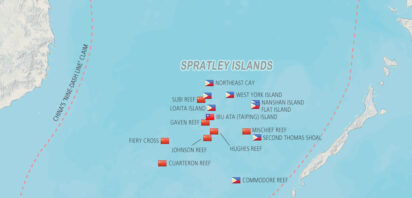
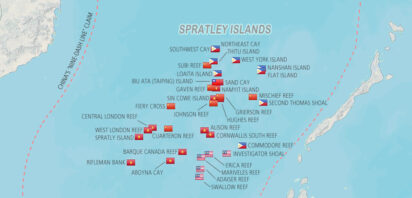
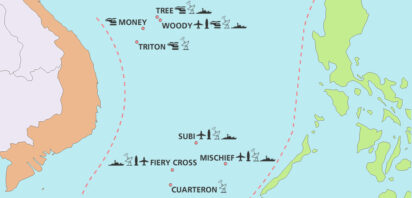
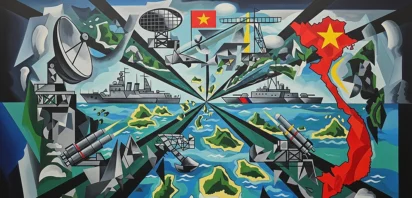
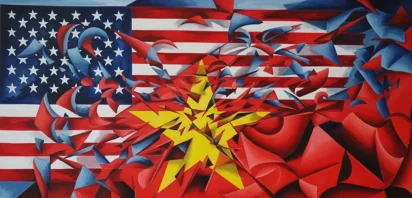
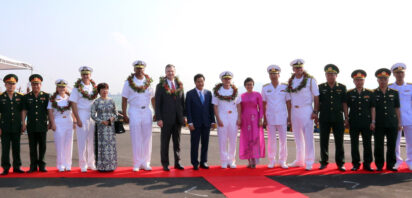
Vietnam’s role in the South China Sea dispute echoes thousands of years of fierce resistance to the military and cultural juggernaut to the north. It is marked by military conflicts – the 1974 Battle of the Paracels and 1988 Johnson Reef Skirmish – which helped draw the present-day map. But it’s also characterized by accommodative ‘bamboo diplomacy,’ which leverages improved relations with the U.S. to avoid domination by an ascendant naval power in China.
A similar dualism is evident in Vietnam’s approach to advancing its territorial claim. On one hand it was an early supporter of negotiations under ASEAN and an advocate for a diplomatic solution. On the other, having learned bitter lessons from recent encounters with China’s naval power and hybrid warfare, Hanoi has been quietly expanding and fortifying its remaining holdings in the South China Sea to avoid a repeat of past defeats.
Vietnam Legal Claims in the South China Sea
Like China, Vietnam claims the entirety of the Spratly and Paracel Islands in the South China Sea, known as the ‘East Sea’ in Vietnam. The claim is supported by historical evidence indicating economic and administrative control going back over 500 years.
Maps and Records Indicating Vietnam’s Historical Use of the Islands
While historical evidence of Vietnam’s South China Sea claim goes back as far as the 15th century, a central plank of the argument is 17th century maps identifying the Spratly and Paracel Islands as belonging to Vietnamese dynasties at the time. In isolation, the maps would be unremarkable as evidence – for every ancient map citing the islands as Vietnamese, another can be produced by China suggesting the opposite. And furthermore, it should be noted that experts have at various times called the authenticity of the historical records used by Vietnam to justify its claim into question. However, Vietnam’s case is supported by third-part evidence, notably 17th century Dutch and Portuguese maps identifying the Paracel Islands as Vietnamese territory (the Kingdom of Annam) and certain Chinese sources from the time explicitly exclude the Paracels and Spratlys as a part of China.
The historical records of Vietnamese dynasties also make reference to the kinds of activities that establish sovereignty under international law, such as exploration, measurements, map-making, and setting border markets. The Vietnamese government argues that the Paracels in particular were administered by Emperor Gia Long starting from 1802, and were formally annexed in a flag-raising ceremony in 1816 – an event recorded in Reverend Jean-Louis Talberd’s diary (published in 1837). In the decades that followed, the Vietnamese authorities dispatched several map-making expeditions, planting trees and leaving sovereignty markers on islets throughout the South China Sea. Taxes were also collected from fishermen in the area and, importantly, none of these administrative activities drew any recorded objection from the Chinese authorities at the time.
French Colonial Era Formalizes Vietnam’s Claim
After the French seized large swathes of Vietnam and Cambodia in 1887, the colonial government continued to solidify its legal claim to the Spratly and Paracel Islands by strengthening administration of the islands and sending naval groups to patrol the area. The 1920s and 1930s are viewed as another period of French consolidation in the South China Sea, though the Chinese government wasn’t in any position to put up a fight due to warlordism and intermittent civil war back home. In the immediate wake of Japan’s invasion of Manchuria in 1931, France formally annexed the Paracel and Spratly islands, claiming that they were terra nullius (unclaimed land) under international law – an argument rejected by China and Japan at the time.