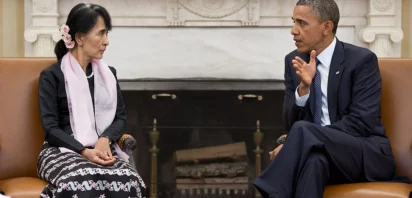
The clock is ticking in Myanmar (also known as Burma) four months after President Obama’s visit there. The general election of 2015 is scheduled to take place in late October, early November. The timing of the polls raises questions about the direction of Myanmar’s political development, where a military-led reform program seems to be running out of steam. With elections due in less than 12 months, the country is at a critical juncture between a path to full democracy and a return to military rule.
The man overseeing Myanmar’s transition to civilian government (it is too early to say ‘democracy’) is President Thein Sein. He is an ambivalent figure to many in Myanmar and beyond. Up until 2010, he was a senior figure in General Than Shwe’s State Peace and Development Council (SPDC), the junta that controlled Burma from 1988 until 2011, when Than Shwe officially dissolved it. Thein Sein became a member of the SPDC’s council body in the 1990s. From 2007 onwards he served as its prime minister and was the public face of the regime. When Thein Sein put aside his uniform in 2010 to register the United Solidarity and Development Party (USDP) for elections that year, many were skeptical of his ability to be an independent political figure.
In all this, the international community may have underestimated the cunning and foresight of the SPDC’s leader General Than Shwe. A career military man, he understood from personal experience the tendency of Myanmar’s military rulers to be overthrown in their dotage by younger and more ambitious colleagues. The famous 1988 pro-democracy protests were sparked by Myanmar’s first aging military dictator Ne Win, when he unexpectedly resigned. Later that year Than Shwe took part in a coup that salvaged the military regime’s continued rule. Four years later he overthrew his superior, Senior General Saw Maung, in a palace coup to become Burma’s dominant strongman. Meanwhile Ne Win died under house arrest during Than Shwe’s regime in 2002. Than Shwe had no intention of following in his predecessor’s footsteps by resigning, but as his own health failed he needed an exit strategy – this is what Thein Sein’s ‘civilianized’ USDP provided.
Thein Sein came to office at an opportune moment for reform in Myanmar for other reasons as well. The years leading up to his election had been rocky ones for the SPDC whilst Western relations with it had gone from terrible to toxic. In January 2007, the United States tabled a motion at the UN Security Council labelling the junta a threat to regional peace and security. Soon afterwards popular frustration with the regime’s decades of economic mismanagement finally boiled over in mid-2007, with the monk-led ‘Saffron Revolution.’ The uprising was successfully repressed, but the ensuing crackdown underscored the widening gulf between the junta and its people. Cyclone Nargis struck the following year, causing catastrophic destruction and over 134,000 fatalities according to the government’s own (presumably conservative) statistics. The junta initially refused all aid workers access to the country and carried on in its plans for a constitutional poll, causing international outrage. In some corners of the diplomatic community there were even murmurs that the “responsibility to protect” doctrine be invoked to override Myanmar’s national sovereignty.