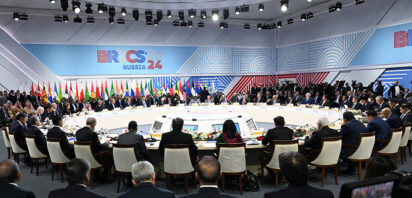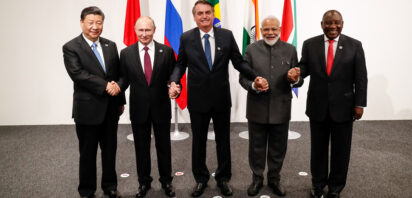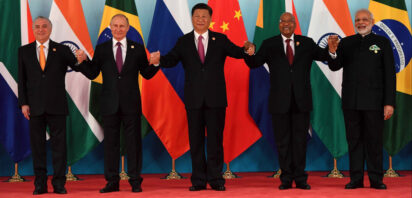
Tuesday’s BRICS agreement on forming a rival institution to the IMF and World Bank may one day be looked back on as a seminal moment in the decline of the post-WWII international order. Here there’s a message that’s plain for all to see: the developing world has rejected the long-held idea that emerging countries could be absorbed into pre-existing regimes and reform them from within. As soon as 2016, there will be two separate institutional blocs with an overlapping global mandate of eliminating poverty and ensuring economic stability.
But what does this actually mean for the future of global politics?
Historical Background
It’s first instructive to recount why the existing regime has become untenable to the BRICS. Both the World Bank and the IMF were founded in the direct aftermath of World War II. The World Bank’s mandate was originally to provide funding for reconstruction efforts, and eventually it transformed into alleviating global poverty. The IMF was meant to preside over the international monetary system and ensure exchange rate stability via pegging the US dollar to gold (a system that was abandoned in 1971).
Both institutions were meant to promote the indirect economic interest of the West, and more specifically the United States. In a more direct sense, the leader of the IMF has always been a European and the leader of the World Bank an American. This ‘gentleman’s agreement’ on leadership has persisted since 1946, and more recently it came under a volley of criticism from developing countries when former managing director Dominique Strauss-Kahn was replaced by Christine Lagarde amidst a sexual assault scandal in 2011 (coincidentally, this is also the approximate time when the BRICS began negotiations for a rival set of institutions).
Beyond matters of leadership, there have also been questions surrounding the IMF and World Bank’s politicization; or their occasional willingness to transcend the economic and delve into the more subjective arena of human rights. One recent example of this is World Bank President Jim Yong Kim’s halting of a $90 million load to Uganda over the country’s draconian anti-gay laws. To outside observers in the developing world, this incident offered further proof that the West-led multilaterals would be willing to hold developing economies hostage on matters of human rights.