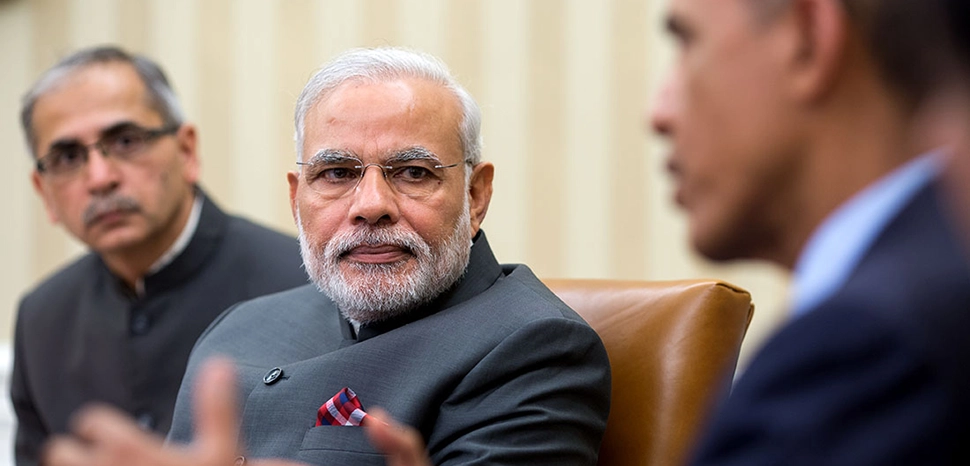
China’s Global Times publishes an article praising Narendra Modi as “India’s Nixon”; Japan’s Shinzo Abe opts for Twitter diplomacy, honoring the prime minister elect as one of his three follows; old-school Putin just picks up the phone and calls in his congratulations; and the White House makes an awkward announcement that Modi is welcome to visit the United States anytime – let’s just forget about the whole visa ban.
World leaders have been lining up to congratulate Modi, and with good reason. After a decade of Congress rule, Modi’s Bharatiya Janata Party (BJP) has been swept into power in a resounding victory. The BJP has its own unique ideas on what’s best for the country, which could spell major changes for India’s foreign policy.
The Bharatiya Janata Party: A Different Beast
Narendra Modi’s Bharatiya Janata Party is above all a Hindu nationalist party. Some contend that it is the unofficial political arm of the Rashtriya Swayamesevak Sangh (RSS), a six-million strong grassroots organization that seeks to remake India as a Hindu nation, and whose members adopt an austere lifestyle of study, volunteer work, and self-defense drills. Though RSS cadres emptied from their camps to campaign for the BJP in these elections, any direct link between the two organizations is usually played down owing to the enduring stigma of allegations that Mahatma Gandhi’s assassin, Nathuram Godse, was a former member of the RSS. Nevertheless, it’s clear that Modi has a personal connection to the organization having volunteered in the RSS throughout the 1970s and 80s, before being recommended to join the BJP in 1987.
The BJP/RSS onus on Hindu cultural rejuvenation and the importance of spreading Hindu values runs contrary to the Congress mantra of a secular state that seeks unity in diversity. With the former view now in ascent, we can expect the subject of communal violence to elbow its way into public dialogue. Some members of India’s 180-million strong Muslim minority are anxious over Modi’s victory, and though the prime minister has been quick to distance himself from inflammatory comments made by his associates, there are still questions over whether RSS-inspired ideology will reflect in BJP policy now that the party has once again secured power. However, it should be noted that these same worries were surfacing in 1998 when the BJP’s Atal Bihari Vajpayee first took office, and they ultimately proved unfounded.