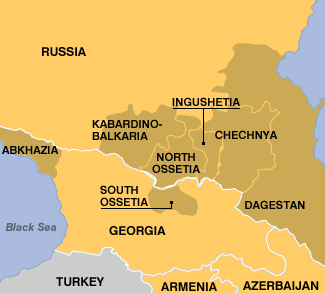
Eastern Europe is still tattooed by the Soviet Union. Breakaway regions in Georgia and Moldova—Abkhazia, South Ossetia and Transnistria respectively—are autonomous territories in everything but name. The three act as autonomous states but are not recognized internationally. They are linked by their mutual recognition of each other’s independence and, more importantly, by their dependence on Russian political and economic policy. These common ties become increasingly apparent when examining the recent presidential elections and Russian political appointments in the respective regions, says Elena Mizrokhi of Geopoliticalmonitor.com.
Aside from Russia, only Venezuela, Nicaragua, Nauru, and Tuvalu have recognized Abkhazian and South Ossetian independence. No countries have officially recognized Transnistria. The three breakaway territories are therefore cut off from the international community—both economically and politically. Separatist movements in Abkhazia, South Ossetia, and Transnistria, are a legacy of Stalinist Russia. In the 1920’s, Stalin introduced the “nation-building” policy of korenizatsiya (which roughly translates to indigenization or nativization) designed, in theory, to foster ethnic and lingual integration. In practice, Stalin’s policy dispersed pockets of ethnically concentrated people as a means of diffusing potential opposition to the communist regime. This strategy sowed the seeds of conflict that sparked nationalist movements during the final years of Perestroika (1988-91). The result was violent confrontations in Tbilisi and Chisinau and protracted guerilla warfare in Abkhazia lasting until 1994.
Today, these regions remain entirely dependent on the Russian ruble. Since 2004, Putin and Medvedev have capitalized on the rise of oil prices, channeling economic gains into a foreign policy that seeks to reassert Russian influence in its neighbourhood—particularly in Eastern Europe and the Southern Caucasus. Moscow’s sense of urgency in the region is now heightened by America’s military cooperation with Poland, the Czech Republic, Georgia, and the Ukraine—primarily through NATO. The Kremlin perceives NATO as a direct threat to its regional influence.
Moscow’s financial support demonstrates the geopolitical significance of these regions. Transnistria has reportedly amassed over 1.3 billion (USD) in debt to Russia’s state-owned gas monopoly, Gazprom. With the exception of a small stream of revenue generated from tolls for use of the Roki Tunnel linking the mountainous region with Russia, South Ossetia relies entirely on funding from Moscow. Similarly, it is estimated that approximately 70 per cent of Abkhazia’s budget is made up of direct Russian investments. The remainder of Abkhazia’s economy relies on the tourist business heavily oriented toward Russians.
Russia formally recognized Abkhazian and South Ossetian independence following the Georgian War of August 2008. The war was Russia’s first international military conflict since the collapse of the Soviet Union and served to highlight Moscow’s longstanding involvement in the domestic politics of these territories. During the 1990s, Russia led peacekeeping operations while controlling the borders of the breakaway regions. Its omnipresence allowed secessionist elites to build the seditionist political and cultural institutions that ultimately hindered Moldovan and Georgian national unity. Today, over 1,000 Russian troops are stationed in Transnistria. Abkhazia houses approximately 1,700 Russian troops, a Russian missile defense system, and will soon welcome Russian army and navy bases.
Despite Russia’s unparalleled influence in the region, Kremlin-backed candidates have largely failed in their recent electoral bids. Such an unprecedented public rebuke is startling because the three territories exist almost exclusively off Russian subsidies. Recent election results mark a clear setback for Moscow’s policy in the former Soviet space and will likely have reverberating consequences on regional politics for years to come.
In Abkhazia, the sudden death of president Sergei Bagapsh in May 2011 triggered elections where Vice President Alexander Ankvab ran against Prime Minister Sergei Shamba. Ankvab won the contest receiving over 50 per cent of the popular vote. Moscow has not yet stated its support for Ankvab. However, based on historical evidence, one can safely assume that Ankvab is not Moscow’s preferred man in Sukhumi.
In the 2004 elections, Vladislav Ardzinba (the incumbent and President of Abkhazia since its self-declared independence in 1994), was publicly supported by former KGB officer Raul Khadjimba—a man known to have close ties to Moscow. Ankvab was the frontrunner in that campaign but was deemed an ineligible candidate and therefore decided to ally himself with Bagapsh. Some observers believe that Russia attempted to sideline Ankvab. Since 2005, Ankvab has survived six attempts on his life.
In South Ossetia, the Supreme Court disputed the results of the November 2011 elections after the loss of the Russian-backed candidate, Alla Dzhioeva. Dzhioeva defeated Medvedev’s candidate, Anatoly Bibilov, but was barred from running in the new round of elections. Early in February 2012, Dzhioeva, who disputed the Supreme Court’s decision, was beaten unconscious by the police during a raid on her party headquarters. The incident followed a declaration by Bibilov two days earlier where he announced his decision to withdraw from the presidential race. While it is not clear what role the Kremlin played in Biblov’s decision or the attack on Dzhioeva, Moscow did not lose its firm grip on South Ossetia. The final round of elections in April saw Leonid Tibilov, a former KGB chief, victorious. Tibilov had previously publicly stated his desire to see South Ossetia join the North Ossetia region—a region of the Russian Federation.
Recent presidential elections in Transnistria were equally transformative. Former parliamentary speaker Yevgeny Shevchuk won the election runoff in December 2011. The Russian-backed candidate, Anatoliy Kaminsky, placed a distant second. Because Transnistria borders with Romania, the European Union has recently directed attention to settling the separatist dispute. The 5 plus 2 talks between Transnistria, Moldova, Ukraine, and Russia—with the OSCE as monitor and the EU and US as observers—have increased pressure on Russia to assist in the resolution of the conflict. By allowing the recent change in leadership in Transnistria, Moscow has demonstrated its ability to regulate the conflict without fully relinquishing its influence.
Despite the leadership shift in the Russian ‘protectorates’, Moscow has quickly reasserted its influence and power in the three territories through indirect representation.
Aleksandr Tkachev, the governor of Krasnodar Krai in Russia’s southern Caucasus since 2000, was recently appointed as the Russian presidential representative for Abkhazia. Tkachev’s appointment is controversial because of the strict sanctions he placed on Abkhazia in retaliation for electing Bagapsh in 2004.
In South Ossetia, Medvedev appointed Taymuraz Mamsurov, governor of the Republic of North Ossetia and Alania as the presidential representative in the breakaway territory. Mamsurov has repeatedly advocated for the unification of North and South Ossetia, calling the division between the Ossetian people “absurd” while also claiming it “cannot last forever.”
Finally, Dmitry Rogozin, the Russian Deputy Prime Minister—responsible for overseeing the arms industry—was recently appointed special envoy in Transnistria. Rogozin also holds the position of Russia’s chairman of the Russia-Moldova inter-governmental cooperation commission. The dual-track appointment, short of official Russian recognition, implicitly treats Transnistria and Moldova as separate entities and opens avenues for direct relations between the Russian government and Tiraspol authorities—effectively bypassing Chisinau.
These key appointments indicate that Russia is far from abandoning its support of the three secessionist regimes. However, it is not quite clear how Moscow will be able to fulfill its economic commitments to the three breakaway regions based on its recent economic performance. Economic recession coupled with the emergence of grass roots political opposition movements (who encourage Moscow to direct its attention internally rather than externally) has significantly altered the Russian political landscape. An increasing number of regions within Russia will certainly require higher state subsidies to assist with economic recovery and to quell internal disputes. Ultimately, Moscow’s future policies in secessionist states like Abkhazia, South Ossetia, and Transnistria will largely depend on the administration’s ability to quell voices of discontent in its own backyard and tend to its economy.
Elena Mizrokhi is a contributor to Geopoliticalmonitor.com
Comments
Sort: Most recent | First to last | LikedThough Russia may have adversaries in these regions, those voices of discontent towards Russia will quickly turn towards their own governments when limited funds and mounting debts put strains on their countries. Russia exerts its influence with money and gas - it attracts them with subsidies and keeps them with debt. It's not a friendship easily discarded.
Though the citizens might not have a chance to experience life without Russia as they may be currently voicing, the leaders will know full well their success lies in Russian support.
Look at these points:
in Abkhazia’s presidential election VICE PRESIDENT Alexander Ankvab ran against PRIME MINISTER Sergei Shamba both of them from pro Russian ruling elite. Transformation?
in South Ossetia the Supreme Court disputed the results of the November 2011 elections after the loss of the RUSSIAN-BACKED candidate, Alla Dzhioeva. Dzhioeva defeated MEDVEDEV'S CANDIDATE, Anatoly Bibilov. Obviously both of them were pro Russian candidates. Transformation?
in Transnistria, presidential election won former PARLIAMENTARY SPEAKER Yevgeny Shevchuk from pro Russian rulling elite. Transformation?
Another ridiculous statement is that Transnistria has borders with Romania. Obviously author never bothers to check where actually Transnistria is.
A very strange analysis and weird conclusions.