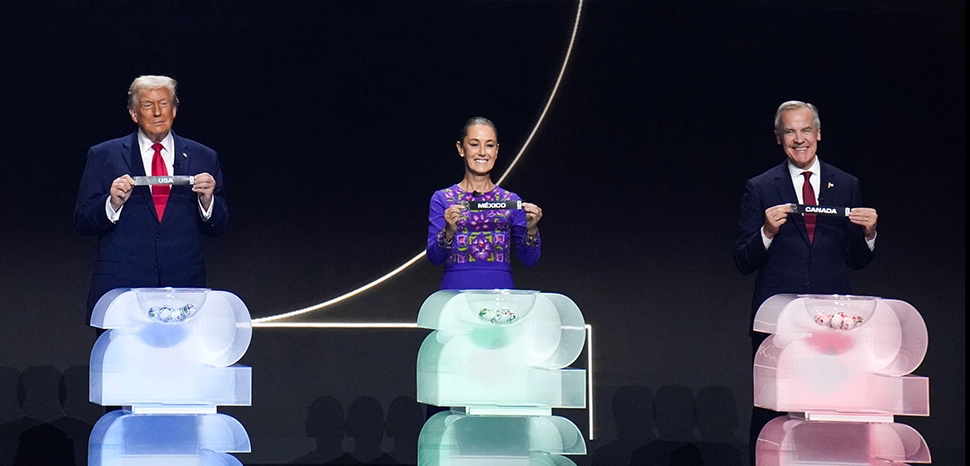
Rarely have international sports events historically been insulated from global conflicts and geopolitical interests. As the United States is drawn deeper into its four-month-long war with Iran, heightened tensions between the two countries have spilled over into global sports. The strain came as the United States, alongside Canada and Mexico, prepares to host the FIFA World Cup from June 11 through July 19. The situation is without precedent: for the first time, a FIFA World Cup host is at war with a nation qualified for the tournament. Although Iran was originally scheduled to both train for and play its group-stage matches on US soil, mounting security concerns over repeated ceasefire violations and unfruitful negotiations in the Middle East have cast uncertainty on such arrangements.
Iran is among the few nations qualified for the World Cup that fall under Trump’s travel ban.
As time runs out, and with entry visas yet to be processed, Iran’s participation hangs in the balance. On May 25, it was announced that Mexico will now host the Iranian delegation for the duration of the tournament. According to Mexico’s President Claudia Sheinbaum, a FIFA representative asked Mexico to host Iran’s training base, moving it from Tucson, Arizona, to Tijuana, Mexico, amid concerns about the United States’ reluctance to allow the Iranian national team to remain on American territory between matches.
Mexico accepted FIFA’s proposal. An Iranian request to move its World Cup matches to Mexico in April had been rejected by the soccer organization on the grounds that the tournament schedule could not be altered. Interestingly, the idea had previously been brought up by Iran’s ambassador to Mexico, Abolfazl Pasandideh, during a press conference in early March. There, Mr. Pasandideh urged Mexico to condemn the US attacks and welcomed the possibility of the Iranian soccer team being moved to stay on Mexican soil.
“For us, it would be best if the matches were played in Mexico. Although our nation does not hate the American people, but rather the government of the United States, we love the Mexican people and hold very positive feelings toward them,” stated Mr. Pasandideh.
Days before FIFA formally confirmed the decision, the President of Iran’s Football Federation, Mehdi Taj, announced that Tehran’s inquiry to switch training bases had been approved, arguing that the move would supposedly ease complications stemming from US visa restrictions —though now the team needs a last-minute visa to enter Mexico.
Furthermore, switching Iran’s camp base raises the question of the United States’ fulfillment of its responsibilities as a World Cup host. According to FIFA’s official Government Declaration, host countries pledge to “welcome the presence of FIFA, all member associations of FIFA and all visitors from around the world,” and also commit to “fully support […] the hosting and staging of the tournament.”
Sports Diplomacy as a Pressure Release Valve
President Sheinbaum has called for peace and dialogue to resolve the conflict in the Middle East, striking a delicate balance between avoiding further confrontation with a US administration that has floated the idea of ground troops in Mexico and defending national sovereignty, a recurring point of contention in tense US-Mexico relations.
Mega sporting events, like the FIFA World Cup, serve as soft diplomacy tools, where politically sensitive relationships can be attended to under the cover of the festivities. In this case, the upcoming matches serve as ground for geopolitical tension management: relocating Iran’s camp base to Mexico becomes a way to maintain Iran’s participation in the World Cup while avoiding further political friction in and with the United States.
Furthermore, this decision allows Mexico to use its position as host to stabilize a growing row. By agreeing to host Iran’s training base, Mexico is presenting itself as a pragmatic actor willing to absorb geopolitical pressure in order to ensure the show goes on.
Another classic feature of sports diplomacy is to maintain visibility and engagement when traditional channels of diplomacy are strained. For Iran, simply being present in the World Cup, regardless of where the national team will ultimately train, symbolizes normal participation in global institutions, reinforcing Tehran’s legitimacy internationally.
US-Mexico Relations Forced to Play Defense
US-Mexico relations are undergoing another fragile period since President Trump returned to office in January 2025. Over the past year and a half, the Trump administration has steadily turned the screws on its southern neighbor, repeatedly employing the threat of punitive tariffs as leverage to advance security demands aimed at drastically curbing cross-border illegal immigration, fentanyl trafficking, and organized crime.
Every demand coming from Washington was met with President Sheinbaum’s attempt to appease her US counterpart, showing willingness to cooperate on transborder security matters while maintaining Mexico’s sovereignty as a red line in the bilateral relationship. Her emphasis on “cooperation without subordination” sought to contain the fallout from President Trump’s unilateral pressure campaign while safeguarding Mexico’s deep economic relationship with the United States, particularly as the USMCA review was on the horizon —whose first round of negotiations was launched on May 28.
While President Sheinbaum’s approach has yielded political victories at home, new pressure mounts as the Trump administration continues to target what it has framed as an “intolerable alliance” between the Mexican government and the cartels. Washington has begun targeting the political apparatus that nurtures criminal organizations within Mexican borders. For instance, on April 29, current Sinaloa Governor Rubén Rocha Moya, a member of the ruling Morena party, together with nine current and former Mexican officials were indicted for assisting the Sinaloa Cartel in trafficking drugs into the United States in exchange for bribes and political support.
Internationally, President Sheinbaum strongly pushed back against the US military raid that resulted in the capture of Venezuela’s President Nicolás Maduro. Interestingly, the US indictment highlighted allegations from political opponents and Mexican media that Caracas helped finance Andrés Manuel López Obrador’s unsuccessful presidential campaign in 2006. Such claims have left Mexico in a vulnerable position.
On top of that lies the question of Cuba. Even after the US Operation Epic Fury, Mexico continued to supply oil to the island. However, shipments were suspended after President Trump issued an executive order in late January threatening tariffs on countries exporting oil to Cuba. Although Mexico maintained its humanitarian support, Washington’s move served as a tacit reminder that Mexico’s intentions to pursue an independent policy toward Cuba are constrained by the realities of its relationship with Washington.
Playing on an Uneven Field
Against this backdrop, under Mexico’s hosting of Iran’s training base lies a symbolic message. Although the origins and intensity of Mexico’s tensions with the United States are nowhere near similar to those of Tehran’s, both represent cases of states navigating an asymmetric relationship with US power.
Sports diplomacy offers a space where Mexico and Tehran’s different historical trajectories converge around a shared sensitivity to US traditional hegemony. Tehran is locked in open confrontation with Washington. Ironically, its new host, Mexico, is often confined to play its own half, absorbing pressure and managing risks from its northern neighbor rather than setting the pace of the game. Mexico has been repeatedly drawn into President Trump’s political discourse that entertains the possibility of cross-border military action to tackle organized crime violence, and has increasingly found ways to subtly encroach on Mexico’s sovereignty.
President Sheinbaum’s pragmatic foreign policy approach has earned praise from her US counterpart and allowed to keep US-Mexico cooperation rolling. But her pragmatism does not erase overnight the longstanding imbalance at the heart of the bilateral relationship. Mexico continues to operate within a dynamic where US signaling resembles more of an imposition rather than an invitation to collaborate.
Unlike Tehran, Mexico lacks a strategic wild card, such as Iran’s blockade of the Strait of Hormuz, to use as leverage to offset US pressure and turn the game upside down. Geography has made Mexico’s export-dependent economy fundamentally tied to the United States, its main trading partner, leaving little room for maneuver independently from Washington’s priorities.
Mexico’s position on the back foot is evident in its policy towards Cuba. Should a deal be finalized in the Middle East, there’s little doubt that the island would be next target on President Trump’s list, while pressure on Mexico to ramp up its fight against criminal organizations would far from disappear. Mexico already halted oil shipments to the island to avoid fueling Trump’s ire. Should pressure from Washington intensify, Mexico’s room for defiance will become even narrower, and ideological sympathy will be all that Sheinbaum’s government can offer.
The views and opinions expressed in this article are those of the author alone and do not represent those of Geopoliticalmonitor.com