Global geopolitical trends we’re tracking this week:
Key Dates
December 20 – Brazil Focus Market Readout (inflation and central bank rate expectations for the year ahead).
December 21 – Germany consumer confidence.
December 21 – United Kingdom core retail sales for November.
December 21 – Italy producer price index (PPI) for November.
December 21 – Canada core retail sales for October.
December 21 – Canada housing price index for November.
December 22 – United Kingdom GDP and current account for Q3.
December 22 – Mexico retail sales for October.
December 22 – United States GDP for Q3.
December 22 – United States existing home sales for November.
December 23 – Spain GDP for Q3.
December 23 – United States durable goods orders for November.
December 23 – Canada GDP for October.
December 23 – United States new home sales for November.
December 24 – Mexico trade balance for November.
World
COVID-19 fast facts
- Omicron continues to spread around the world. The novel COVID-19 variant is now present in over 89 countries, according to the WHO, and spreading at a rapid pace, with omicron cases doubling every 1.5 to 3 days in countries with established community transmission.
- Over the weekend, the Netherlands became the first European country to re-impose full lockdown conditions, closing all bars, restaurants, cinemas, gyms, and non-essential shops until at least mid-January. Notably, the lockdown is preemptive as COVID cases have actually been trending down and omicron still accounts for a small share of infections.
- Other European countries have been edging closer to lockdown in recent days: Denmark proposed new limits on group gatherings and entertainment venues; talk of hitting the ‘circuit breaker’ has re-emerged in the United Kingdom; and Ireland has imposed curfews on pubs and bars.
- In some potentially positive news: hospitalization rates in South Africa’s ongoing omicron wave have dipped dramatically, suggesting the possibility that omicron is milder than previous variants: on average, only 1.7% of identified COVID-19 cases are being admitted to the hospital in the second week of their infection, compared to a rate of 19% during the previous delta wave. (Others argue that his is not indicative of mildness, and rather is a factor of pervasive infection rates from recent delta-fueled waves in South Africa).
- US President Biden will address the nation regarding COVID-19 on Tuesday, a speech in which he is expected to make the case for greater vaccination. Omicron represented just 2.9% of US cases through December 11; however, the variant is projected to become dominant in as soon as two weeks.
Americas
Chile marks political sea change in election of leftist president
Chile’s presidential run-off election took place over the weekend, a contest that pitted left-wing former student agitator Gabriel Boric against the right-wing José Antonio Kast (for more details, see the recent situation report). Despite polls in the lead-up to the election showing the two candidates neck-and-neck, Boric ended up winning by a comfortable margin of 12 points and will become the youngest president in Chile’s modern history at 35 years-old. Boric will now attempt to alleviate the inequality that has driven hudreds of thousands of protestors into the streets in recent year. His presidency will also prevail over the ongoing process of constitutional reform. The combination of Boric’s left-wing politics, along with the generally progressive make-up of of the constitutional convention, points to a potential far-reaching rethink in Chile’s relationship with the various mining giants that operate there. Chile currently produces around one third of the world’s copper, and the country is the second-largest global producer of lithium.
Europe
Russia issues an ultimatum in Ukraine crisis
Moscow has distributed a list of demands to NATO governments, steps that it maintains are necessary in order to deescalate simmering tensions along the Ukrainian border. The list includes: a ban on Ukraine’s future entry into the alliance; rolling back NATO troop levels in Eastern Europe to 1997 levels, including in member countries such as Poland and the Baltic states; and removing forward-deployed US nuclear weapons from Europe. Taken at face value, most of the demands are diplomatic non-starters, and can only be meant as compromise fodder en route to Moscow’s overriding objective of obtaining guarantees that Ukraine and Georgia will not end up in NATO one day (and this has already been rejected in NATO capitals). However, there’s also a school of thought that interprets the demands as merely diplomatic theatre, likely intended for the domestic audience, ahead of a Russian invasion that’s now all but assured to take place sometime in January.
Africa
Ethiopia declares new victories against Tigrayans in civil war
The Ethiopian armed forces announced have announced that they have retaken more towns from the Tigray People’s Liberation Front (TPLF) and their allies, though the claims remain unconfirmed at this time. The towns in question are Kobo and Waldia. If confirmed, the capture marks progress in government efforts to push the TPLF out of Amhara, and further way from the logistical hub of Weldiya, which holds out the prospect of establishing supply lines eastward to Djibouti – a key consideration given the ongoing blockade of the Tigray region. However, as the recent case of the Lalibela UNESCO site illustrates, these victories can be short-lived for Addis Ababa as the TPLF seems to be favoring guerilla tactics that prioritize inflicting damage on enemy supply and fighting capacity rather than attempting to hold down territory, especially in regions outside of Tigray where local support cannot be taken for granted.
Data Snapshot
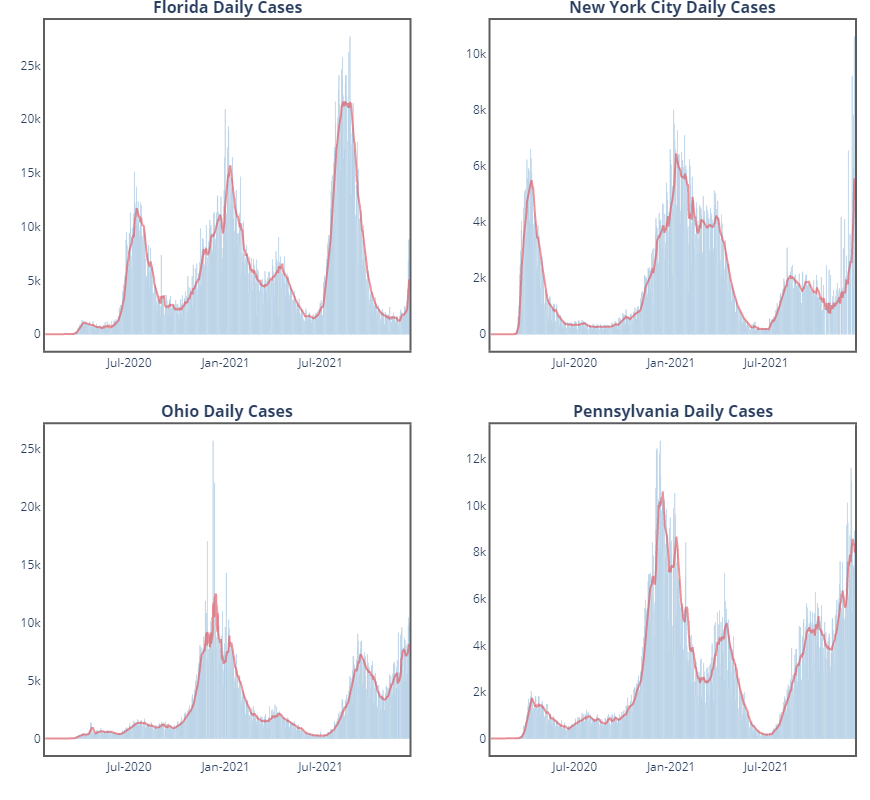
COVID cases have remained relatively stable in the United States over the holidays, but case rates are expected to spike as omicron becomes more established.