Hegemonies rarely collapse from a single blow. They erode over time, through accumulated shocks and narrowing margins of flexibility. Rome did not fall at Adrianople; Britain did not cease to matter after 1914. Power transitions unfold when material convergence coincides with declining systemic elasticity.
This article proposes the concept of a “Credibility Index” as a structural measure of hegemonic durability. Moving beyond GDP and military spending as stand-alone indicators, it argues that power in the contemporary international system depends on a state’s ability to absorb shocks while preserving relative advantage over allies and rivals. This framework compares the United States and Chinese trajectories across five dimensions: structural scale, financial capacity, military reach, resilience, and institutional cohesion, under baseline and stress scenarios.
The analysis suggests that US power is not collapsing but gradually diluting in relative terms. The United States appears increasingly oriented toward durability, while China’s trajectory reflects a stronger emphasis on acceleration. The central question is whether, and how, the United States can adapt to an emerging form of managed bipolarity.
Historical Parallels and Structural Comparison
Historical analogies are heuristic tools, not predictive templates. Comparisons between the contemporary United States and the Late Roman Republic reveal structural similarities: elite polarization, erosion of norms, personalization of politics, and wealth concentration. Such parallels suggest that prolonged instability could produce a more centralized executive order. Not necessarily dictatorship, but institutional reconfiguration. Crisis, in this reading, can serve as a catalyst for structural adaptation.
Other analogies point in a less reassuring direction. The late Western Roman Empire confronted fiscal strain, military overstretch, administrative rigidity, and external pressure that exploited internal fragmentation. Rome’s problem was not sudden weakness but diminishing capacity to reform. The system appeared resilient, until its deeper fragilities were exposed.
The United States has faced comparable turbulence before. During the Gilded Age, extreme inequality, labor unrest, immigration anxiety, and regional bitterness created a pervasive sense of decline. Yet that period preceded industrial expansion, overseas influence, and progressive reform. Perceptions of decay did not preclude renewal.
The United States retains formidable structural advantages: geographic insulation, favorable demographics relative to peers, nuclear deterrence, and food and energy self-sufficiency. It maintains leadership, the world’s largest nominal economy, and the dominant reserve currency. It anchors alliance networks and underwrites global financial infrastructure. Federalism also acts as a stabilizer: when Washington stalls, states continue to function. Historically, retrenchment proves fatal only when the national core itself is compromised.
The greater risk is not invasion or abrupt collapse but gradual erosion of flexibility, declining legitimacy abroad and growing institutional distrust at home. A severe financial correction, a prolonged debt standoff, or an acute political crisis would test systemic resilience. The United States would likely withstand such a shock structurally. The more difficult question is whether influence lost during crisis can be fully recovered. In international politics, vacuums are rarely empty for long.
Theoderic the Great governed Italy competently after Rome’s fall, but he ruled a kingdom, not an empire. Without systemic renewal, primacy gradually yields to pluralism. If the United States stagnates, the international order may shift from US-anchored liberalism toward looser, competitive blocs. Indeed, elements of that shift are already visible: supranational institutions, global supply chains, digital sovereignty disputes, and empowered nonstate actors increasingly complicate traditional Westphalian assumptions.
What would a prestige crisis look like? Domestically, it would involve sustained polarization, fiscal instability, and institutional paralysis. Internationally, it would not require NATO’s dissolution or the dollar’s displacement. Instead, it would manifest as competitive pluralism: allies hedging, rivals probing, and regional powers asserting greater autonomy.
Adaptation, however, remains plausible. Deindustrialization is often misunderstood. US manufacturing employment has declined, but output has not collapsed; productivity and automation have reshaped rather than erased the sector. Immigration has historically reinforced economic dynamism when upward mobility remains accessible. The core challenges lie elsewhere: fiscal sustainability, administrative reform, strategic coordination, and, most critically, legitimacy. Empires falter not simply when GDP dips, but when citizens cease to view the system as fair.
After the Napoleonic Wars, the Concert of Europe sustained relative stability through coordination among major powers. The greatest danger historically is not decline itself but unmanaged transition. Power shifts are less destabilizing when institutions adapt and incumbents negotiate from relative strength. The transition from Britain to the United States illustrates this dynamic.
The Credibility Index
Drawing on Robert Keohane’s theory of complex interdependence and Charles Kindleberger’s work on hegemonic stability, this framework assumes that durable hegemony rests on scale, power projection, and financial centrality. Crises rarely destroy hegemonies outright; they leave scars that narrow margins for future maneuver. Material capacity is necessary but not sufficient. Credibility mediates how power is perceived and exercised.
The Credibility Index conceptualizes credibility as a finite strategic resource: accumulated through performance and expended during crisis. When credibility is abundant, allies defer and rivals hesitate. As margins narrow, signaling grows costlier and policy missteps carry greater consequences. When relative parity emerges, other states begin treating the incumbent as a near peer rather than a systemic anchor. Below that point, reputational losses compound.
The framework is analytical rather than predictive. It simplifies complex dynamics into comparative indicators in order to evaluate directionality rather than precise forecasts.
The index aggregates five dimensions: structural scale, military reach, financial centrality, resilience under stress, and institutional cohesion. These components are weighted to reflect their relative contribution to systemic influence (see the methodological note and data appendix below for details). The model emphasizes additive construction to avoid artificial collapse effects, and focuses on trends rather than point predictions.
A stress scenario, modeled as a significant financial correction, tests institutional elasticity under pressure. Baseline, optimistic, and pessimistic brackets illustrate plausible directional variation. Detailed formulas and sources are provided in the appendix.
Mapping Trends and Projections
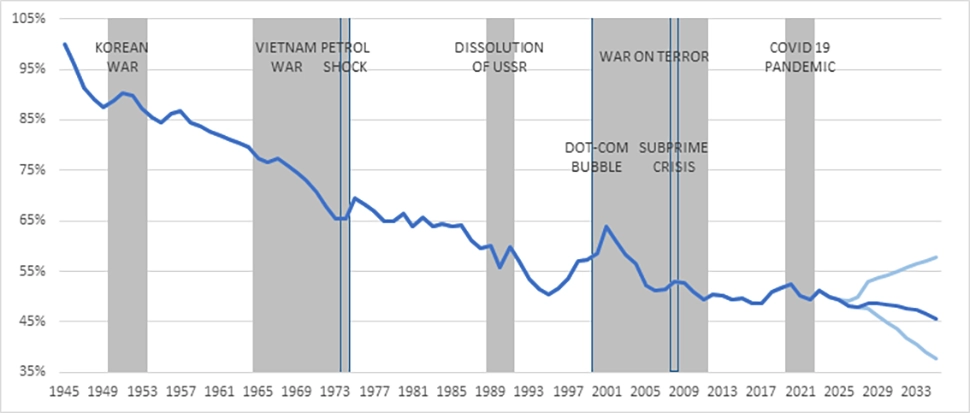
Figure 1 presents the U.S. Credibility Index normalized to 1945.
Following World War II, the index declined from its exceptional starting point before stabilizing during the early Cold War. The Vietnam period produced a marked contraction. A substantial rebound occurred during the 1990s, reflecting unipolar advantage. After 2001, however, the trend flattened at a lower plateau. The global financial crisis and the COVID-19 pandemic each produced additional, though contained, declines.
Over the next decade, three trajectories appear plausible: modest recovery, stabilization near current levels, or further gradual erosion. None implies sudden collapse; all imply narrower margins.

Figure 2 examines rebound frequency and amplitude.
Excluding the exogenous shock of Soviet dissolution, recovery intervals have remained relatively consistent. Yet each successive peak has occurred at a lower relative margin, suggesting diminishing elasticity over time (see appendix). The pattern supports a more cautious forward projection.

Figure 3 disaggregates the index.
Financial capacity has remained the strongest pillar, bolstered by dollar centrality and deep capital markets. Despite rising debt, erosion has been gradual rather than abrupt, reflecting the absence of credible alternatives at scale. Financial power appears structurally entrenched and only partially correlated with domestic political volatility.
Power projection exhibits inertia, lagging economic convergence. Military preponderance has narrowed relatively but remains substantial. However, rising defense burdens alongside modest GDP growth raise questions about long-term sustainability. Alliance cohesion often delivers influence more efficiently than unilateral expansion.
Structural capacity has declined gradually as other economies expanded. This reflects convergence rather than internal collapse.
Resilience remains comparatively stable, underscoring the depth of US economic and institutional buffers. Rising interest burdens exert gradual drag rather than producing abrupt collapse.
Institutional cohesion, however, shows greater volatility. Periods of polarization coincide with measurable declines. Since the early 2000s the trend has edged downward and is projected to enter marginal contraction. The broader index suggests that institutional cohesion exerts disproportionate influence on overall credibility, reinforcing the strategic importance of legitimacy.
Relative shares have declined across several dimensions. This pattern reflects synchronized convergence rather than imminent breakdown.
The United States and China
Decline is relational. US stagnation combined with Chinese acceleration would yield competitive bipolarity. Dual stagnation would encourage fragmented multipolarity. Asymmetrical adaptation would preserve hierarchy.
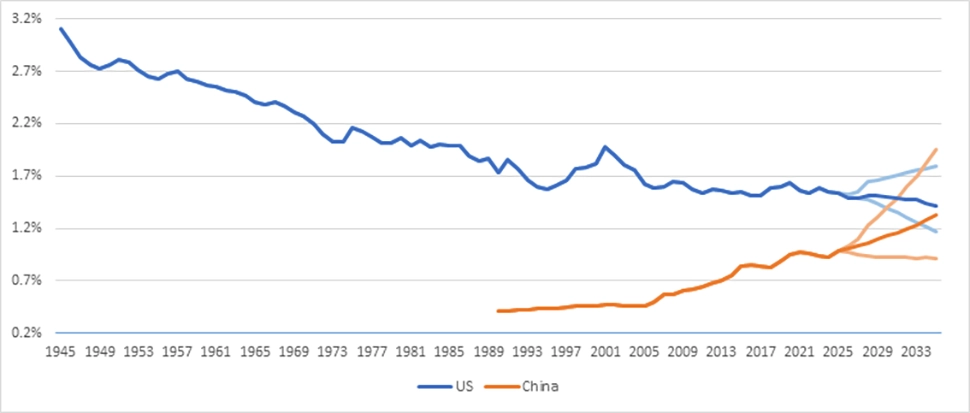
Figure 4 compares aggregate trajectories. China’s institutional capacity may be imperfectly captured by Western-derived governance metrics, particularly in dimensions related to centralized coordination.
China’s index rose rapidly after 2008, narrowed the gap by the mid-2010s, plateaued briefly, and resumed gradual ascent. The two indices are converging, though convergence does not equal replacement. Financial centrality and alliance depth remain asymmetric.
An attempt to forcibly alter Taiwan’s status would introduce extreme downside risk to China’s trajectory.
China’s trajectory is consistent with state-coordinated acceleration, constrained by structural drag. By contrast, the US trend reflects a growing allocation of resources toward institutional maintenance, rather than outward expansion.
If current slopes persist, near-parity conditions could emerge within two decades. Even then, transition would likely be gradual rather than abrupt.
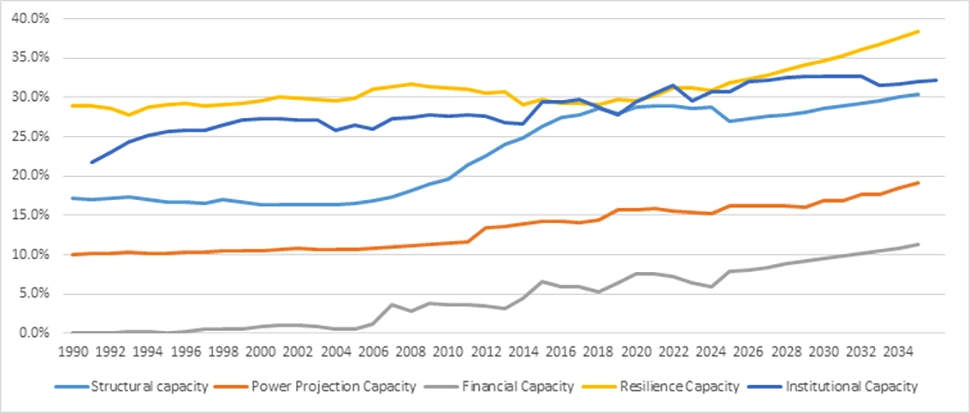
Figure 5 disaggregates China’s profile.
Structural scale is substantial. Financial centrality and power projection remain comparatively weaker, reflecting limited alliance networks and global basing. Institutional capacity, measured here as governance cohesion and policy continuity, constitutes China’s strongest pillar. Whether such cohesion remains durable under slower growth is an open question.
China’s demographic headwinds imply a slowed acceleration, rather than sudden contraction, partly reflecting renewed emphasis on technological soft power and comparatively low financial stress. Marginal gains may yield diminishing returns as convergence advances.
The data suggest that China’s principal constraints are internal structural frictions, rather than immediate external containment.
Unipolarity was historically unusual. The emerging order is more likely to feature distributed influence than outright substitution.
Conclusion
The model does not predict American collapse. It anticipates narrowing margins. US–China convergence reflects differential slopes more than terminal decline.
The United States retains enduring structural advantages: geographic insulation, technological depth, alliance networks, and financial centrality. The principal risk lies in gradual erosion of institutional elasticity.
Adaptation could sustain primacy in modified form. Prolonged stagnation would more likely produce fragmented pluralism than singular Chinese dominance. The framework suggests that institutional cohesion now yields higher marginal returns than incremental gains in GDP or military spending, making legitimacy preservation a strategic imperative.
Details on the data sources and methods employed in this article: