In October 2016, hardly anybody could have envisioned Pedro Sánchez becoming Spain’s next prime minister. He had just been ousted as the Socialist Workers Party’s (PSOE) Secretary General following an internal crisis. In December 2015, he led his party to its worst result in a general election. Three months later, with Sánchez struggling to form a majority government, Congress voted against his candidacy, making him the first officially nominated candidate to fail to secure parliamentary approval to become prime minister.
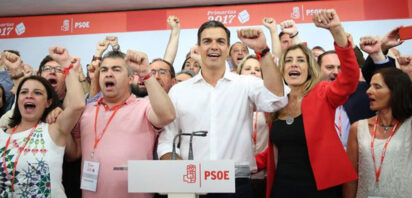
Yet nearly eight months after his political downfall within PSOE, the socialist staged an unlikely comeback, winning the grassroots primary election. Then, on May 31, 2018, as leader of the opposition, he put forward a motion of no confidence against the incumbent Prime Minister Mariano Rajoy, seizing on the National Court’s ruling in the Gürtel corruption trial, which exposed a network of companies that secured public contracts from PP-run administrations in exchange for bribes, helping finance party activities through illicit funds. The motion succeeded, making Sánchez the first politician in Spain’s democracy to remove a sitting prime minister through such a vote.
Sánchez took office without having won a general election or even holding a seat in parliament. Over the subsequent years, his political trajectory came to embody a quality many politicians envy, and few end up mastering so extraordinarily: political survival. Time and again, party allies have fallen victim to corruption scandals, electoral setbacks, and internal feuds, fading into political obscurity while Sánchez has habitually emerged relatively unscathed.
Eight years since his ascension to La Moncloa, however, the spell appears to be wearing off. The politician who rose to power promising transparent governance now finds himself engulfed by the very manner of controversy he once denounced. Prime Minister Sánchez’s minority government is under siege, beset by a succession of corruption scandals that ensnare members of his inner circle and even involve his family. Growing disillusionment with his leadership and a recent string of overwhelming defeats in regional elections spell danger for PSOE ahead of elections next year.
Scandals Close In on Prime Minister Sánchez
Beginning in 2024, a back-to-back wave of scandals has tightened the screws on Sánchez, with no clear end in sight. Among them, last year, Attorney General Álvaro García was disqualified for revealing confidential information regarding the partner of the PP’s regional president of Madrid, becoming the first Attorney General in Spain’s history to be convicted. This past April, the prime minister’s wife was charged with embezzlement, influence peddling, and corruption in business dealings, among others. Most recently, scrutiny shifted to former Socialist President José Luis Rodrgíguez Zapatero, a longstanding backer of Sánchez, amid allegations of influence-peddling related to the state bailout of the Venezuelan-Spanish Plus Ultra airline by Sánchez’s government during the COVID pandemic.
The most politically sensitive and still-developing case is the so-called Leire Díez affair, an alleged scheme financed with PSOE funds that sought to undermine judicial investigations into the prime minister’s family and party members. The network, led by former affiliate Leire Díez and the prime minister’s closest ally Santos Cerdán, is said to have held high-level meetings at PSOE’s headquarters, allegedly seeking to offer financial incentives or favors to members of the Anti-Corruption Prosecutor’s Office, Guardia Civil’s Unidad Central Operativa (UCO) unit in exchange for sensitive information that could obstruct ongoing investigations. Prime Minister Sánchez is widely referenced throughout the official document, as witnesses say he had authorized such negotiations. As the investigations unfold, probabilities remain high that he will be called to testify.
Redrawing the Socialist Map
The political fallout has spilled over to the ballot box. Electoral setbacks hit harder in regions considered Socialist strongholds, and whose featured candidates were hand-picked by the prime minister himself. Last December, the party suffered a historic ten-seat loss in southwestern Extremadura, where PSOE’s candidate in the regional elections is currently under investigation for allegedly creating a tailor-made position for Prime Minister Sánchez’s brother.
In southern Andalucía, Sánchez chose Spain’s former first deputy prime minister to carry out the daunting task of returning the country’s most populated region to socialist control, which PSOE had resoundingly lost in 2018. As one of the most influential figures in the government, her performance was expected to serve as a verdict of the prime minister’s political strategy. Yet, she could not avoid another electoral defeat. In Aragón, a northeastern region with a longstanding reputation as an electoral bellwether, PSOE’s former government spokesperson and Education Minister led the party to its worst result in almost a decade, setting an unfavorable outlook for next year.
The picture was somewhat different in Castilla y León, where the party’s candidate, Carlos Martínez, gained two additional seats. He was not regarded as one of Sánchez’s political protégés, remarking at one point: “I am not a Sanchista. I am a socialist.”
What’s the Alternative?
Taken together, PSOE’s erosion in key strongholds is not yet matched by an opposition ready to replace it. Despite leading the national polls as the most likely alternative, conservative leader Alberto Nuñex Feijoó is struggling to turn public discontent into the parliamentary majority required to govern solo. The scenario is evident across Spain: although the PP emerged victorious in regional elections, the conservatives repeatedly find themselves dependent on hard-right Vox to secure governing majorities.
Vox has evolved from an insurgent party into a third major force and potential kingmaker in Spanish politics, with its leader Santiago Abascal capitalizing on PSOE’s failures and PP’s shortcomings. As much of Europe undergoes a conservative shift, Spain might no longer remain an exception. Vox hopes to keep gaining ground, becoming indispensable should PP win the 2027 election without an outright majority. Current polls suggest Vox would win as many as 58 seats, compared to its 33-seat take in 2023, allowing Abascal to enter negotiations with greater bargaining power.
For Feijoó, however, his party’s growing reliance on Vox represents a conundrum. Many PP voters remain uncomfortable with the idea of a coalition with the far-right, even if it would put an end to Sánchez’s rule. Following the 2023 general election, the Popular Party’s unwillingness to accept Vox as a coalition partner ultimately left the conservatives in the opposition despite finishing first. A similar outcome could emerge in 2027.
Feijóo’s efforts to court the Basque Nationalist Party (PNV) and the Catalan nationalist party Junts to support a censure motion without the far-right proved to be futile. Most recently, he appears to have come to terms with Spain’s political reality. Asked on a late-night talk show about next year’s election, the opposition leader signaled a more flexible stance on governing with Vox should he fail to secure an outright majority.
The defining question facing Spanish politics is not so much whether Sánchez can withstand the storm, but whether anyone in the opposition is competent enough to inherit the ship. Short of the strength to assemble a viable governing majority, Feijoó’s candidacy might be in doubt.
Foreign Policy as Political Refuge
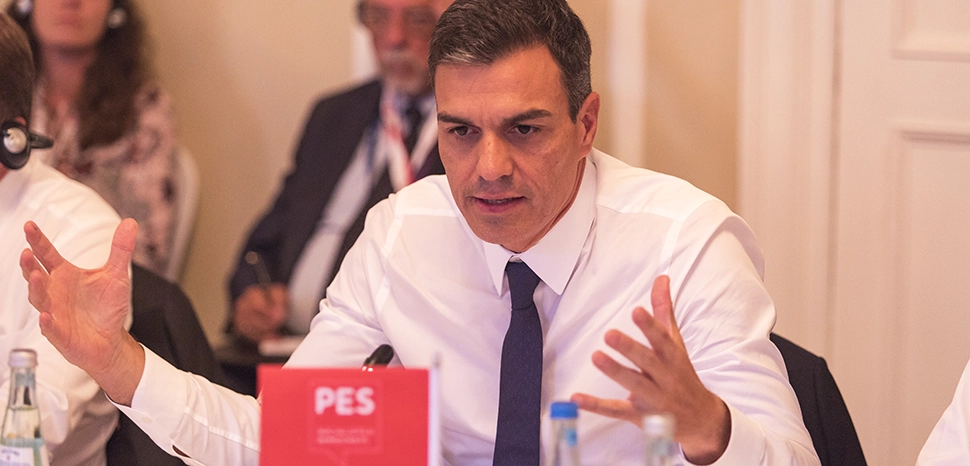
While the government’s left-wing coalition partners increasingly call on the prime minister to bring forward elections scheduled for August 2027, Prime Minister Sanchez strives to portray an image of calm confidence as he looks to bide his time until next year’s contest. Foreign policy crises have repeatedly provided him with a momentary reprieve. Last year, Sánchez used the tariff war with US President Donald Trump to divert attention from his government’s political paralysis to present the General Budget for 2026. Similarly, while facing pressure from corruption scandals, Sánchez closed off Spanish airbases from being used by US ships in the Iran war.
Yet international affairs have also occasionally weakened the prime minister’s position abroad. Sánchez has cast himself as a staunch defender of Ukraine’s territorial integrity, though his reluctance to ramp up defense spending at the expense of Spain’s welfare state has undermined Spain’s credibility within the alliance, and, more broadly, Europe’s ability to strengthen its collective defense against Russia.
The Palestinian cause is a central pillar of Sánchez’s international profile. Despite being a vocal critic of Israel’s military campaign in Gaza, the Spanish government imported more than fifteen million euros’ worth of Israeli arms and ammunition. Although Madrid had approved an arms embargo on Tel Aviv in September 2025, months later, the government granted Airbus an exception to acquire Israeli components, citing its contribution to high-skilled employment in Spain. Particularly, the purchase of six-million-euro ammunition from an Israeli company erupted in a full-blown political crisis. Facing the prospect of a coalition rupture, Prime Minister Sánchez was forced to overrule Spain’s Interior Minister and unilaterally cancel the contract.
Spain: A Country in Waiting
It would be premature to count Sánchez out. With several regional elections still to be held in 2026, one potential scenario for the prime minister might be to bring forward the general election, seeking to coincide with the remaining regional contests to regain some advantage. Yet his margin for error is narrowing, and another major corruption revelation could prove politically fatal. While pressure mounts on the prime minister to call an early election, the opposition has yet to demonstrate that it can offer a convincing governing alternative.
The views and opinions expressed in this article are those of the author alone and do not represent those of Geopoliticalmonitor.com