Across the narrow strait that separates Taiwan from the Chinese mainland lies a question that has haunted the Pacific century: what if the war that everyone dreads actually begins? Beneath the language of diplomacy and deterrence, Beijing’s preparations continue with quiet, methodical intensity, while Taipei builds defenses that may never be tested—or one day be tested all at once.
A Chinese invasion of Taiwan is no longer a thought experiment confined to war colleges or strategy journals. It is a scenario rehearsed in simulations, whispered in capitals, and increasingly woven into the logic of modern geopolitics. Yet the true danger lies not in whether China can invade, but in how it might do so: how surprise, speed, and sheer mass could converge to overwhelm an island unaccustomed to the shock of total war.
This analysis begins at the point where deterrence fails. It asks not what China should do, but what it would do: how missiles, drones, and helicopters could tear open the skies above Taiwan; how an armada of civilian ships might darken the strait; how the balance of power could shift irreversibly within weeks. The contingency envisioned might be considered the worst-case scenario for Taiwan in that little or no outside assistance is rendered over the course of the conflict.
Strategic Foundations of a China-Taiwan Conflict
The possibility of a Chinese invasion of Taiwan is a problem rooted in the physical and structural realities of power.
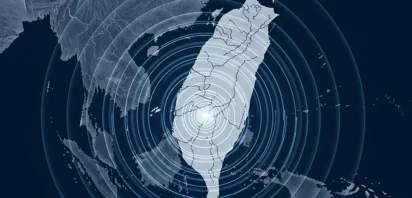
China and Taiwan exist in a geographic relationship that makes conflict both feasible and potentially decisive. The Taiwan Strait, only about 90 miles wide, is narrow enough for China’s military forces to cross quickly, but wide enough to make large-scale defense extremely difficult. Geography alone creates an imbalance: China can easily project strength across the water, while Taiwan has little space to absorb or recover from a sudden assault.
This imbalance is reinforced by scale. China’s population, economy, and industrial capacity are vast, and all are organized under a central command structure capable of mobilizing resources quickly. Taiwan, though technologically advanced, is small and dependent on continuous access to global trade. If war begins, those trade routes would be immediately threatened or cut off.
The military question, therefore, is not primarily about who has the better equipment, but who has the structural ability to sustain combat. China’s enormous industrial base allows it to replace losses, produce munitions, and keep fighting. Taiwan cannot match this depth of capacity.