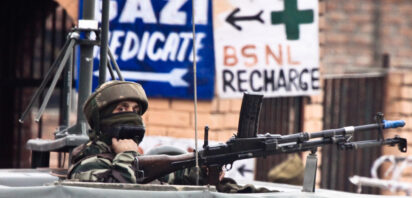
On April 22, a terrorist attack in Indian-administered Kashmir claimed the lives of 26 people, including a number of Indian tourists and the husband of a newly-wed couple. It appears that Hindu men were the primary target of the attackers. Terrorist group ‘The Resistance Front’ (TRF) claimed responsibility for the attack, a group thought to be an offshoot of the Pakistan-based armed group Lashkar-e-Taiba (LeT). India believes the Pakistani state to have associations with this terrorist group and are therefore holding the state partially responsible for the attack. On May 6, a four-day war between India and Pakistan commenced with back and forth airstrikes penetrating as deep as 100 miles into rival territory.
However, as media outlets have attempted to follow the unfolding conflict and create a timeline of events, a deluge of disinformation has flooded the online space. Although disinformation during times of conflict is not a new phenomenon, both the volume and calculated coordination of disinformation during this recent clash has demonstrated how advanced disinformation capabilities have become.
Fact-checkers have been able to pinpoint exact times during the conflict where a “spike” of disinformation has been observed, indicating the extent to which disinformation efforts have been coordinated. Historically, disinformation has been deployed more sporadically – often to challenge specific events or narratives. In this recent conflict however, disinformation has evolved as a real-time weapon, with virtually every new development, every missile strike, accompanied by an immediate campaign to distort the facts.
Although disinformation has proliferated on both sides of this conflict, it is becoming clear that members from the highest levels of the Pakistani state have disseminated disinformation that is now being debunked through various fact-checking procedures. Before exploring these discrepancies further, it is firstly important to assess why disinformation has been so avidly used in this conflict.
These recent examples of both instant and relentless disinformation serve a number of strategic purposes. Firstly, fake images and videos of the conflict have been circulated to stir up emotive responses to the unfolding events. This anger is then directed towards the opposing side and serves as an effective distraction from internal tensions. In recent months, the Pakistani state has struggled to quell anger towards its struggling economy, the imprisonment of Imran Khan, and the marginalisation of locals in Balochistan that has led to escalating unrest. Against this backdrop, it seems state officials have seized the opportunity presented by the recent conflict with India to redirect domestic resentment towards an external adversary.
However, it seems that certain members of the Pakistani youth have seen through this strategy. Lt. Gen. Ahmed Sharif Chaudhry held a press briefing last week in which he thanked the Pakistani youth for their role as “information and cyber warriors,” suggesting that the only disinformation originated from their Indian adversaries that the Pakistani youth worked to debunk. Members of the Pakistani youth took to their social media to respond, writing posts such as “Call us what you like – Cyber Warriors, youth or Digital Daishatgards. We demand the release of Imran Khan and all political prisoners.” Another reads: “If you are thankful to youth, prove it; respect its mandate. Let the constitution prevail.” It is clear that the recent fog of disinformation has not successfully distracted these individuals from their underlying concerns about its state’s conduct.
Disinformation is also a useful tool to suppress information that may damage a nation’s self-image. When the online space becomes flooded with torrents of disinformation, it becomes very difficult to decipher between accurate and false information, either leading users to distrust every piece of information they see, or to only trust for information that supports their preconceptions. Internet algorithms usually “reward(s) dramatic over accurate content,” meaning if disinformation depicts the right kind of “dramatic” action, it may be rapidly disseminated and reach a large audience. During this conflict, there was very little live footage of the unfolding events, so videos from conflicts in Ukraine and Gaza, for example, were used to ensure anger was stirred instantaneously on a large scale.
Breaking Down the Disinformation
Different fact-checking entities from around the world have been working overtime since the outbreak of the conflict to decisively counter disinformation and bring some clarity to the situation. One of the most effective primary sources that has been used to verify claims of specific missile attacks and targets is satellite imagery. As it takes time to request and receive this kind of imagery, we are continuing to receive new evidence on a daily basis.
The New York Times recently analysed a new set of satellite images from Maxar Technologies and Planet Labs and cross-referenced these images with claims made by Indian and Pakistani officials during the conflict. The article concludes that from what we can discern so far, the majority of damage in the conflict has been inflicted by Indian forces, who also appear to have contained more damage to their own facilities than Pakistani officials had indicated. Inevitably, it is within both countries’ interest to demonstrate the strength of their military capabilities in both inflicting damage on rivals and protecting their own assets. Both sides have announced the effectiveness of their own attacks and the ineffectiveness of their rival’s, but according to this new satellite imagery, it appears that India’s strikes were the most effective overall.
Images show a strike on Pakistan’s Bholari air base, under 100 miles from Karachi. Indian officials claimed to have struck an air hangar at this location and satellite imagery shows substantial damage to what appears to be an air hangar. A hole 60-feet wide is visible in the images, which experts have claimed to be consistent with the impact of a missile. Images also show a strike at Nur Khan air base, located 15 miles from the Pakistani Army Headquarters and considered to be India’s most sensitive military target strike across the four days.
This strike was reported by Indian officials and confirmed by satellite imagery in the following days. India also claimed to have struck the runway of Sargodha air base in two different places and again, satellite images corroborate that there are two separate areas of damage. Pakistan’s Lt. Gen. Ahmed Sharif Chaudhry claimed that Pakistan’s military was able to intercept the vast majority of Indian missiles and that only “a few managed to sneak in.” These satellite images suggest otherwise.
By contrast, satellite images of specific Indian military locations that Pakistan claims to have damaged show far less impact. One of the highest profile strikes claimed by Pakistani authorities was on India’s Udhampur air base, which was said to be “destroyed” by the conclusion of the offensive. Although one death has been confirmed at the site, satellite images show minimal damage and certainly nothing comparable to destruction.
At the time of the attack on the base, multiple false depictions of the strike were circulated. In one case, a video of a Rajasthan factory fire with black smoke billowing from the site was falsely depicted as the attack on the Udhampur air base. The video was likely chosen as the abundance of dark smoke created the illusion of a severe attack and heavy damage. As previously mentioned, the “drama” of this depiction would have ensured that algorithms widely circulated the footage, whilst also creating an impression of the power of Pakistani weapons and the damage they can inflict. Satellite imagery has directly contradicted this impression.
Additionally, an AI-generated video was shared online that also claimed to depict the destruction of the Udhampur air base. Fabricated audio was also added to the video, claiming that while Pakistan had been unable to destroy this air base during the 1965 and 1971 wars, its modern JF-17 fighter jets were able to succeed in 2025. While it has not been possible to trace the creator of this video, the narrative it projects is one very much advantageous to the state, showcasing the power of Pakistan’s new and modernised weaponry.
Although the creator cannot be identified, AI detection tools have indicated that there is a 99.7% chance the video was made with AI, leaving little doubt that this was a carefully crafted disinformation product. As more satellite imagery becomes available in the coming days, it should be possible to continue cross-referencing images with official statements to better understand which reports have been accurate and which have not.
While AI disinformation has been prevalent, the recycling of pre-existing images seems to be the most common form of disinformation deployed. Analysis from The Independent has revealed that one video allegedly showing Pakistani jets striking Indian territory was actually footage from the video game Battlefield 3. Another viral clip of Pakistani retaliation was actually revealed to show the 2020 Beirut port explosion, again showing how “dramatic” false footage is being chosen specifically.
Not only have fake visual sources been circulated, but it has also become clear that people have been impersonating official spokespeople to create further chaos and confusion. A fake Indian advisory has been identified who spread panic by posting false civil defence protocols that warned civilians to stock up on food and medicine. Such instructions can lead to panic-buying and sudden supply shortages and were evidently used to stir fear and unrest.
No Clarity from Official Channels
The Pakistani state has continued to deny any role in the spread of disinformation, however it seems not even its civilian and military leadership are able to agree on the narratives they communicate. A BBC report has traced a number of contradictory statements that together demonstrate the very active role the state has played in misleading people. The BBC highlighted how Pakistan’s Information Minister Attallah Tarar stated that between 40-50 Indian soldiers had been killed by Pakistan, but the defence minister put the total at 25.
Following this discrepancy, an army spokesperson claimed that they had no official number of Indian soldiers killed and that the ministers who had given calculations had based these numbers on “chatter” in the media. Such statements call into question the reliability of official spokespeople in Pakistan, who seem to make public declarations without evidence and cannot even agree among themselves what falsehoods to disseminate.
Ultimately, although it is not possible to debunk and trace every instance of disinformation and concretely prove who created it, it is clear that disinformation has been used extensively and deliberately during this conflict. There also appears to have been a concerted effort from within Pakistan’s state apparatus to create the impression that it had caused great damage to its Indian rivals, both in terms of physical destruction and loss of life, whilst intercepting most of India’s retaliation and incurring very little damage itself.
Misleading recycled footage, AI images and videos and impersonations have all been used to corroborate this narrative of Pakistan’s military prowess. While it is too early to reach conclusions as new evidence continues to surface each day, the evidence we have received thus far suggests that this narrative is inaccurate. What is certain is that disinformation has emerged as a low-cost, highly effective weapon of war – and what we have witnessed is just the beginning of a new era in information warfare.