If there’s one point of agreement across Canada—and even among its concerned allies—it’s the dismal state of the Canadian Armed Forces (CAF). Yet, as highlighted by a Radio-Canada report, this isn’t due to a lack of resources. The real issue lies in the CAF’s inability to harness its wealth effectively, plagued instead by inefficient procedures and a troubling absence of collective strategic planning to allocate its budget wisely.
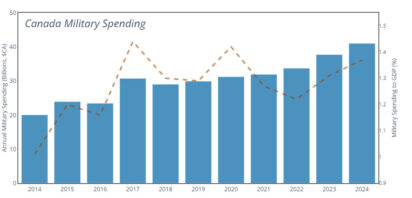
In a “death spiral” – this is how Minister of National Defence Bill Blair described the current state of the Canadian Armed Forces (CAF) at the Ottawa Conference on Security and Defence back in March. Lacking an estimated 16,000 personnel, the CAF’s current organization and development of strategic procurement programs have led concerned allies to call on the country to meet the 2 percent of gross domestic product spending target agreed to by NATO. Yet, the dire state of Canadian defense capabilities at present are down to more than a mere lack of funding (defense spending has increased by 70% 2017-2026).
When one looks a little closer at how we got here, a striking pattern emerges: procurement programs stretched out over decades, with costs skyrocketing in the process. Case in point: Canadian frigates, submarines, and recently, even basic tactical vehicles. The Army should also be mentioned, which took around twenty years to acquire just over 100 artillery pieces of all kinds (compared with the 1,500 lost by Russia in two and a half years). This inefficiency is not just a problem of resource allocation; it’s emblematic of deeper systemic issues.
A Bloated and Inefficient Process
Calls for an improvement in Canadian defense spending and efficiency are likely to grow through the second Trump term, with 2 percent of GDP the bare minimum for keeping Washington happy with NATO allies. Unspent budgets, misallocation of resources and a lack of leadership have left Canada reeling, years off being sufficiently operational for global threats.
But, as underlined by the Radio-Canada article, “if tomorrow morning the Canadian government were to allocate $15 billion more annually to the Department of National Defence to meet its NATO commitments, the Canadian Forces wouldn’t know what to do with it.” The issue isn’t funding but the inability to spend allocated resources. For example, according to Radio-Canada, since 2018-2019, unspent funds have grown from $500 million annually to $2.5 billion by 2021-2022, or nearly 9.4% of the total defense budget. In the decade leading up to the election of Trudeau, nearly a quarter of the DNDs procurement budget went unspent, over $7 billion in total.
The lofty commitments of the 2017 defense policy, entitled “Strong, Secure, Engaged,” have not been met. The policy promised an extra $553 billion for the defense budget over the next 20 years, under required NATO commitments, and but a drop in the ocean for a country with such relatively low defense spending this century.
Officially, the Department of National Defence claims its major projects require financial flexibility from year to year. “The department adopts a flexible funding model to ensure projects receive the necessary financing when they need it,” according to a CAF official contacted by Radio-Canada. But insiders point to deeper issues: poor project planning, inability to meet timelines, and a lack of personnel—both civilian and military—needed to manage procurement. These challenges result in chronic inefficiency.
Between 2010 and 2023, while the federal public service workforce expanded by 26%, the Department of Defence saw virtually no growth in its staffing, with only a marginal 0.2% increase, despite a surge in projects to acquire planes, helicopters, tanks, and ships. “We don’t lack projects or ideas for spending money; we’re just incapable of doing it!” a source familiar with the department’s budget process revealed to Radio-Canada.
Procurement Challenges
Moreover, defence procurement challenges are widely acknowledged, with federal ministers such as Jean-Yves Duclos and Bill Blair, opposition members like James Bezan, and the Department of National Defence’s (DND) own annual plans highlighting systemic inefficiencies, and dissatisfaction with the Trudeau government’s approach. “The Liberals’ first defense policy document, Strong, Secured, Engaged, was a book of empty promises. They missed every marker set out in the original defense policy for defense spending, resulting in massive gaps in equipment and readiness. Trudeau has overspent in every department except our military, yet his government promised to cut almost $1 billion annually from the defense budget and allowed over $10 billion more to lapse over eight years,” declared Bezan.
The DND’s 2024–25 plan outlines key hurdles, including balancing costs, operational needs, and socio-economic benefits; adapting to a rapidly changing security landscape and evolving technology; managing pandemic-induced supply chain delays; and addressing staffing shortages in critical procurement areas. While the ongoing Defence Procurement Review aims to streamline processes and foster innovation, significant regulatory and bureaucratic obstacles persist.
Case in point: in 2011, the Harper government announced the replacement of the Royal Navy’s destroyers and frigates with 15 new combat ships. Thirteen years later, they are still not under construction. On June 28, as if it were a long-forgotten surprise, Defence Minister Bill Blair visited the Irving shipyard in Halifax to witness the first steel cut for the ships’ construction, calling it the “the largest shipbuilding initiative that Canada has undertaken since the Second World War,”….thirteen years after the ships were promised by the DND. Meanwhile, the price tag has risen from $26 billion to $60 billion. The Parliamentary Budget Officer, Yves Giroux, estimates the cost of the project will exceed $80 billion—$5.3 billion per ship.
In a speech at CANSEC 2024, Minister of Public Services and Procurement, Jean-Yves Duclos underlined the government’s commitment to improving the processes: “Defense procurement can be a long and arduous process. […] We are undertaking a review of defense procurement to determine how we can accelerate the process. […] To achieve this transformation, we will need to challenge the status quo in many respects. We’re identifying ways to compress timelines for major government acquisitions.” Duclos is not the only official who understands that the time to act is now, before it is too late.
From Words to Action
While recent speeches hint at reform, concrete action is essential to revitalize the CAF and fulfill its national and allied commitments. This includes its contributions to NATO and ensuring adequate readiness for high-intensity conflicts, where attrition necessitates a larger quantity of equipment. The Ukraine war has underscored the necessity of national will and decisive leadership—qualities that seem to be in short supply across Canadian governance, bureaucracy, and public opinion.
Ukraine has also underscored the need for equipment adapted to high-intensity, highly mobile forms of warfare, and in numbers. War of attrition seems to be back, with simply colossal loss figures. For example, Russia has reportedly lost nearly 9,900 pieces of military equipment, including approximately 2,400 trucks and similar vehicles, 2,200 infantry fighting vehicles, and 1,900 tanks. In October 2024 alone, Russia is estimated to have lost 695 pieces of equipment, including 253 infantry fighting vehicles, 103 tanks, and 41 armored personnel carriers. Ukrainian forces have also experienced significant equipment losses, particularly during counteroffensive operations. Not to mention the massive loss of life, estimated to be in the order of 500,000 dead and injured on the Ukrainian side alone.
Talking to Radio Canada, Steve Saideman, professor of International Affairs at Carleton University, highlights that one of the critical challenges lies in finding an effective solution to this complex problem. The principal question is: how can we prioritize quantity in the 21st century? In the last thirty years, procurement strategies have focused on quality—acquiring the best possible equipment and relying on a limited number of versatile assets capable of performing multiple functions – which appears structurally incompatible with prolonged high-intensity warfare below the nuclear threshold. A type of war that the professor is skeptical about Canada’s capacity to wage “I just don’t see Canada having that capacity,”he said. “If we got into a serious shooting match with either China or Russia, we’d lose ships, and that would require replacement faster than the replacement ships that we’ve been doing right now.”
Therefore, there has to be a national will and firm political conviction to turn the tide. That is the view of military historian Sean Maloney, who states that “[will] is absolutely fundamental to any effort that you’re talking about. And it does not exist in this country, either at the elected political level, in the bureaucracy, or the population.” The paradox of the Canadian military is clear: it has resources but lacks the means to deploy them effectively. The road to recovery is not only about increasing funding but reforming processes, fostering innovation, and rebuilding national resolve. Whether this can be achieved in time to meet evolving security challenges remains an open question.
The views expressed in this article belong to the author(s) alone and do not necessarily reflect those of Geopoliticalmonitor.com.