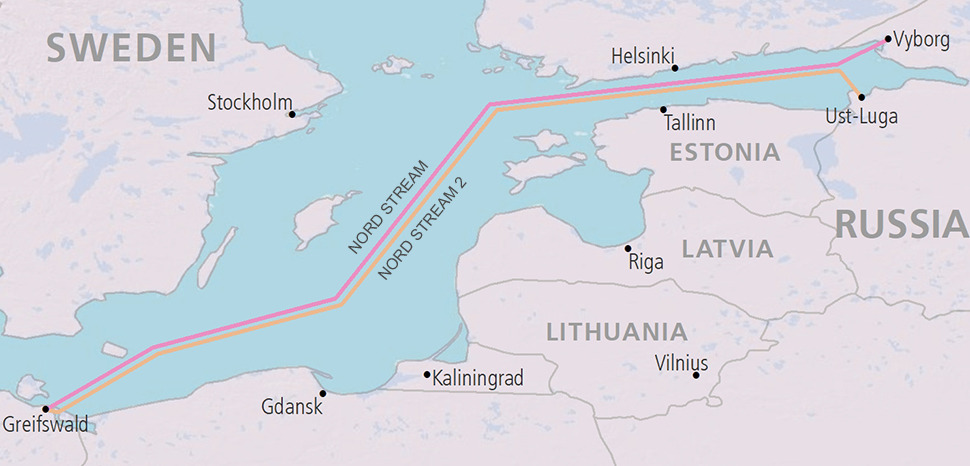
The US and Germany have reached a deal ending a longstanding dispute over the construction of the Nord Stream 2 pipeline – a natural gas pipeline that bypasses conventional Central European routes by traversing the Baltic Sea, providing a direct link between Germany and Russian energy supply. The deal should come as no surprise given Berlin’s longstanding commitment to the $11 billion project and the sunk costs involved (the pipeline was almost complete by the time President Biden took office). But this is cold comfort for Kyiv, which will inevitably view the US-Germany deal as Ukraine being sacrificed on the altar of great power politics.
Background
Once completed, Nord Stream 2 will carry 55 billion cubic meters (bcm) of gas annually, doubling the capacity of the preexisting Nord Stream pipeline to 110 billion bcm. This increased transit capacity means Russia can circumvent conventional routes traversing Ukraine, allowing for Kyiv to be threatened with a cut-off of Russian energy imports without an accompanying disruption of European energy supply (thus making European countries less likely to intervene forcefully on Ukraine’s behalf, at least in theory).
This Russian effort is not limited to Nord Stream 2; Moscow has initiated various other pipeline projects, including Yamal-Europe, Blue Stream, South Stream (cancelled in 2014), and Turk Stream, all designed to achieve a similar end of diversifying routes into Europe, increasing continental dependence on Russian supply, and increasing Moscow’s options in the event of a conflict in its near abroad.
Ukraine – the longstanding distribution hub of Russian energy into Europe – stands to lose in this new normal in two ways: 1) reduced transit fee payments (the current deal provides around $3 billion in transit fees annually); and 2) reduced chance of European support it in the event of a conflict with Russia.
The present five-year transit deal between Ukraine and Russia expires in 2024. Its terms had already been moving in the wrong direction for Kyiv, with pumped volume floors dropping from 65 bcm in 2019 to 40 bcm in 2024 (the volume floor was 87 bcm in the previous deal), resulting in lower minimum transit fees. The next deal will surely be even worse with Nord Stream 2 coming online, which is why we saw the (largely symbolic) gesture of Germany sending a special envoy to help Ukraine negotiate a new 10-year deal in 2024 under the terms of the US-Germany compromise, which, in the words of one US official, can help ensure that Ukraine will continue to earn gas transit fees ‘for as long as possible.’
Analysis
There’s no doubt about it: the US-Germany deal shores up bilateral relations between the two longstanding allies at the direct expense of Ukraine. Nord Stream 2 has long been a thorn in the side of the US-Germany relationship, with both the Trump and Biden administrations at various points threatening to sanction Berlin over the project. However, if the deal represents a geopolitical betrayal it was a betrayal long foretold by Germany’s determination to move forward on Nord Stream 2 (and the success of other Russian initiatives to diversify supply lines away from Ukraine). So far as US grand strategy is concerned, US-Germany relations are a matter of far greater importance, and even more so given trans-Atlantic diplomatic drift under the Trump administration.